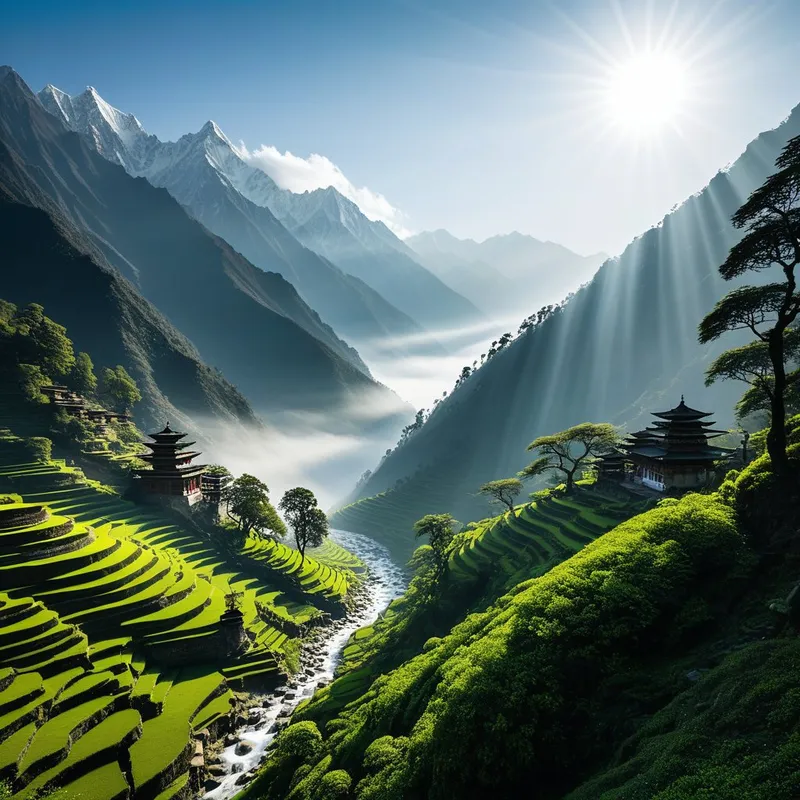
Arcadia / Shangri-La Myth Meaning & Symbolism
The universal myth of a hidden, perfect land of peace and harmony, representing the soul's deepest longing for a return to an unspoiled, eternal state of being.
The Tale of Arcadia / Shangri-La
Listen, and I will tell you of a place that is not on any map, yet is etched upon every heart. It is a whisper on the wind that carries the scent of peach blossoms and eternal spring. It is the ache in the bones of a traveler who has seen every city, yet knows the one he seeks lies just beyond the next, impossible ridge.
In the high, forgotten fastnesses of the world, where the air grows thin and stars burn like cold diamonds, there lies a valley. It is cradled by mountains so vast they hold back time itself. No winter ever finds its way down those sheer, cloud-piercing walls. Here, the sun is always gentle, the streams sing with the clarity of melted crystal, and the very breeze carries a fragrance that soothes the soul and slows the frantic pulse of the world.
The people of this place are not like us. Time flows over them like water over smooth stone, leaving no mark. Their eyes hold the calm of deep, still pools, reflecting knowledge not of books, but of being. They tend gardens where fruit bears without fail, study arts that harmonize the inner spirit with the outer world, and speak in voices that seem to blend with the hum of the earth. They have forgotten greed, strife, and the gnawing fear of death, for in this sanctuary, such things are but distant, fading echoes from a forgotten dream.
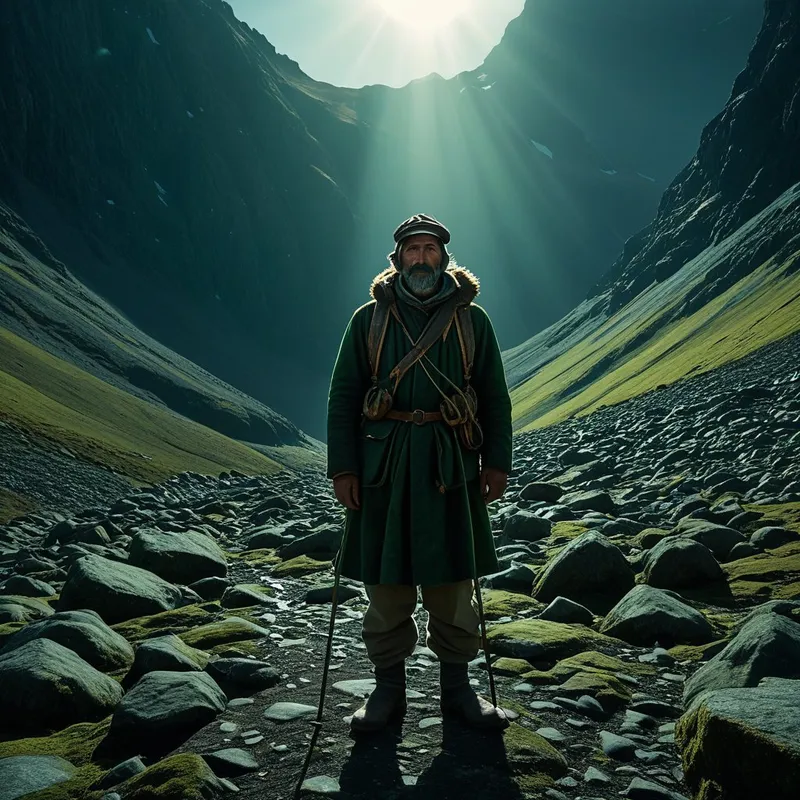
But a crack must appear in even the most perfect shell. Sometimes, by a confluence of storm and lost path, or through a desperate, yearning search that pierces the veil of the mundane, an outsider stumbles in. He is ragged, frostbitten, his mind frayed by the horrors and hollow triumphs of the world below. He falls to his knees on the soft grass, not in prayer, but in a shock of disbelief. The very light here feels like a balm on his wounded spirit.
He is welcomed, not with fanfare, but with a quiet, profound courtesy. He is fed, healed, and shown the serene rhythms of life in Shangri-La, or the pastoral bliss of an Arcadia that never knew the plough’s bite. For a time, he rests. He believes he has found the answer to every question, the end of every quest.
Yet, the memory of the world—a lover’s face, a duty left undone, the very weight of his old life—begins to pull at him. The very perfection that healed him starts to feel like a beautiful, gilded cage. A choice, terrible and inevitable, crystallizes: to stay in this eternal present, this blissful amnesia, or to return to the land of time, suffering, and meaning. The myth ends not with a bang, but with this silent, wrenching question hanging in the perfumed air. Does he remain in the dream, or does he turn, with the secret burning in his heart, to face the storm once more?
Cultural Origins & Context
The myth of the hidden paradise is not owned by one culture but is a shared breath of the human imagination. Its most famous Western incarnation is Arcadia, a real region of Greece that poets like Virgil transformed into a literary symbol of pastoral innocence, a retreat from the corruption of urban Rome. It was a nostalgic construct, a Golden Age projected onto the landscape.
In the East, the legend of Shangri-La was popularized by James Hilton’s 1933 novel Lost Horizon, but it taps into deep, ancient streams. It synthesizes Tibetan Buddhist beliefs in hidden mystical valleys (beyul) like Shambhala, Taoist tales of Penglai, and even Persian gardens of paradise. In a time of global depression and looming war, Hilton’s story gave a name to a universal longing for a sanctuary safe from the world’s chaos.
These stories were told by poets seeking political metaphor, by monks guiding spiritual seekers, and by novelists addressing modern anxiety. Their societal function was dual: to offer a critique of contemporary society’s ills (complexity, war, greed) and to act as a spiritual compass, pointing toward an ideal of harmony, balance, and inner peace that felt just out of reach, yet perpetually possible.
Symbolic Architecture
At its core, the myth of the hidden paradise is not about geography, but about psychology. It represents the soul’s homeland, a state of primordial, undivided wholeness that we intuit we have lost. It is the uroboric state of infancy, the Garden before the Fall, the integrated Self before the psyche was splintered by experience and the demands of the ego.
The paradise is not a place to be found, but a state of being to be remembered.
The impassable mountains symbolize the formidable barriers of our own conditioning, trauma, and forgetfulness that separate us from this inner peace. The ageless inhabitants represent parts of the psyche that have achieved integration—the Self in its balanced form. The weary traveler is the conscious ego, battered by life’s trials, embarking on the often desperate quest for meaning and respite.
The critical, often overlooked, turn in the myth is the traveler’s potential departure. This is the myth’s profound depth. It poses the ultimate question: Is the goal of life to achieve perfect, static bliss and remain there? Or is wholeness something we must integrate and then bring back into the world of time, conflict, and change?
The Dreamer's Resonance
When this myth surfaces in modern dreams, it rarely appears as a literal Himalayan valley. Instead, one dreams of discovering a secret, perfectly preserved room in their childhood home, a hidden garden behind a familiar wall, or a serene, empty beach at the end of a chaotic city alley. The somatic feeling is one of profound relief, deep calm, and awe. The breath slows. A weight lifts.
Psychologically, this dream signals a moment of respite and reconnection with the collective unconscious. The dreamer is likely exhausted, over-adapted to the demands of the persona (the social mask), and in need of soul-nourishment. The hidden paradise dream is the psyche’s sanctuary, offering a vision of what life could feel like without the constant friction of anxiety, obligation, and fragmentation. It is a restorative vision of the Self, inviting the dreamer to identify what in their waking life is creating the “mountains” that block access to this inner peace.
Alchemical Translation
The alchemical journey of individuation is precisely the myth of Shangri-La. The initial stage (nigredo) is the traveler’s despair, the feeling of being lost in the “storm” of life’s suffering and meaninglessness. The quest itself is the individuation process—the difficult, often lonely work of confronting the shadow and navigating the inner landscape.
Finding the paradise represents the albedo, a sublime moment of illumination and cleansing. It is encountering the anima or animus in its most perfected form, or a direct experience of the Self’s harmony. This stage is essential, but it is not the end.
The true alchemy is not in finding the gold, but in learning to carry its light without being consumed by it.
The final, crucial transmutation (rubedo) is modeled by the choice to leave. To integrate paradise is not to live there forever in spiritual retirement. It is to internalize its peace, its timeless perspective, and its harmony, and then to return to the ordinary world—the mundus—transformed. The individual is no longer a desperate seeker, but a carrier of the secret. They must now live in the world of time and conflict, but from the grounded, centered place of one who has touched the eternal. The paradise becomes not a memory of a place, but a quality of consciousness, a sanctuary carried within. The myth, therefore, is a map for becoming whole, not to escape life, but to live it fully, bearing the unbearable contradiction of being both mortal and touched by the timeless.
Associated Symbols
Explore related symbols from the CaleaDream lexicon: