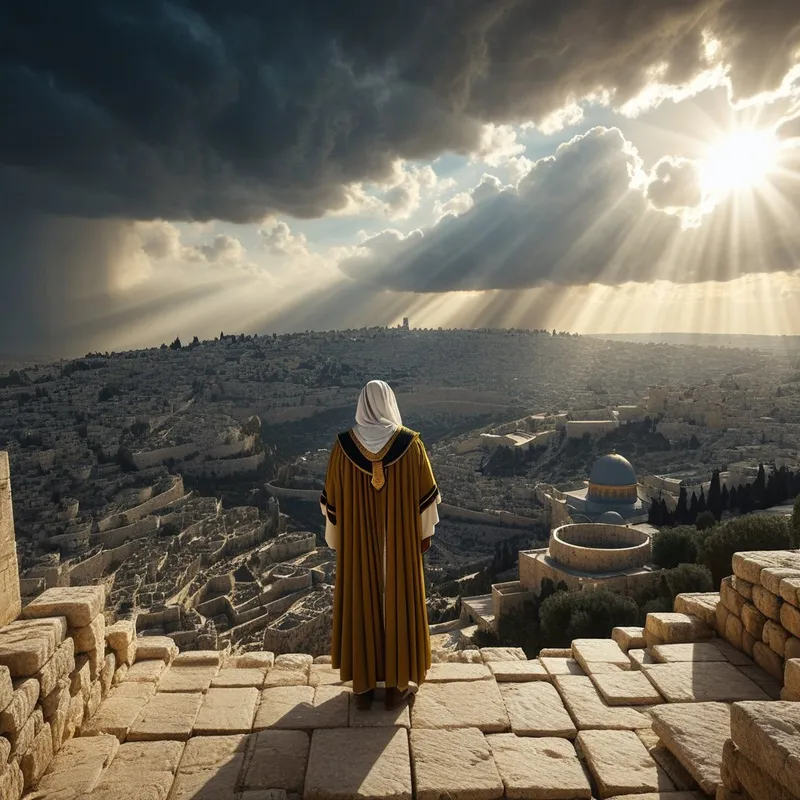
Araunah's Threshing Floor Myth Meaning & Symbolism
A king's costly purchase of a threshing floor to halt a divine plague, transforming a place of toil into the site of ultimate atonement.
The Tale of Araunah's Threshing Floor
Hear now a tale of plague and price, of a king brought low and a holy hill claimed. The air over Jerusalem was thick, not with incense, but with the silence of the dead. For the Angel of YHWH stood with sword drawn over the threshing floor of Araunah, and pestilence crept through the streets like a thief.
King David, the shepherd-king, the man after God’s own heart, had stumbled. Pride had moved him to number the fighting men of Israel and Judah, to count his strength not as a gift from the Divine, but as his own possession. And the choice of consequences was given: years of famine, months of flight before enemies, or three days of the sword of YHWH. David, in his anguish, chose to fall into the hands of God, for His mercy is great.
So the plague descended. From Dan to Beersheba, seventy thousand men fell. As the destroying angel stretched its hand toward Jerusalem itself, YHWH stayed the blow. “Enough,” came the command. “Stay your hand.”
The prophet Gad came to David, his face grave. “Go up,” he said, “and raise an altar to YHWH on the threshing floor of Araunah the Jebusite.” David did not delay. He went up, as commanded, to the high place where Araunah, the former king of this rocky height, was threshing wheat. Seeing the king and his servants approach, Araunah went out and bowed low, his face to the stone.
“Why has my lord the king come to his servant?” Araunah asked.
David’s reply was direct, borne of grief and urgency. “To buy the threshing floor from you, that I may build an altar to YHWH, that the plague may be averted from the people.”
Then Araunah, in a gesture of both deference and generosity, offered more. “Let my lord the king take and offer up what seems good to him. Here are the oxen for the burnt offering and the threshing sledges and the yokes of the oxen for the wood. All this, O king, Araunah gives to the king.” His words were a gift of everything: the land, the tools, the sacrifice itself.
But King David’s response was firm, a declaration that would echo through the ages. “No, but I will buy it from you for a price. I will not offer burnt offerings to YHWH my God that cost me nothing.”
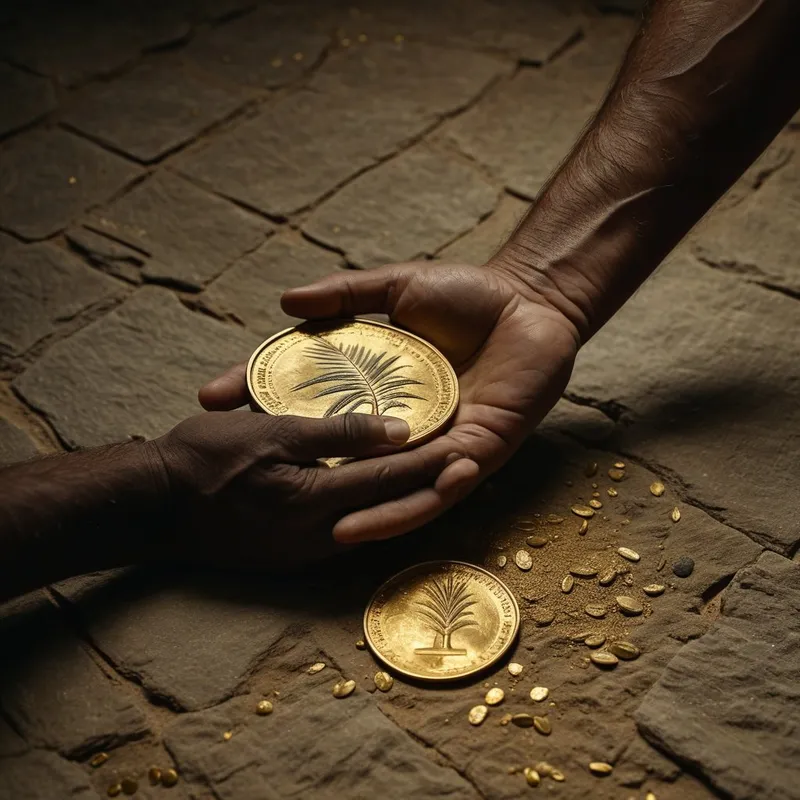
So David paid the price. Fifty shekels of silver for the threshing floor and the oxen. He built the altar there, upon that bedrock. He offered burnt offerings and peace offerings. And fire from heaven, it is told, consumed the offering upon that altar. And the sword of the angel was put back into its sheath; the plague was stayed.
That place, the threshing floor of Araunah, purchased for a full price, became the holy ground. It was the rock upon which the Temple of Solomon would one day stand, the foundation stone of the world, the place where heaven and earth would touch.
Cultural Origins & Context
This narrative is preserved in the 2 Samuel and later echoed in 1 Chronicles, texts that form part of the Deuteronomistic history—a theological compilation seeking to explain Israel’s fate through the lens of covenant fidelity. The story functions as an etiological myth, explaining the sacred provenance of the Temple Mount.
Crucially, the site is identified as Mount Moriah, the very place where Abraham bound Isaac. This layers the story with profound ancestral resonance. Furthermore, Araunah (or Ornan) is a Jebusite, a pre-Israelite inhabitant of Jerusalem. The transaction is not a conquest but a lawful purchase, legitimizing Israelite sovereignty over this most holy site through recognized custom. It was told and retold to underscore that the center of national worship was not taken by force, but solemnly acquired, and that true worship requires personal cost and responsibility from the sovereign and the people alike.
Symbolic Architecture
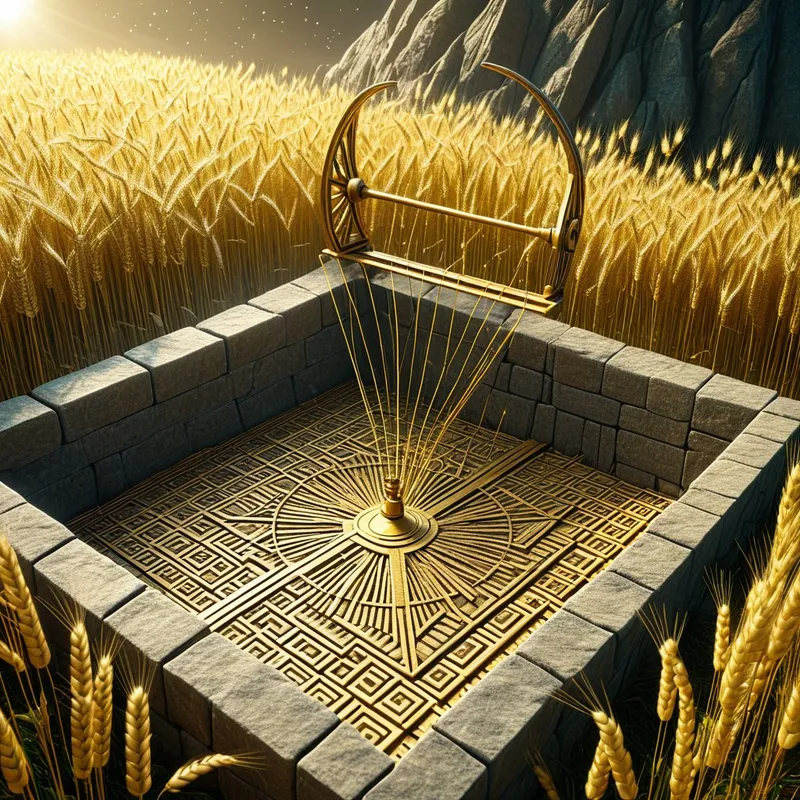
At its core, this is a myth of foundation, but a foundation purchased through crisis, confession, and costly exchange. The threshing floor is the ultimate symbol of transformation—the place where grain is separated from chaff through violent, rhythmic beating. It is a place of work, of discernment, of extracting sustenance from the husk of death.
The sacred center is not found in pristine innocence, but is purchased in the aftermath of failure, on ground already stained with the chaff of human toil and error.
David, the messiah-king, here embodies the paradox of the ruler archetype: he is both the cause of the national calamity and the agent of its resolution. His sin of pride (the census) creates the plague (the consequence), and his act of humility (the purchase and sacrifice) ends it. The myth dismantles the idea of divine right without responsibility. True authority is validated not by birthright alone, but by the willingness to bear the cost of one’s errors and the people’s redemption.
Araunah represents the “other,” the indigenous wisdom, the ground itself that must be acknowledged and honored, not merely appropriated. His generous offer to give everything highlights the temptation of cheap grace—the desire for resolution without personal investment. David’s refusal is the myth’s ethical heart.
The Dreamer's Resonance
To dream of a threshing floor is to dream of a psychic process of violent, necessary separation. The dreamer may be in a life phase where core values (grain) must be distinguished from outdated identities, defenses, or prideful narratives (chaff). This is rarely a gentle process.
Dreaming of purchasing such a place, especially at a high cost, suggests the conscious ego (the David-self) recognizing that the next stage of psychological or spiritual development cannot be gifted or inherited. It must be earned through a sober transaction with an inner “other”—perhaps a neglected talent, a shadow aspect, or a deep, instinctual wisdom (the Araunah-self). The plague in the dream might manifest as a spreading sense of anxiety, depression, or a “sick” atmosphere in one’s life, pointing to a foundational error or avoidance that now demands addressing.
Alchemical Translation
The alchemical journey here is solve et coagula—dissolve and reconstitute. The plague is the solve, the dissolution of the old, prideful structure of the psyche (David’s kingdom-as-possession). The threshing floor is the limen, the threshold where this dissolution occurs.
Individuation requires paying the full price for your own ground. You cannot build your sacred temple on borrowed land or on a sacrifice that cost you nothing.
The transaction is the pivotal moment of consciousness. The ego (David) must negotiate with the autonomous, often foreign-seeming complexes of the unconscious (Araunah) not to obliterate them, but to lawfully integrate their territory. Paying the “fifty shekels of silver” symbolizes surrendering a quantifiable, substantial portion of one’s conscious resources—time, energy, comfort, old self-images—to secure this new inner ground.
The fire from heaven that consumes the offering is the coagula, the divine spark that validates the process, transmuting the costly sacrifice into a new, stable foundation. The threshing floor of mundane struggle and crisis becomes the Temenos, the protected sacred space where the work of wholeness can begin. For the modern individual, the myth maps the painful but essential journey from causing one’own suffering through unconscious pride, to taking full responsibility for purchasing—through honest reckoning and costly effort—the very ground upon which healing and integration can be built.
Associated Symbols
Explore related symbols from the CaleaDream lexicon: