Arachne from Greek mythology Myth Meaning & Symbolism
A mortal weaver challenges a goddess, her art judged as hubris, and is transformed into the first spider in a tale of creation and consequence.
The Tale of Arachne from Greek mythology
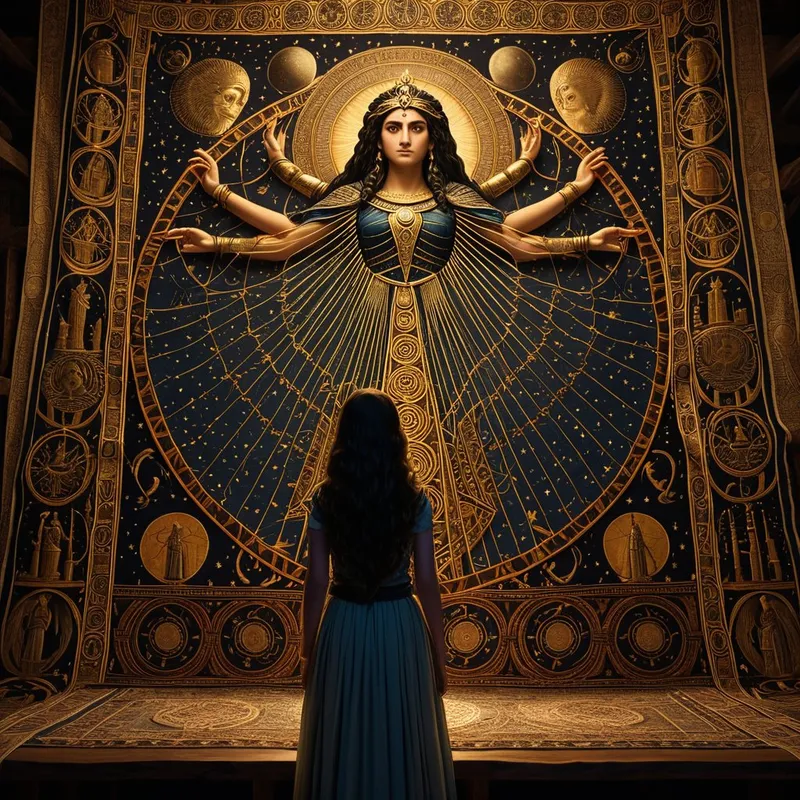
Listen, and hear the story of threads and thunder, of a shuttle that dared to sing louder than a goddess’s praise. In the dusty, sun-drenched land of Lydia, there lived a girl named Arachne. She was not born of noble blood or divine favor, but of the earth and the humble craft of wool. Yet, from her fingers flowed a miracle. Her loom did not merely weave cloth; it breathed life. She could spin wool so fine it felt like cloud-mist, dye threads with the purple of twilight and the crimson of dawn, and in her tapestries, nymphs danced so vividly you could hear the rustle of their leaves, and oceans swelled so truly you smelled the salt.
Her fame spread like pollen on the wind, from village to city, until it reached the high halls of Olympus. People no longer said, “She weaves well.” They whispered, “Surely Athena herself has taught her.” Or, more dangerously, “She surpasses the goddess.” This murmur, this seed of mortal pride, took root. Arachne, flush with the fire of her own skill, declared it openly. “Let Athena come and contest with me! If I lose, I will pay any penalty.”
The air grew heavy, scented with ozone. An old woman, back bent with years, appeared at Arachne’s door, her eyes sharp as needles behind the wrinkles. She counseled humility, urging the girl to beg the goddess’s pardon for her reckless tongue. But Arachne, her soul a furnace of talent, only scoffed and repeated her challenge. Then, the transformation—a blaze of divine light, the old crone shedding her disguise like a cocoon. There stood Athena, tall and terrible, grey eyes stormy, aegis upon her breast. “She has come,” Athena said, and the challenge was accepted.
Two looms were set. The goddess wove a warning: a central, majestic tableau of her own victory over Poseidon for the city of Athens, surrounded by four smaller scenes of mortals transformed by the gods for their hubris—a dire gallery of consequence in brilliant, awful thread. Arachne did not flinch. Her fingers flew. What she created was not reverence, but revelation. She depicted the gods in their deceits and desires: Zeus as a bull, a swan, a shower of gold; Poseidon in equine guise; Dionysus with false clusters of grapes. Each scene was a masterpiece of audacious beauty, so perfect in its execution it made the divine transgressions feel immediate, tangible, undeniable.
The work finished. Even Athena, in the silent, breathless moment of viewing, could find no flaw in the technical mastery. But the subject was an unbearable insult, a mortal’s flawless mirror held up to divine folly. In that perfection lay the deepest blasphemy. The goddess’s rage, cold and final, erupted. She tore the glorious tapestry to shreds and, with her shuttle of boxwood, struck Arachne once, twice, three times upon the brow.
A profound despair, blacker than any dye, flooded the weaver. Her pride shattered, her life’s work destroyed, she fashioned a noose from her own thread. But Athena would not grant her the peace of death. “Live on, guilty girl,” the goddess declared, and sprinkled her with the juices of a magical herb. A shrinking horror seized Arachne. Her body compacted, her head dwindled, her fingers multiplied and lengthened into delicate, jointed legs. She was suspended, not by a rope, but by a silken line from her own transformed body. Arachne was gone. In her place, the first spider, condemned to weave for all eternity.
Cultural Origins & Context
This myth reaches us primarily through the Roman poet Ovid, in his epic Metamorphoses. Written during the reign of Augustus, it is a product of a sophisticated, literary culture that repackaged Greek myths for Roman audiences. Ovid’s version is particularly charged with themes of artistic ambition, the tension between power and creativity, and the cruel caprice of the gods—themes that may reflect his own fraught relationship with imperial authority.
While Ovid is our main source, the tale’s roots are undeniably Greek, belonging to a vast oral tradition where myths functioned as foundational texts. Told by bards and woven into the fabric of daily life, such stories explained natural phenomena (the origin of spiders), reinforced social hierarchies (the peril of challenging the divine order), and explored the boundaries of human endeavor. The myth served as a cautionary tale about hubris—the overweening pride that invites divine retribution—directed specifically at the artisan class. It warned that supreme skill, even if innate, must acknowledge its divine provenance, or risk catastrophic fall.
Symbolic Architecture
At its core, the myth of Arachne is an archetypal drama of the Creator confronting the established Ruler. Arachne’s genius is raw, emergent, and purely of the individual. Athena represents the institutional, cultural patronage of craft—wisdom and skill in service of the established cosmic and social order.
The artist’s deepest rebellion is not in criticizing power, but in creating a world so complete it needs no authority to validate it.
The loom is the central symbol: an instrument of fate, of neural networks, of cosmic interconnection. Weaving is poiesis—the act of bringing form out of chaos. Arachne’s tapestry is the shadow of the gods, the unconscious truth of their mythos laid bare. Her art is not merely skillful; it is psychologically accurate, revealing the animating passions behind the divine masks. This is the true transgression: not a lack of skill, but an excess of truthful vision that the official narrative cannot tolerate.
Her transformation is not a mere punishment, but a profound, alchemical enantiodromia (a conversion into one’s opposite). The mortal who dared to weave the gods is made into a creature that weaves only its own world, its own trap, its own home—a perfect, lonely metaphor for the introverted artist consumed by their craft.
The Dreamer's Resonance
To dream of weaving, of spiders, or of a contest with an immense, authoritative female figure often signals a profound engagement with the Arachne complex in the modern psyche. Somatically, one might feel a tightening in the hands, brow, or solar plexus—the places of craft, thought, and will.
Psychologically, this dream pattern emerges when the dreamer’s innate, perhaps hidden, creative genius (their “Arachne skill”) is coming into conscious conflict with an internalized “Athena” principle. This internal Athena could be the voice of critical parental authority, the rigid demands of perfectionism, the fear of societal judgment, or the intellectual superego that seeks to control and order raw creative impulse. The dream is a stage for the showdown between the soul’s authentic expression and the inner critic that threatens to tear it apart. The feeling of being shrunk, silenced, or trapped in a repetitive, isolating pattern (the spider’s fate) speaks to the depression and creative blockage that follows when the inner goddess wins through sheer force of shaming authority.

Alchemical Translation
The individuation process modeled here is the transmutation of hubris into humility, and of punishment into purpose. The myth presents the catastrophic, literal version. The modern alchemy asks: How do we integrate this drama without being destroyed?
The first stage is Acknowledgment of the Gift: Recognizing one’s “Arachne skill”—that unique, driving talent that feels innate, obsessive, and dangerously prideful. This is the prima materia, the raw, fiery talent.
The second is the Confrontation with the Inner Athena: Instead of an external contest, this is an internal dialogue. The conscious mind (Athena) must not destroy the creative instinct (Arachne), but must learn to contain and channel it. The goddess’s tapestry—with its scenes of consequence—represents the necessary wisdom of context, history, and consequence that must frame raw creativity, not censor it.
The goal is not to avoid the weave, but to become the whole loom: the creative impulse, the wisdom of form, and the thread of connection itself.
The final, crucial alchemy is in the Metamorphosis. The myth ends with a curse. Our psychic work is to redeem it. To be “made a spider” is to accept the nature of the creative life: it is often solitary, cyclical, and involves spinning the substance of your very being into your work. The “web” is no longer a trap of shame, but the interconnected network of one’s opus, one’s relationships, and one’s psyche. The spider sustains itself from its own transformations; the integrated creator learns to nourish themselves through the act of creation itself, finding autonomy and purpose in what was once deemed a punishment. The eternal weaving becomes not a curse, but the defining, sacred activity of a soul that has claimed its craft as its destiny.
Associated Symbols
Explore related symbols from the CaleaDream lexicon: