Arachne Myth Meaning & Symbolism
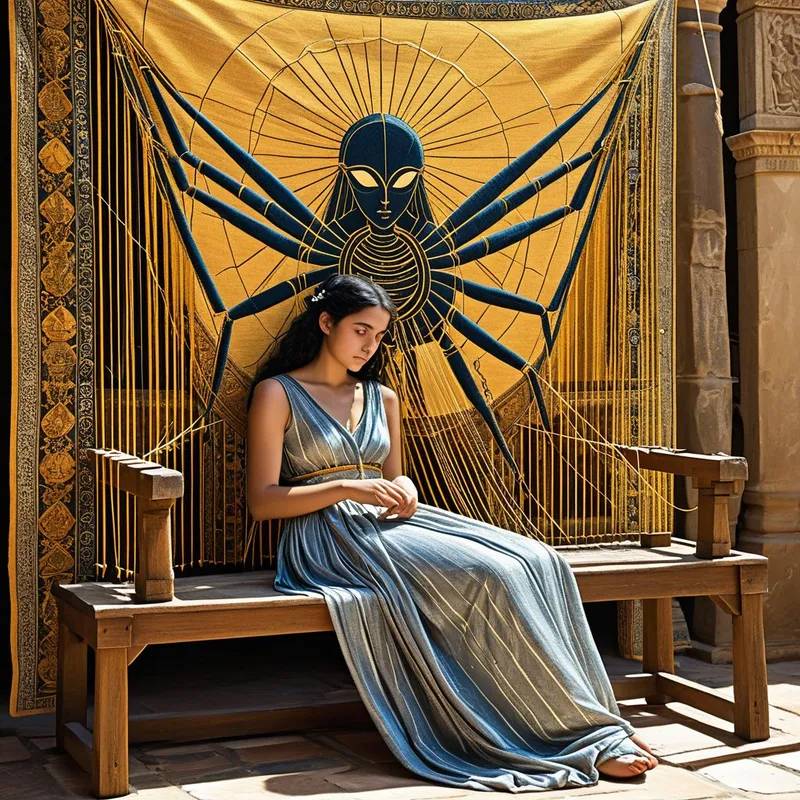
A mortal weaver of supreme skill challenges the goddess Athena to a contest. Her hubris leads to a divine curse, transforming her into the first spider.
The Tale of Arachne
Listen, and hear the story spun not from wool, but from fate itself. In the land of Lydia, there lived a maiden named Arachne. Her fame was not born of noble blood or divine favor, but sprang from the shuttle in her hand and the loom that sang beneath her touch. She was a daughter of a humble dyer, yet the threads obeyed her as if she were their sovereign. Her tapestries were not mere cloth; they were captured life. You could see the dew on a spider’s web, feel the breeze in a meadow, and hear the rustle of leaves in a forest glade. People whispered that Athena herself must have taught her. This was the spark that lit the fire.
“No god taught me,” Arachne declared, her voice sharp as a needle. “Let the goddess come. Let her contest with me. If I lose, I will pay any price.”
The air grew heavy, thick with the scent of ozone and olive oil. An old woman, leaning on a staff, appeared in the crowd. Her eyes were milky, but her voice carried the weight of ages. “Child,” she croaked, “recant your boast. Beg forgiveness from the mighty Athena. Humility is a prize greater than skill.” But Arachne, her pride a brighter thread than any in her basket, scoffed. “She is afraid! Let her come in her true form!”
Then, the transformation. The old crone straightened, her staff becoming a spear, her rags shimmering into the aegis with the Gorgon’s head. Athena stood revealed, radiant and terrible. The crowd fell prostrate. But Arachne only paled, then set her jaw. The challenge was accepted.
Two looms were erected. The click-clack of shuttles became the only sound in the world. Athena wove a warning: the central, majestic figure of herself, triumphant over the sea-god Poseidon in their contest for Athens. In the four corners, mortals who dared defy the gods were shown in their grim, transformed punishments—a dire lesson in thread and dye.
Arachne’s fingers flew. Her tapestry was a masterpiece of defiance. She depicted the gods not in glory, but in guile. There was Zeus as a bull, a swan, a shower of gold, deceiving mortal maidens. There was Dionysus in his revels, Poseidon in his tempers. Each scene was flawless, breathtaking in its technical perfection and devastating in its audacity. It was, undeniable, the superior work.
Athena examined it. A silence deeper than the Chaos fell. The goddess saw no flaw in the craft, only in the soul of the crafter. In a fury born of wounded divinity and a truth she could not bear, Athena tore the glorious tapestry to shreds. Then, with her shuttle, she struck Arachne’s forehead once, twice, three times.
A poison of shame, not of body but of spirit, flooded Arachne. She could not endure the weight of the goddess’s wrath, nor the hollow victory of her own proven skill. She fashioned a noose from her own threads and sought the final escape. But Athena spoke: “Live on, defiant one. Hang forever, and spin forever.”
As the words left her lips, Arachne’s body shrank and darkened. Her hair fell out, replaced by multiple eyes that saw in all directions. Her nose and ears vanished; her fingers became long, delicate spinners. Where the proud weaver stood, now dangled a small, grey spider—Arachne—descending on a silken line of her own making, condemned to weave her beautiful, intricate webs for all time.
Cultural Origins & Context
This myth reaches us primarily through the Roman poet Ovid, in his Metamorphoses. While Ovid’s version is the most detailed and psychologically rich, the core tale is Greek, reflecting profound cultural tensions. In a society where craft (techne) was a divine gift, Arachne’s story served as a potent cautionary narrative. It was told not just as entertainment, but as a social and religious lesson on the proper relationship between mortals and the divine order (dike).
The weaver’s loom was a central metaphor for fate and cosmic order, presided over by goddesses like Athena and the Moirai (Fates). For a mortal, especially a woman of low birth, to achieve a skill that rivalled the patron deity of that very craft was to threaten the hierarchical fabric of the universe. The myth functioned to reinforce boundaries: human excellence is permitted, even celebrated, but it must always acknowledge its source in, and subordination to, divine authority. To claim autonomy, to expose the flaws of the gods, was the essence of hubris—an overweening pride that inevitably attracted nemesis, divine retribution.
Symbolic Architecture
At its heart, the myth of Arachne is a profound drama of the creative spirit in collision with the established structures of authority, both external and internal.
The greatest art is often born from the tension between reverence and rebellion, a tension that can unravel the artist if left unresolved.
Arachne represents the raw, unmediated genius of the Creator. Her skill is innate, “self-taught,” symbolizing a talent that feels so personal it seems to spring from the very core of one’s being, disconnected from tradition or tutelage. This is the intoxicating, dangerous belief in pure, autonomous talent.
Athena, in this context, is not merely a jealous goddess. She symbolizes the internalized Superego—the collective voice of tradition, rules, acceptable forms, and the “right way” to create. She is the critical inner authority that says, “You must acknowledge your sources, you must respect the masters, you must work within the canon.” The contest, then, is an externalization of an internal civil war: the brilliant, rebellious ego (Arachne) versus the punishing, moralizing superego (Athena).
The transformation into a spider is the key alchemical symbol. It is not a mere punishment, but a paradoxical enantiodromia—a Jungian term for the emergence of the unconscious opposite. Arachne’s hubris, her inflation, leads to a crushing deflation. She is reduced to the essence of her craft, divorced from human form and social context. The spider is pure, instinctual weaver. Her web, beautiful and functional, is now also a trap and a prison. She becomes her art, and her art becomes her world—a solitary, perpetual cycle of creation that sustains and isolates her.
The Dreamer's Resonance
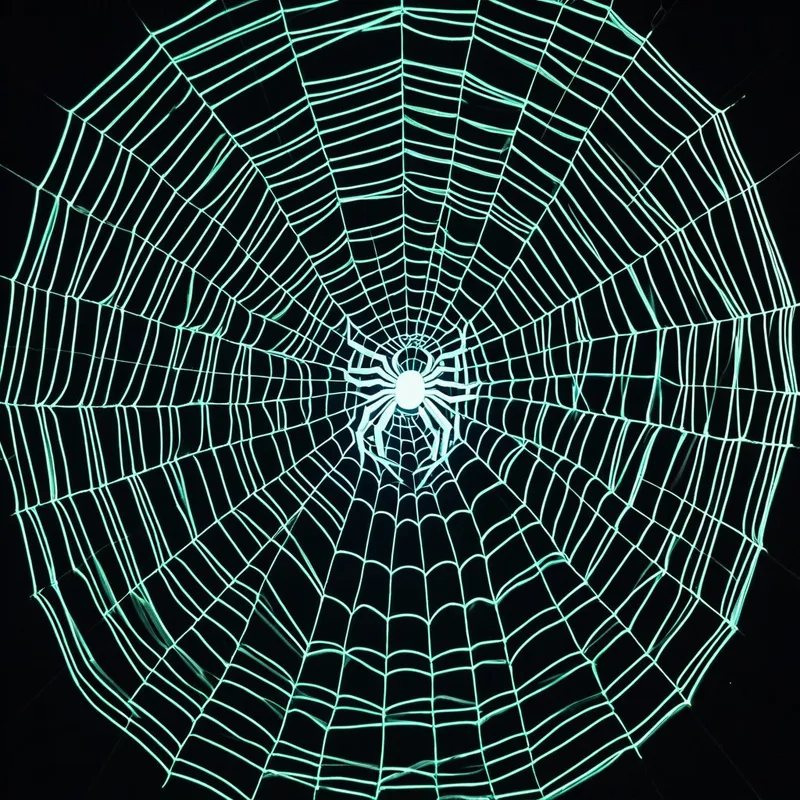
When the pattern of Arachne appears in modern dreams, it signals a critical passage in one’s creative or professional life. To dream of weaving a magnificent tapestry that is then destroyed by a powerful, shadowy figure (a boss, a parent, a critic) points to a profound fear: that one’s authentic voice and highest skill will be met not with acclaim, but with annihilating criticism or rejection. The dreamer may be on the cusp of a breakthrough but is paralyzed by an internalized “Athena”—a voice that demands conformity and punishes audacity.
Dreaming of being trapped in a web, or of one’s fingers turning into spinners, speaks to a somatic experience of creative entanglement. The individual may feel their gift has become a cage; their productivity is compulsive, a source of identity that also isolates them. They are “spinning their wheels,” creating beautifully but without connection or recognition, feeling the sting of a self-imposed or socially-enforced exile. The dream is an expression of the psychic poison Arachne felt—a deep shame or rage that one’s best work is not, or cannot be, truly seen and valued.
Alchemical Translation
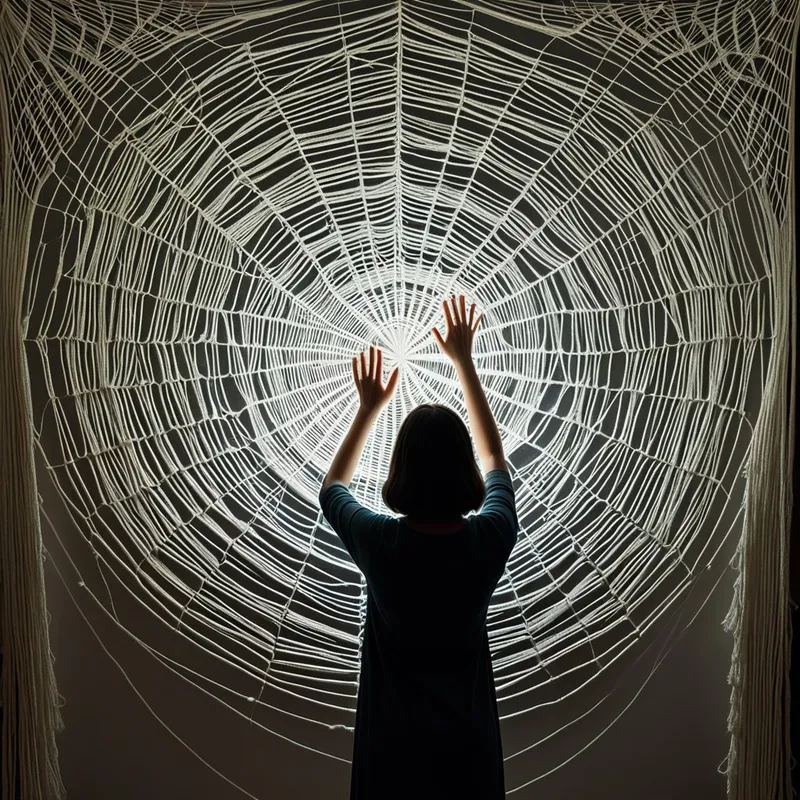
The individuation process modeled by Arachne’s myth is the arduous journey from unconscious genius to conscious craftsperson. The initial stage is inflation: the ego, identified entirely with its brilliant talent (Arachne boasting), believes it is self-made. This necessitates a confrontation with the archetypal authority (the Athena complex). The “destruction of the tapestry” is a necessary, if brutal, stage of nigredo—the blackening, the crushing of the ego’s pride.
The curse is also the gift: to be forced into the form of your own genius is to fully inhabit your destiny, however constrained.
The alchemical work lies in integrating the meaning of the transformation. The goal is not to avoid becoming the spider, but to consciously become the weaver within the spider. This means accepting that one’s core identity is tied to a compulsive, beautiful act of creation, but seeking to weave webs that connect rather than only ensnare. It involves acknowledging the “goddess”—the traditions, influences, and structures that shaped one’s field—without being subsumed by them.
The modern individual undergoing this transmutation must move from a stance of defiant, isolated autonomy (“I am solely responsible for my genius”) to one of humble, connected mastery (“I am a vessel for a skill that moves through me, and I weave in conversation with a greater tapestry”). One learns to spin the silk of one’s unique perspective while remaining aware of the larger web of culture and community. The curse of perpetual weaving becomes, through conscious acceptance, the vocation of the true artist: to forever spin the raw material of experience into meaning, from a place of grounded, resilient humility.
Associated Symbols
Explore related symbols from the CaleaDream lexicon:
- Website
- Fashion
- Mauve Silk
- Silkworm Thread
- Silkworm
- Venomous Spider
- Tarantula
- Spooky Spider
- Forgotten Silkworm
- Terrifying Black Widow
- Arachne Web
- Frosted Spiderweb
- Celestial Dreamcatcher
- Fashion Sketch
- Patterned Leggings
- Tangled Web Room
- Tangled Web
- Dreamcatcher Web
- Woven Fabric
- Embroidery Stitch
- Natural Dye Plants
- Natural Dye
- Ornamental Stitch
- Spider's Web
- Jorogumo Spider
- Silk Embroidery
- Weave
- Silk
- Lace
- Mesh