Aqua Virgo Myth Meaning & Symbolism
A Roman myth where a divine maiden reveals a hidden spring to thirsty soldiers, symbolizing the emergence of life-giving purity from the unconscious.
The Tale of Aqua Virgo
The sun was a hammer on bronze, and the dust was a shroud. It was the year of the consuls, a time when the legions of Rome marched not just for conquest, but for survival. A detachment of soldiers, parched and weary, their throats raw as the flint beneath their sandals, had strayed from the known roads. The land was sullen, a cracked clay bowl under a merciless sky. Their guide, a local girl of the countryside, watched them with eyes that held not fear, but a deep, still knowing. She was no ordinary peasant; there was a quietude about her, a presence that stilled the very air.
The tribune, his voice a dry rasp, demanded water. The men scanned the barren hills, seeing only mirages and death. But the girl, her name lost to the wind that carried the scent of distant myrtle, simply turned. Without a word, she walked toward a grove of ancient oaks, a place humming with a silence deeper than absence. The soldiers followed, skepticism warring with a desperate hope.
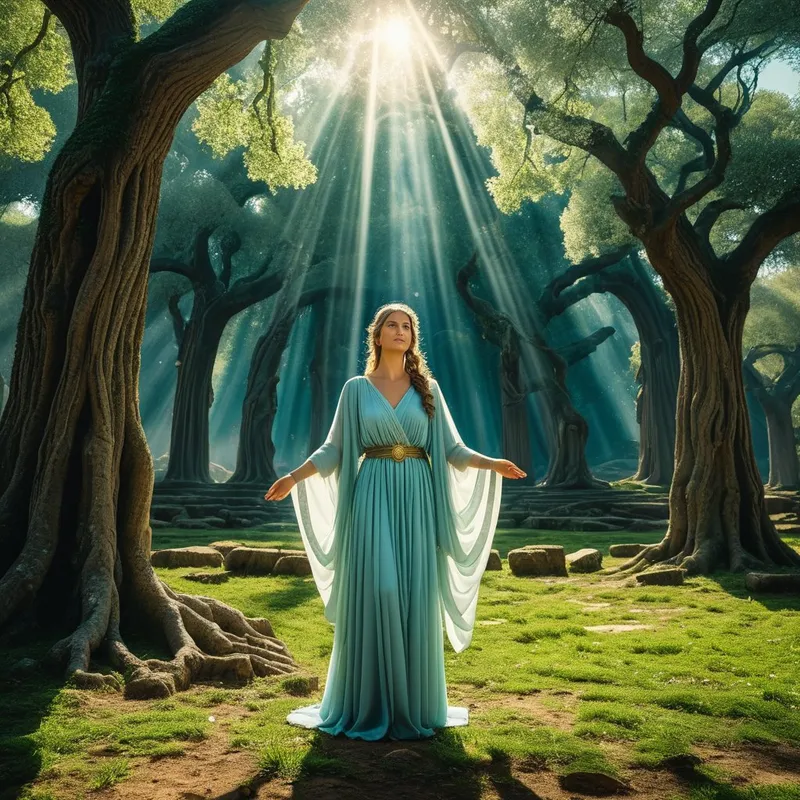
She stopped before a tangle of wild vines and crumbling stone. Here, the air was cool. Kneeling, she placed her palm flat upon the earth. She did not dig. She did not call out. She simply asked. And the earth, as if responding to a forgotten promise, shuddered. Not with violence, but with release. From a hidden seam in the rock, clear, cold water burst forth, singing as it met the light for the first time. It was not a trickle, but a generous flow, pure and sweet, cascading over moss and stone. The soldiers fell to their knees, not in prayer, but in animal need, drinking from their helmets, their hands, their very souls soaking in the gift. They looked at the girl, now haloed in the dappled light filtering through the oaks, and they understood. They had not been led by a peasant, but by a numen. She was the spirit of the spring itself, made flesh to guide them—the Aqua Virgo. She had revealed the secret heart of the land, the lifeblood hidden beneath the surface of struggle. And with that revelation, their march transformed from a weary trudge into a procession of the blessed.
Cultural Origins & Context
The myth of Aqua Virgo is not merely a charming etiological tale for a water source. It is a foundational narrative embedded in the Roman psyche, reflecting a core relationship with the land and the divine. Historically, the Aqua Virgo aqueduct was commissioned by Marcus Vipsanius Agrippa in 19 BCE, a monumental feat of engineering that channeled water to the Baths of Agrippa and the heart of the Campus Martius. But its engineering was cloaked in sacred myth.
The story was likely propagated by the engineers and priests themselves, a powerful piece of sacred propaganda. It served multiple societal functions. First, it sanctified a critical public utility, transforming a civic project into a divine gift, making its protection a religious duty. Second, it reinforced Roman values: the virtue of the guide (her purity, her pietas or duty), the reward for perseverance (the soldiers' plight), and the benevolence of the local spirits toward the Roman order. The maiden, the Virgo, represents the untamed, fertile spirit of Italia itself, willingly submitting to and nourishing Rome. The myth was told at the source, at the terminal fountain, and in the whispers of water flowing through the city, a constant reminder that civilization’s grandeur flowed from a sacred, virgin source.
Symbolic Architecture
At its core, Aqua Virgo is a profound symbol of revelation from the unconscious. The parched soldiers represent the conscious ego—directed, striving, but ultimately desiccated and lost without connection to a deeper source. The barren landscape is the known world, the field of conscious effort which has yielded all it can.
The spring does not create itself for the seeker; it is revealed by one who knows the secret language of the deep earth.
The maiden is the archetypal mediator, the anima figure or psychopomp. She is not the source, but its personified gateway. Her virginity is not primarily sexual, but symbolic of intactness, potential, and unspoiled origin. She is a vessel of pure possibility. Her act of revealing the spring—without tool or force—symbolizes an intuitive knowing, a connection to the collective unconscious that logic cannot access. The water itself is the symbol of life, emotion, spirit, and psychic energy—the anima in its liquid form. The myth, therefore, maps the process by which a depleted conscious mind, guided by the intuitive feminine principle, accesses the renewing, nourishing waters of the inner self.
The Dreamer's Resonance
When this myth stirs in the modern dreamer, it often manifests as a profound somatic thirst within the dream narrative. You may dream of searching through a vast, arid city or a lifeless office complex, your mouth full of dust. The landscape of the dream feels psychologically barren, representing a period of creative drought, emotional exhaustion, or spiritual cynicism.
The key figure—the maiden or guide—may not appear in classical form. She could be a mysterious stranger offering a cup, a child pointing to a hidden door, or even an animal leading you to a forgotten park fountain. The act of discovery is crucial: finding a hidden tap that works, a sudden rain in a sealed room, or a crack in your own home’s foundation from which clear water flows. The somatic release upon drinking is profound—a feeling of cellular replenishment, cooling, and peace.
Psychologically, this dream pattern signals a critical turning point. The ego has exhausted its known resources. The dream is the psyche’s compensatory act, staging a miraculous intervention from the unconscious. It is an invitation to stop striving on the surface and to allow yourself to be guided by a quieter, more receptive part of your own nature toward inner sources of renewal you had forgotten or never known existed.

Alchemical Translation
The journey of Aqua Virgo is a perfect model for the alchemical stage of solutio—dissolution into the watery prima materia—as part of the individuation process. The conscious personality (the soldiers) must first experience the nigredo, the blackening, the state of aridity and despair. This is not failure, but a necessary precondition.
The guiding anima (the maiden) represents the emerging symbol from the unconscious that makes the next step possible. Her role is to facilitate the coniunctio, the sacred marriage between the dry, solar consciousness and the moist, lunar unconscious. The bursting forth of the spring is the moment of psychic revelation, where what was hidden and potential becomes manifest and life-giving.
The aqueduct that carries the water to Rome is the adapted personality—the conscious mind now structured to channel and utilize the newfound psychic energy for creation and nourishment.
For the modern individual, the alchemical translation is clear. Our "march" is the daily grind, the pursuit of external goals that can leave us spiritually dehydrated. The "maiden" is the intuitive hunch, the sudden inspiration, the dream image, or the therapeutic insight that seems to come from nowhere. The "spring" is the authentic Self, the deep well of creativity, emotion, and meaning. The myth teaches that salvation is not found by doubling down on our conscious efforts in the wasteland, but by having the humility to follow the subtle guide within toward the hidden source. We do not conquer the spring; we are granted its grace, and in doing so, we learn to build an inner aqueduct—a sustainable connection to our own Aqua Virgo—to nourish our entire being.
Associated Symbols
Explore related symbols from the CaleaDream lexicon: