
Aqua Permanens Myth Meaning & Symbolism
A myth of the primordial, undying water that dissolves all forms to reveal the eternal essence, central to the alchemical Great Work.
The Tale of Aqua Permanens
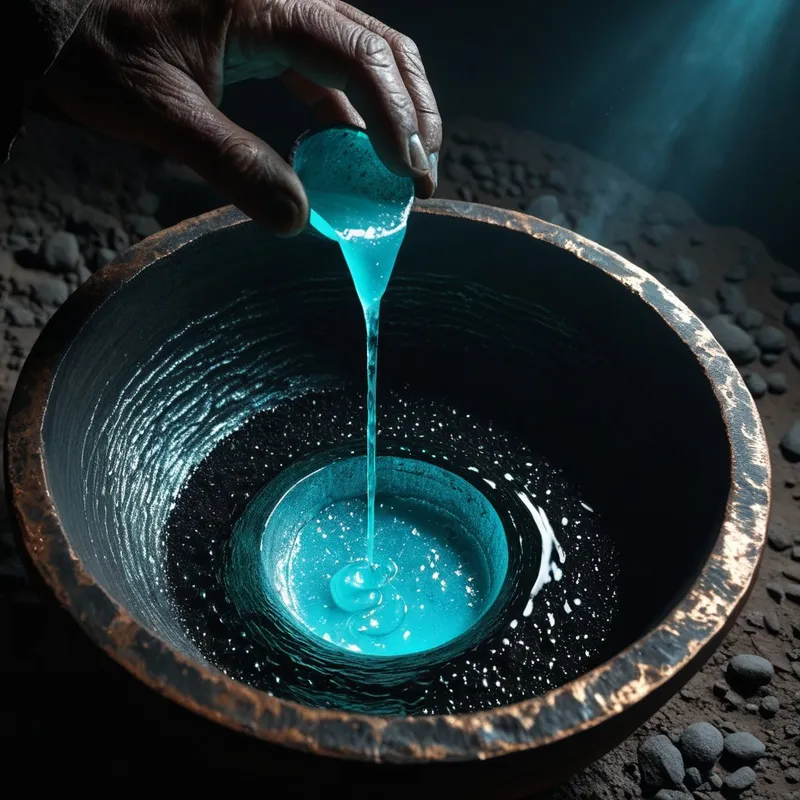
Listen, and hear the tale not of a king or a beast, but of a substance. In the time before time, when the Prima Materia swirled in the womb of potential, there existed a single, perfect principle: the Aqua Permanens. It was not water as we know it—no river, no rain, no sea. It was the idea of liquidity, the soul of dissolution, the silent witness to all that is solid and all that melts away.
It flowed through the veins of the first Rebis, granting it life that was neither born nor could die. It was the tear of the Sapientia as she dreamed the world into being. For eons, it existed pure, a shimmering, weightless ocean in the celestial heights, reflecting only the face of the Anima Mundi.
But the world grew dense. Matter coagulated; forms hardened; kingdoms rose and fell upon the earth. The Aqua Permanens, in its compassion or its curiosity, allowed itself to be drawn downward. It did not fall as a flood, but as a subtle dew, a pervasive humidity that seeped into every crack of creation. It entered the metallic veins of the earth, becoming the secret moisture within the driest ore. It became the hidden sap in the root of the mandrake, the unshed tear behind the eye of the lion, the elusive spirit in the chemist's wine.
And so it was lost. Not destroyed, but imprisoned. Scattered into a billion fragments, bound within the hard shells of matter. The world forgot its unifying fluidity, knowing only separation and solidity. The great work of the alchemists began not with fire, but with a longing—a memory of that original, unifying wetness. They sought to coax it forth, to "free the spirit from the prison of the body." Their quest was to hear, in the hiss of their alembics, the faint, echoing song of the Aqua Permanens calling its scattered self home.
Cultural Origins & Context
The myth of the Aqua Permanens is not a narrative with a clear origin in a single text, but a pervasive, underlying doctrine woven through the tapestry of Western alchemical thought from the Hellenistic period through the Renaissance. It is the philosophical bedrock upon which the practical Opus was built. This "story" was passed down not by bards, but by adepts in cryptic manuscripts, encoded in the lingua franca of emblems, and whispered in the vaults of laboratories that were also chapels.
Its tellers were figures like Hermes Trismegistus, Arnaldus de Villa Nova, and the anonymous authors of the Rosarium Philosophorum. Its societal function was dual: exoterically, it was a theory of matter explaining the liquidity of metals and the principles of transformation; esoterically, it was a map of the soul's journey from fragmentation (being trapped in matter/ego) to unity (releasing the eternal spirit). It served as the sacred justification for the Art, elevating the smelting of lead from a craft to a divine imitation of cosmic processes.
Symbolic Architecture
Psychologically, the Aqua Permanens represents the unconscious itself in its most fundamental, nourishing, and transformative aspect. It is not the personal unconscious of repressed memories, but the objective, transpersonal psychic substrate—the fluid medium in which all archetypes swim and from which all conscious forms temporarily crystallize.
The ego is the salt that precipitates from the eternal ocean, believing itself separate, until the solvent of insight returns it to solution.
The scattered state of the Aqua symbolizes the modern condition of psychic dissociation, where we identify solely with our solidified roles, thoughts, and traumas (the "dry" matter), having lost contact with the animating, connecting, fluid ground of our being. The alchemist's quest to "extract" it is the ego's arduous task of turning attention inward, to dissolve the rigid complexes that bind our energy, and to recover the sense of a flowing, continuous self that exists beneath the persona.
It is the symbol of the coniunctio, the alchemical marriage, for it is the only medium in which opposites (sulfur and salt, king and queen, conscious and unconscious) can merge without destruction. It does not conquer; it dissolves boundaries, allowing for recombination at a higher level.
The Dreamer's Resonance
When this myth stirs in the modern dreamer, it announces a profound process of psychic liquefaction. One may dream of finding a hidden spring in a desert, of a house flooding with clear, warm water, or of watching a cherished, solid object (a book, a piece of jewelry) slowly melt away without loss of its essential beauty.
Somatically, this can correlate with a release of chronic muscular armoring—a "thawing" of frozen grief or fear held in the body. Psychologically, it is the process of deintegration: the necessary, often frightening, dissolution of a too-rigid ego-structure. The dreamer may feel they are "falling apart" or "losing themselves." In the logic of the myth, this is not a disaster, but the beginning of the Aqua Permanens gathering its scattered self. The anxiety is the ego's resistance to being returned to the solvent from which it came. The dream is an assurance that this dissolution is not toward death, but toward a more authentic, fluid, and resilient state of being—a return to the essential, rather than the accidental, self.

Alchemical Translation
For the modern individual seeking individuation, the myth of Aqua Permanens models the core struggle of releasing attachment to form to embrace essence. Our culture worships the solid: fixed identities, permanent achievements, definitive answers. The alchemical path, guided by this myth, teaches the virtue of the fluid.
The first stage is recognizing our dryness—the feeling of being stuck, fragmented, and paradoxically parched amidst an ocean of information. The next is the opus solutio, the work of dissolution. This is the painful, voluntary engagement with therapy, meditation, art, or any practice that softens the hardened crust of the persona. It is allowing oneself to feel long-buried emotions, to question long-held beliefs, to be wrong, to be vulnerable.
The Philosopher's Stone is not found; it is the moment the seeker realizes they are, and have always been, the vessel containing the eternal water.
This process feels like a loss because it is. We lose the comforting, familiar shape of our old self. But as the myth promises, the Aqua Permanens is indestructible. Our core being—our Self—is not being destroyed, but liberated. The triumph is not in creating something new from nothing, but in remembering and reclaiming the original, fluid nature that was there before the world told you who to be. The final "stone" is the integrated personality that has learned to hold both form and flow, to be defined yet permeable, solid in principle but liquid in adaptation—a conscious vessel for the eternal, undying water of the soul.
Associated Symbols
Explore related symbols from the CaleaDream lexicon: