Apollo 11 Myth Meaning & Symbolism
The myth of three heroes who journeyed beyond the world to touch the silver otherworld, returning forever changed with a vision of unity.
The Tale of Apollo 11
Listen, and hear the tale of the first crossing.
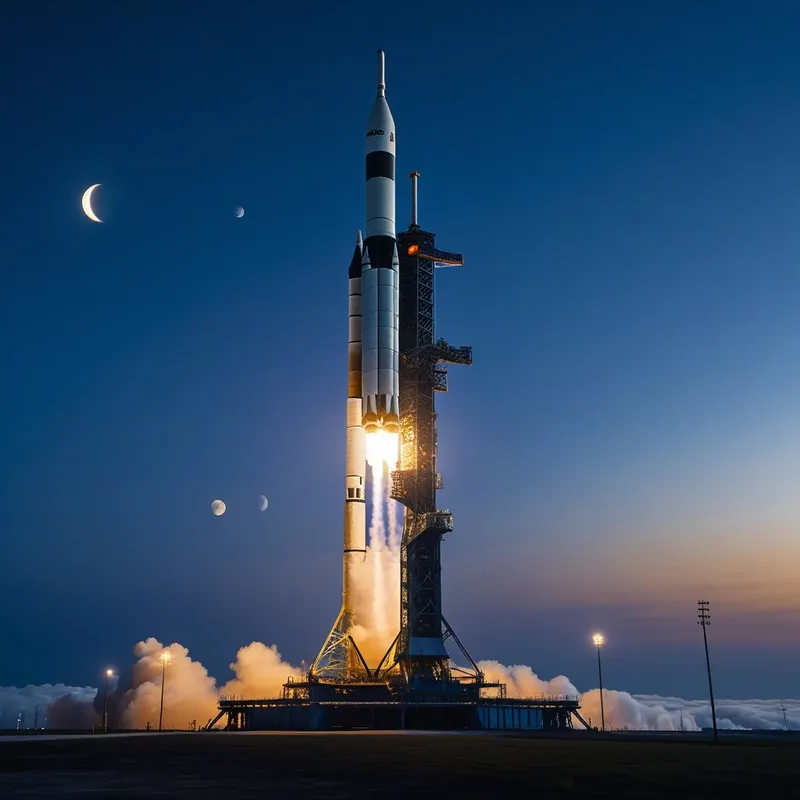
It began not in fire, but in a terrible, trembling silence. Upon the sacred sands of Cape Canaveral, a tower of impossible white stood, a needle stitching earth to sky. Within its heart slept three souls, chosen by the Mission Control. Their names were whispered like prayers: Armstrong, Collins, and Aldrin. They were sealed in a shell of metal and glass, a fragile egg against the abyss.
Then, the gods of fire awoke. A roar older than time tore the sky. The tower shuddered, and the great vessel, Saturn V, began its slow, agonizing climb. It was a struggle against the very weight of the world, a battle of thrust and gravity. For three days, the heroes sailed the sunlit river between worlds, their home shrinking to a brilliant blue marble hung in the black velvet of the cosmic sea.
But the true trial awaited at the silver shore. The vessel split; Collins remained alone in the command ship Columbia, a solitary sentinel. Armstrong and Aldrin descended in the spidery, golden Eagle. Alarms shrieked—the ancient computer was overwhelmed. The ground was a field of boulders. With a pilot’s cold grace and a final puff of dust, they settled onto the Mare Tranquillitatis. A voice crackled across the void: “The Eagle has landed.”
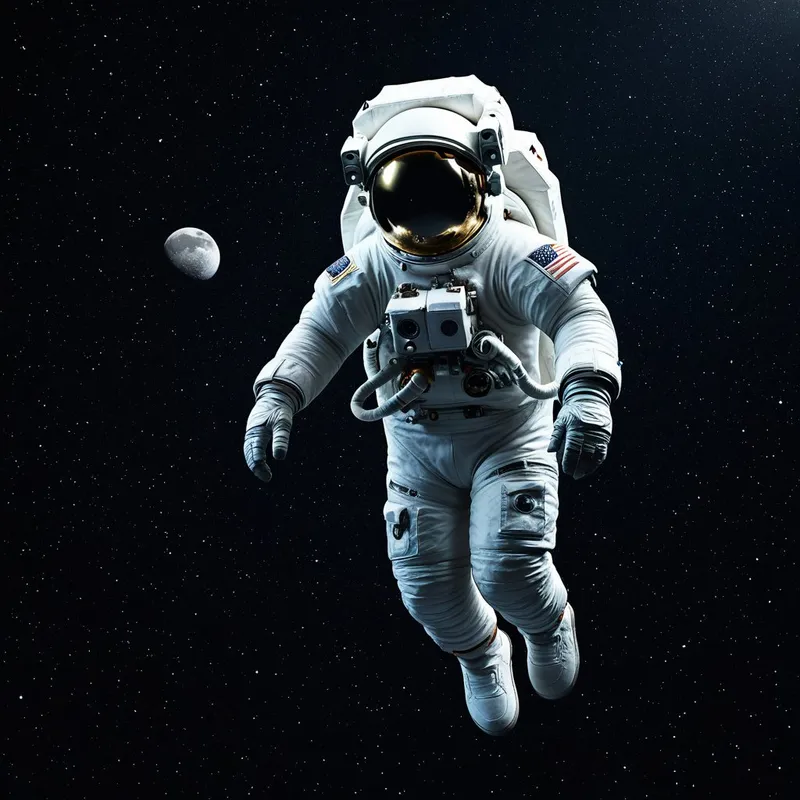
Then came the step. A hatch opened onto a landscape of absolute stillness. Armstrong, clad in a second skin of white and gold, descended the ladder. His boot, heavy with the history of a species, pressed into the grey dust. “That’s one small step for a man,” he declared to the listening world, “one giant leap for mankind.” He was joined by Aldrin, who described the place as a “magnificent desolation.” They planted a flag that hung limp in an airless sky, gathered stones of the otherworld, and looked back at the distant, beautiful, fragile Earth—a whole world contained in a single glance.
Their return was a fiery prayer. The ascent stage of the Eagle leapt back to the waiting Columbia. Reunited, the three heroes turned their backs on the moon and fell toward the blue planet. They plunged through a sheath of flame, were gathered by the ocean, and emerged, not just as men, but as myth. They had gone to the otherworld and returned, bearing its cold, silent truth within them.

Cultural Origins & Context
This myth was born in the mid-20th century, a period now known as the Space Age. Unlike ancient myths transmitted orally over generations, this saga was witnessed in real-time by hundreds of millions through the new, global nervous system of television and radio. The myth-makers were a complex priesthood: engineers at NASA, journalists like Cronkite, and the political architects of the Cold War.
Its societal function was multifaceted. On one level, it was a narrative of tribal triumph in a global competition. On a deeper, more enduring level, it served as a collective ritual of aspiration. It answered a profound human need for a unifying, transcendent story during a century of fragmentation and terror. The live broadcast was the communal campfire; the crackling voice from the moon was the bard’s chant. It provided a shared symbolic event that momentarily dissolved boundaries, offering an image of humanity not as nations, but as a crew on a single, planetary vessel.
Symbolic Architecture
At its core, the Apollo 11 myth is a pristine map of the heroic journey into the unknown realms of both cosmos and consciousness. The Saturn V represents the immense, focused thrust of human will and intellect required to break free from the gravitational pull of the known, the familiar, the collective consensus.
The journey to the moon is the journey of the conscious ego, leaving the maternal orbit of Earth (the unconscious, the source) to confront the solitary, reflective Other.
The Columbia, with Collins alone aboard, symbolizes the part of the psyche that must remain in orbit—the observing consciousness, the connection to home that must be maintained even during the deepest descent. The Eagle is the specialized vehicle of exploration, the focused consciousness that lands on the alien terrain of the unconscious (the moon). The moon itself is the archetypal anima, the silver, passive, reflective counterpart to the active, solar, blue-and-green Earth.
The most potent symbol is the View of Earth. This was the myth’s true revelation, not the footprint. Seeing the whole, isolated, breathtakingly beautiful Earth from deep space catalyzed a psychological shift—the Overview Effect. It is the symbol of achieved wholeness: the realization that all conflicts, borders, and divisions are contained within a single, fragile, living entity.

The Dreamer's Resonance
When this myth stirs in the modern dreamer, it often signals a critical phase of differentiation and confrontation with the “other.” Dreaming of piloting a fragile craft toward a luminous but distant celestial body speaks to a journey toward a daunting but luminous goal—a career apex, a creative project, or a state of self-knowledge that feels alien and remote.
Dreams of being Collins, alone in orbit, watching a companion module descend to a world below, reflect the somatic experience of supportive isolation. The dreamer may be in a phase where they must hold space for a partner, a project, or a part of themselves undertaking a risky descent, feeling both connection and profound solitude. Conversely, dreams of alarm lights flashing in a lunar lander mirror waking-life anxieties where systems (emotional, professional, physical) are being overloaded, requiring calm, manual override of panic to achieve a perilous but necessary landing.
Alchemical Translation
The alchemy of Apollo 11 is the transmutation of tribal ambition into a symbol of planetary individuation. The base metal of geopolitical competition (Cold War rivalry) was subjected to the intense heat of technological and human effort (the Saturn V's fire). This process aimed not for simple victory, but for the lapis philosophorum—the philosopher’s stone—which in this myth is the captured image of the whole Earth.
The hero does not conquer the moon; he is captured by the vision of home seen from its surface. The triumph is not in the landing, but in the return with transformed sight.
For the individual, this models the psychic journey out of the comfortable, enmeshed identity (Earth) to confront the cold, silent, often desolate aspects of the unconscious Self (the moon). This is not an integration that makes the unconscious conscious in a warm, fuzzy way, but rather a recognition of its “magnificent desolation”—its otherness. The successful return and splashdown represent the reintegration of this experience into the personal psyche. The individual is no longer merely a citizen of their personal history or tribe; they have seen themselves from a distance. They carry the “Overview Effect” within—a hard-won perspective that unifies inner conflicts by revealing the small, beautiful, isolated wholeness of their own being. The flag left behind is the old identity; the rocks brought back are the incorruptible, eternal truths of the Self.
Associated Symbols
Explore related symbols from the CaleaDream lexicon: