
Aphrodite's Girdle Myth Meaning & Symbolism
The myth of the magical girdle that holds the power of irresistible desire, revealing the primal force of attraction and its role in cosmic order.
The Tale of Aphrodite's Girdle
Hear now of the weave that bound the world. Not of stone or steel, but of a subtler stuff: the shimmering threads of longing itself. This is the tale of the kestos himas, the girdle of Aphrodite.
In the high halls of Olympos, where ambrosia scents the air and the laughter of the gods echoes like distant thunder, there walked the one born of sea-foam and severed sky. Aphrodite. Where her foot fell, flowers sprang, not from earth, but from the very air, blooming with the color of first blush. Her presence was a soft, warm wind that stirred not leaves, but hearts. And about her waist, she wore her secret and her sovereignty: a girdle.
It was no mere adornment. Woven by the cunning Hephaistos in the forges of divine artifice, or perhaps spun from the essence of her own birth, it held within its intricate knots and gleaming folds the sum of all enchantment. It contained the whispered promises of lovers, the heady flush of first sight, the gentle ache of yearning, and the fierce, burning fire of passion. To possess it was to command the very force that moves suns and mortals alike.
The story of its power unfolds not in peace, but in the grim dust of war. The plains of Troy groaned under the weight of men and metal. The gods themselves were divided, picking favorites among the bleeding heroes. Hera, whose heart burned with a cold fury for the city of Paris, who had spurned her, looked upon the stalemate and saw a need for a different weapon.
She sought out Aphrodite in her bower, a place where the air was thick and sweet. "Daughter," Hera began, her voice honeyed with purpose, "you see the strife. The will of Zeus is obscured by the clash of spears. A… distraction is needed. A realignment of hearts."
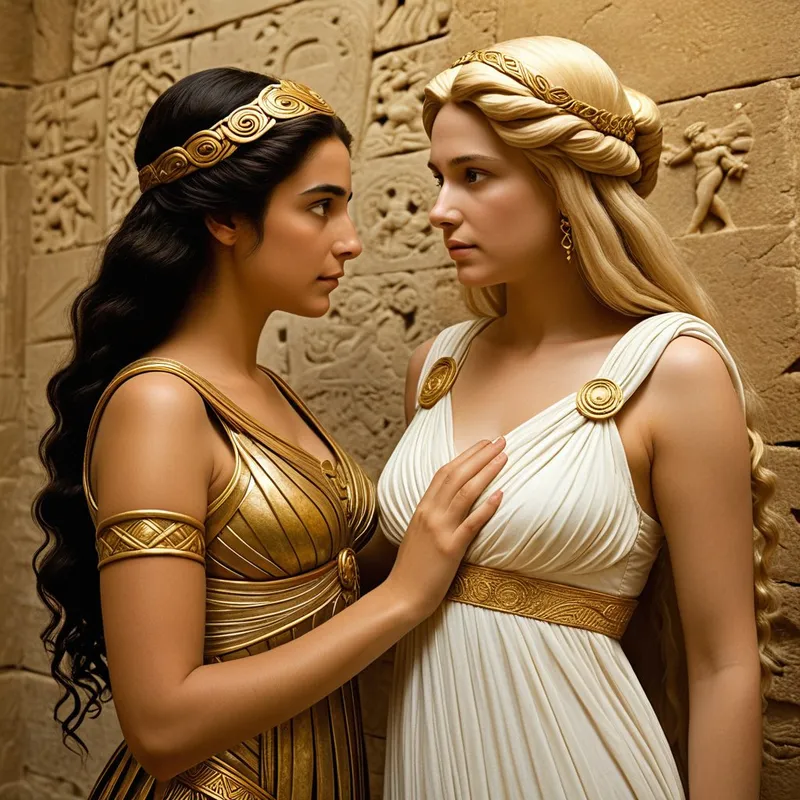
Aphrodite, reclining amidst cushions that smelled of myrrh, knew the request before it was spoken. Her fingers traced the warm metal at her hip. She understood the cost, the vulnerability in lending her very essence. Yet, the politics of Olympos were a tapestry she helped weave. With a smile that held the mystery of deep waters, she unclasped the girdle. It came away with a soft sigh, like a released breath. "Take it," she said, placing the shimmering weight in Hera's hand. "Let it remind them what they fight for, and what they truly desire."
Hera, now armed with a power greater than any thunderbolt, descended. She did not aim it at warriors, but at their commander. Finding Zeus watching the battle from a cloud-wreathed peak, she approached. The girdle’s magic, now wielded with Hera’s formidable intent, unfolded like a perfume of pure persuasion. The king of gods, who moments before pondered strategies and fates, felt the world shift. His gaze upon Hira softened, then ignited with a forgotten fire. The din of war faded into a distant murmur. All thought of Troy, of oaths, of cosmic order, dissolved in the overwhelming, glorious distraction of desire. He drew his wife away, and a golden cloud enveloped them, leaving the war, for a precious, pivotal interval, to the whims of mortals.
Cultural Origins & Context
This myth is preserved for us primarily in the epic poetry of Homer, in Book XIV of the Iliad. It is a story told not in isolation, but embedded within the grand, tragic tapestry of the Trojan War, serving as a divine interlude that highlights the profound forces operating behind human conflict. In the oral tradition of the aoidoi (bards), such tales were not mere entertainment; they were a sacred technology for explaining the nature of reality.
The girdle, or kestos himas, functioned within a culture that deeply understood and ritualized the power of eros and philia. Aphrodite’s cults celebrated this force as fundamental to cosmic harmony and procreation. The myth of her girdle personifies this understanding: desire is not a vague feeling but a tangible, transferable power—an artifact. It acknowledges that attraction is the great manipulator of wills, capable of diverting even the most focused intention, be it of a king or a god. Societally, it served as a divine explanation for the irrational, the passionate detours that shape histories and lives, reminding listeners that alongside strategy and strength, the soft power of allure holds immense sway.
Symbolic Architecture
At its core, the girdle symbolizes the concentrated essence of erotic and creative power. It is the potential for connection, attraction, and generation made manifest as a tool.
The Girdle is the bounded form of the unbounded force; it is chaos given a pattern, wild attraction given a channel.
Psychologically, it represents the archetypal power of the Anima in its most potent form. It is not merely femininity, but the specific capacity to enchant, to relate, to draw things into union. When Aphrodite lends it to Hera, it illustrates how this power can be detached from its source and wielded strategically. Hera, the archetype of the wife and sovereign, uses the Lover’s tool to achieve a ruler’s end. This reveals a profound truth: the forces of love and desire are neutral energies that can be harnessed for creation, connection, or, as in this case, sublime deception and diversion.
The act of Zeus being distracted symbolizes a universal psychological event: the moment the conscious, directing mind (the king, the ego) is overwhelmed by the pull of the unconscious, libidinal energy. His "fall" into the golden cloud is a descent into a state of enchantment where logos (reason, order) is temporarily suspended for eros.

The Dreamer's Resonance
When this myth pattern stirs in the modern dreamer, it often signals a confrontation with the raw, magnetic power of desire within their own psyche. To dream of such a girdle—or any object of captivating, binding allure—suggests the dreamer is navigating a force that feels both immensely personal and strangely autonomous.
Somatically, this may manifest as dreams filled with intense attraction, magnetic pulls toward or away from people or situations, or the feeling of being "spellbound." The girdle in a dream is rarely just an ornament; it is active. The dreamer may be fastening it, losing it, having it stolen, or feeling its constriction. These images point to the dreamer's relationship with their own capacity to attract and connect. Are they in conscious command of this power, or is it being used by another part of them (an inner Hera) to manipulate a situation? Is the power felt as a source of strength or as a vulnerability that must be given away? The dream invites an examination of where and how the energy of desire is flowing—or being blocked—in one's life.

Alchemical Translation
The alchemical journey modeled here is the integration of eros into the service of the whole self. Individuation is not about rejecting desire but about transmuting its raw, often disruptive, power into a conscious faculty.
The operation is this: to reclaim the girdle from the strategic Hera within and return it to the essential Aphrodite, so that desire serves not manipulation, but authentic relatedness and creation.
Initially, our erotic power (the girdle) may be "on loan" to other complexes. We let our need for security (Hera) wield our attractiveness to secure a partner. We let our need for control use our charm to manipulate outcomes. This is the girdle in another's hands. The alchemical task is to withdraw that projection, to take back the girdle and wear it as our own, integrated attribute. This means owning our capacity for attraction, passion, and deep connection without shame or strategy, recognizing it as a fundamental, creative force of our being.
When Aphrodite wears her girdle, it is an expression of her nature. When we achieve this integration, our desire ceases to be a weapon or a weakness and becomes instead a compass, guiding us toward what is truly life-giving, connecting us to the world and others with authenticity. The myth warns of the chaos that ensues when this power is divorced from its source and used for ulterior ends, and it promises the harmony that comes when desire and identity are once again aligned. We move from being enchanted or enchanting others unconsciously, to consciously embodying the creative, connective force itself.
Associated Symbols
Explore related symbols from the CaleaDream lexicon: