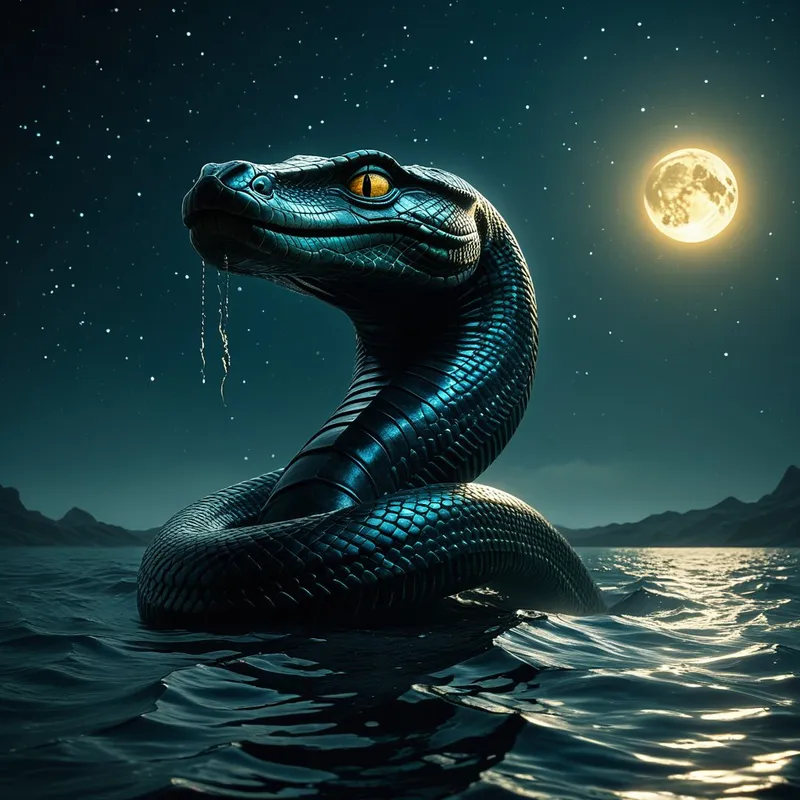
Apep Myth Meaning & Symbolism
The eternal battle where Ra's solar barque fights the serpent Apep, a myth of cosmic order versus primal chaos, repeated each night and dawn.
The Tale of Apep
Listen, and hear the tale that is sung not once, but every single night since the first dawn.
The world rests. The sun, the great Ra, has completed his journey across the sky-vault. His golden barque now dips below the western horizon, and the realm of Duat opens its starless gates. This is no gentle twilight, but a descent into the belly of possibility, where the laws of day loosen their grip.
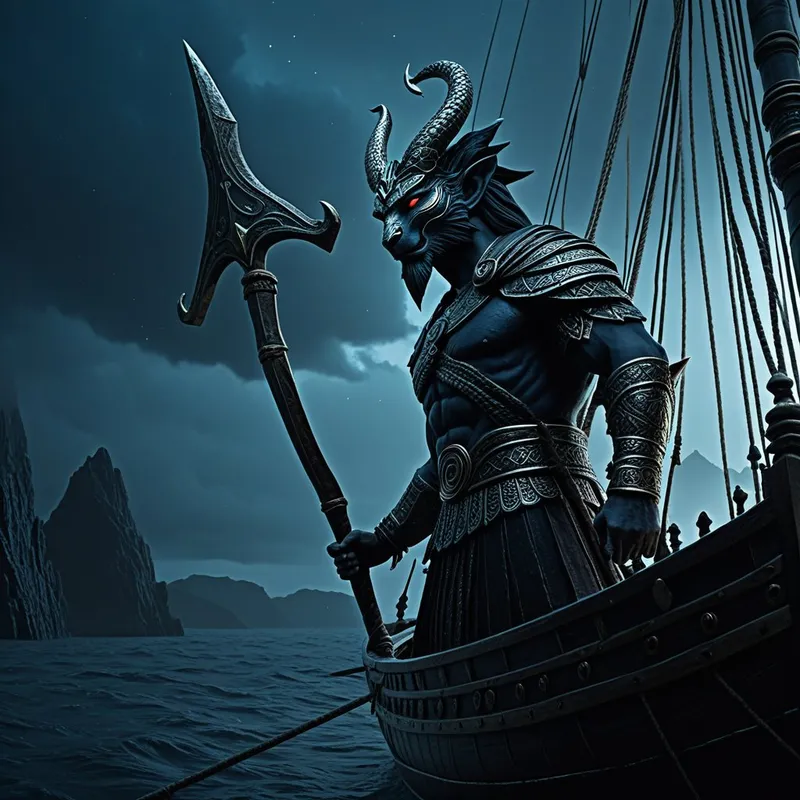
Within the barque, Ra is not alone. A crew of mighty gods mans the vessel. Thoth marks the passage. Nut stretches above. And at the prow, fierce and unblinking, stands Set, his spear ready.
For they know He is waiting.
He is Apep. He was here before the first word of creation was spoken. He dwells in the endless, dark waters of Nun, coiling in the absolute deep. He is the enemy of ma'at. He does not seek to rule; he seeks to un-create. To still the barque. To swallow the sun whole and return all to the silent, formless void.
As Ra’s barque enters the deepest hour, the waters of the underworld river grow thick and cold. A turbulence begins, not of current, but of anti-current. From the abyssal black, a mountain of scaled darkness rises. It has no eyes, for it needs none. It is a presence of lack, a hunger for non-being. Its maw opens—a cavern that drinks light and sound.
This is the moment. Set lets out a mighty roar, a sound that is storm and defiance. He thrusts his spear, not of wood, but of thunder and meteoric iron, into the looming form. The other gods join the fray. They cast spells of binding, weaving nets of magic to entrap the serpent. They shout the names of power, each syllable a weapon against the formless.
The battle is titanic and intimate. The barque rocks violently. The light of Ra flickers, dimmed by the serpent’s breath. For a terrifying heartbeat, it seems the darkness will win. The universe holds its breath.
But the gods do not relent. Set strikes again and again. The spells of Thoth tighten. And Ra, at the center, burns with a core of unwavering will. With a final, collective exertion, they wound Apep, they drive him back, they cut through his coils. He sinks, thrashing, back into the waters of Nun—wounded, but not dead. Never dead.
And the barque, scarred but victorious, sails on. It approaches the eastern horizon. The first faint line of light appears. Ra is reborn. The sun rises. Ma’at is upheld for another day. But in the deep, Apep coils and heals, waiting for the next descent, for the next night’s necessary battle.
Cultural Origins & Context
This was not merely a story for entertainment, but a sacred, functional cosmology enacted daily. The myth of Apep was central to the Egyptian understanding of reality. It was recited in temple rituals, most likely by priests during the night watches, to magically assist Ra in his subterranean battle. Texts like the Book of Apophis detail elaborate ceremonies involving the burning of wax models, the drawing of the serpent in green ink, and its ritual destruction—a sympathetic act to ensure the sun’s return.
The myth served a profound societal function: it explained the fragility of order. The Egyptians saw their civilization as a sacred island of ma’at in a sea of potential chaos (isfet). Pharaoh’s duty was to uphold ma’at, just as Ra did. Thus, Apep represented not only cosmic disorder but also social collapse, foreign invasion, famine, and injustice. The daily victory of Ra was a divine mandate and reassurance that through proper ritual and righteous living, order could—and must—be continually reaffirmed.
Symbolic Architecture
Apep is the ultimate symbol of the Shadow on a cosmic scale. He is not evil in a moralistic sense, but the principle of entropy, dissolution, and the undifferentiated state that precedes and threatens consciousness.
Apep is the inertia of the psyche that resists the dawn of awareness, the pull back into unconsciousness that every act of consciousness must overcome.
He represents the part of existence that rejects form, distinction, and life itself. Ra’s journey is the journey of the conscious ego, the "I," through the darkness of the personal and collective unconscious. The gods in the barque are the auxiliary forces of the psyche—wisdom (Thoth), protective aggression (Set), and overarching structure (Nut)—that the ego must integrate to survive the voyage. The battle is never final because the unconscious is endless; integration is a perpetual process, not a one-time achievement.
The Dreamer's Resonance
When this myth stirs in modern dreams, it rarely appears as a literal Egyptian tableau. Instead, one may dream of a vital project (the solar barque) being sabotaged by inexplicable delays or internal resistance (the coiling serpent). One might dream of a fragile light source threatened by an encroaching, formless darkness, or of trying to navigate a vehicle through an impossibly thick, hostile medium.
Somatically, this can feel like a profound lethargy, a "weight of the world" pressing down at night, or anxiety about impending collapse. Psychologically, it marks a confrontation with a deeply rooted pattern of self-sabotage, a depressive pull, or a chaotic complex that threatens to dissolve one's sense of self and purpose. The dream is mapping the nightly journey of the psyche, where the ego-structure is tested against disintegrative forces from within.
Alchemical Translation
The alchemical work mirrored in this myth is the nigredo, the dark night of the soul, which is a necessary precursor to renewal. One does not "defeat" their inner Apep; one engages it, contains it, and transforms its energy.
The modern individuation process requires this nightly descent. We must enter our own Duat—our repressed memories, our ignored wounds, our chaotic impulses—and sail the barque of our conscious identity through it. The protective gods are the psychic functions we must call upon: the sharp discernment of Set (to confront), the mindful recording of Thoth (to understand), and the containing faith of Nut (to hold the process).
The triumph is not the annihilation of chaos, but the daily courage to sail through it, integrating its reality into the wholeness of the self, thereby making the dawn of a broader consciousness possible.
Each personal victory over inertia, each conscious choice made against the pull of dissolution, is a ritual re-enactment of Ra’s victory. We do not become beings of pure light; we become the barque that carries the light through the darkness, acknowledging that the darkness is an eternal part of the voyage. Our "sunrise" is a moment of renewed clarity, a hard-won insight, or a simple commitment to continue, forged in the belly of our own necessary night.
Associated Symbols
Explore related symbols from the CaleaDream lexicon: