
Annapurna Myth Meaning & Symbolism
A myth where the goddess of nourishment vanishes, plunging the cosmos into starvation, teaching that spirit and sustenance are one sacred, indivisible whole.
The Tale of Annapurna
Listen. There is a hunger older than time.
It began not with a roar, but with a silence—a terrible, hollow silence that seeped into the bones of the world. For an age, a philosophical debate had echoed through the halls of the divine. Shiva, the great renunciant, his body smeared with the ash of burned-out universes, declared to his beloved Parvati, “The world is an illusion. Maya. All that matters is spirit. Food, sustenance, this material world—it is a chain that binds the soul.”
Parvati, who is the world in all its vibrant, pulsing reality, heard this. A profound sorrow, deeper than any ocean, filled her heart. She saw the arrogance in this absolute denial of the tangible, the nourishing, the given. To teach the lesson that could only be felt in the gut, in the trembling hand, she chose to vanish.
She withdrew her aspect as Annapurna, the Full One, She Who is Full of Food.
And the universe began to starve.
It was not a sudden famine, but a creeping void. The earth’s bounty turned to dust in the mouth. Rivers ran clear but provided no sustenance. Trees bore fruit that was hollow, like painted wood. In the celestial realms, the Devas felt their radiance dim. On earth, humans moved like ghosts, their prayers turning to dry rasps. The great cycle of giving and receiving, the very breath of creation, had stalled.
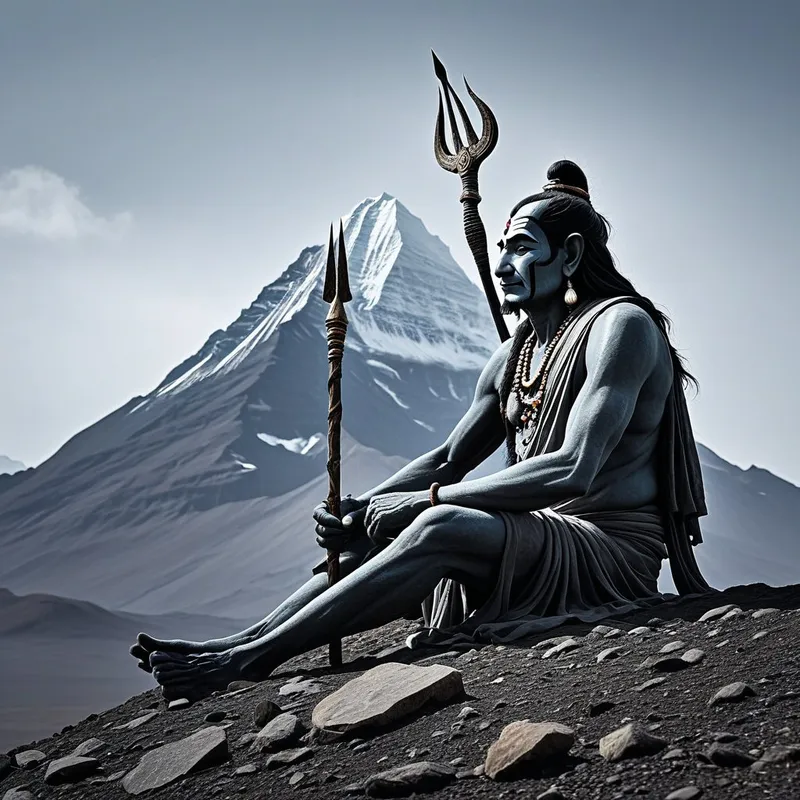
The greatest ascetic of them all was not spared. Shiva, on his icy mountaintop, found his profound meditations interrupted by a gnawing emptiness he could not transcend. His powerful frame grew gaunt. The vision of the formless absolute blurred before eyes weakened by hunger. The spirit, he realized in a moment of devastating clarity, cannot soar when the body is broken. His lofty philosophy crumbled before the most basic, undeniable truth: life needs food.
Humbled, shattered, the great god took up a begging bowl. He descended from his mountain solitude and walked the barren streets of Varanasi, the city of light, now a city of shadows. He stood at doorways, a silent, spectral figure, his bowl empty. No one could fill it, for the source of all nourishment was hidden.
Finally, he came to a simple, unassuming kitchen. A divine fragrance, the memory of all good things, emanated from within. He entered. And there she was. Annapurna. Not as the distant goddess, but as the cook, the sustainer, her form glowing with a gentle, nourishing light. She smiled, a smile that held no reproach, only infinite compassion. Shiva, the destroyer of worlds, extended his begging bowl.
With a grace that made the act a sacred ritual, Annapurna took her golden ladle and served him a single morsel of khichdi. As the food touched his lips, the cosmos let out a sigh. Color returned to the world. The rivers sang. The trees grew heavy with fruit. The lesson was served, and it was delicious. Shiva understood: the material is not opposed to the spiritual; it is its vessel, its manifestation. The bowl and its content are both sacred.
Cultural Origins & Context
The myth of Annapurna finds its roots in the Vedas and Puranas, most notably the Shiva Purana and the Devi Bhagavata Purana. It is a story told not just in temples, but in the most fundamental unit of society: the kitchen and the hearth. Annapurna’s worship is uniquely democratized. While she has grand temples, like the famed Annapurna Temple in Varanasi, her primary altar is in every home where food is prepared with reverence.
The myth served a critical societal function, weaving spiritual philosophy into the fabric of daily survival. In a culture that deeply values asceticism and renunciation (sannyasa), the story of Annapurna acts as a crucial counterbalance. It sanctifies the grihastha (householder) stage of life, asserting that feeding others is not a mundane chore but a divine duty (dharma) as sacred as any meditation. The tale was passed down by mothers to daughters, by priests to communities, during harvest festivals and daily food offerings (naivedya), ensuring that the act of eating never became merely biological, but remained a sacrament.
Symbolic Architecture
At its core, Annapurna is not merely a goddess of food; she is the archetypal embodiment of unconditional nourishment. Her myth deconstructs the perilous duality between spirit and matter, transcendence and immanence.
To deny the body is to starve the soul. The deepest hunger is not for bread alone, but for the sacredness inherent in the bread.
Shiva represents pure, unmanifest consciousness—the spirit. Annapurna-Parvati represents Shakti, the manifesting energy that gives form and sustenance to that consciousness. Their separation creates cosmic dysfunction. The begging bowl (bhiksha patra) of Shiva is a powerful symbol of humility and receptivity. The proud, self-sufficient ego must become empty and ask to be filled. Annapurna’s ladle is the instrument of grace; nourishment is given not as a reward, but as a natural expression of divine abundance.
The city of Varanasi, the setting for the climax, is itself a symbol. It is considered the axis mundi, the center of the world, where heaven and earth meet. That the crisis of nourishment is resolved here signifies that the reconciliation of spirit and matter is central to the world’s existence.

The Dreamer's Resonance
When this myth stirs in the modern psyche, it often manifests in dreams of profound emptiness or searching for sustenance. You may dream of wandering through endless, sterile supermarkets with empty shelves, or of cooking a feast that no one comes to eat. You might find yourself at a banquet but unable to swallow, or conversely, eating voraciously yet remaining hungry.
These are not dreams about physical diet, but about psychic malnutrition. They signal a state where one part of the self—often the spiritual, ambitious, or intellectual “Shiva” aspect—has disparaged or cut off from the nourishing, sustaining, embodied “Annapurna” aspect. The somatic feeling is one of hollow fatigue, a depletion that sleep does not remedy. The psyche is enacting the myth, showing you that your current mode of being is starving a vital part of you. The dream is the first tremor of the goddess’s withdrawal, a call to acknowledge what you have labeled “mundane” or “unspiritual” as essential to your wholeness.

Alchemical Translation
The individuation process modeled here is the alchemical coniunctio oppositorum—the sacred marriage of opposites within the psyche. Our modern quest often glorifies the “Shiva” within: the drive to transcend, to achieve, to dissociate from the messy, needy, material world of feelings, relationships, and bodily needs. We seek enlightenment but scorn the simple act of cooking a good meal. We pursue success while neglecting to nourish our hearts.
The alchemical gold is not found by escaping the kitchen, but by recognizing the kitchen as the laboratory of the soul.
The myth instructs us that the first step is the “great withdrawal.” The nourishing function collapses, leading to a crisis—burnout, depression, a sense of meaningless striving. This is the necessary desolation that shatters spiritual arrogance. Then comes the descent: the proud ego must take up the begging bowl. This is the humility to ask for help, to receive therapy, to rest, to cook a simple meal for oneself, to admit need.
The final transmutation occurs in the act of receiving. When Shiva accepts food from Annapurna, spirit is embodied. For us, this means allowing spiritual insights to be grounded in kind action, letting self-care be a spiritual practice, understanding that a healthy body and a nurtured heart are the vessels for a clear mind and a compassionate spirit. We become both the nourisher and the nourished, completing the sacred circuit. We become, in our own small way, a living mandala where the ladle of giving and the bowl of receiving are held in one, graceful, balanced hand.
Associated Symbols
Explore related symbols from the CaleaDream lexicon: