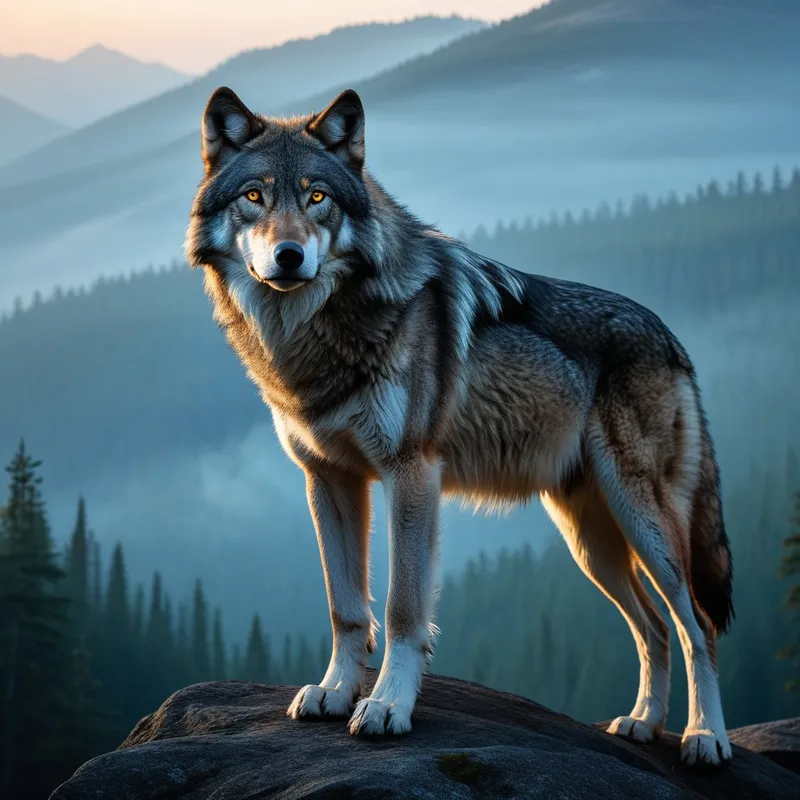
Animal Spirit Guide Myth Meaning & Symbolism
A mythic journey where a seeker, lost in the wilderness of self, is met by a wild guide who reveals the soul's true, untamed nature.
The Tale of Animal Spirit Guide
The world was a tapestry of whispering pines and sighing winds, a place where the boundary between earth and sky was a thin, trembling veil. In those days, a person could walk for a lifetime and never find the edge of their own soul. It was into this vastness that a seeker walked, not a hero of great deeds, but one hollowed by a quiet, persistent longing. They felt like a stranger in their own skin, their footsteps out of rhythm with the heartbeat of the world.
Driven by this ache, they left the warmth of the communal fire and walked into the deep woods, into the vision quest. Days bled into nights under a cold, watchful moon. Hunger became a companion; thirst, a teacher. The familiar shapes of the world—the trees, the stones, the streams—began to shift and speak in a language older than words. In this liminal space, at the very brink of their strength, where the mind's chatter finally fell silent, the true wilderness within began to stir.
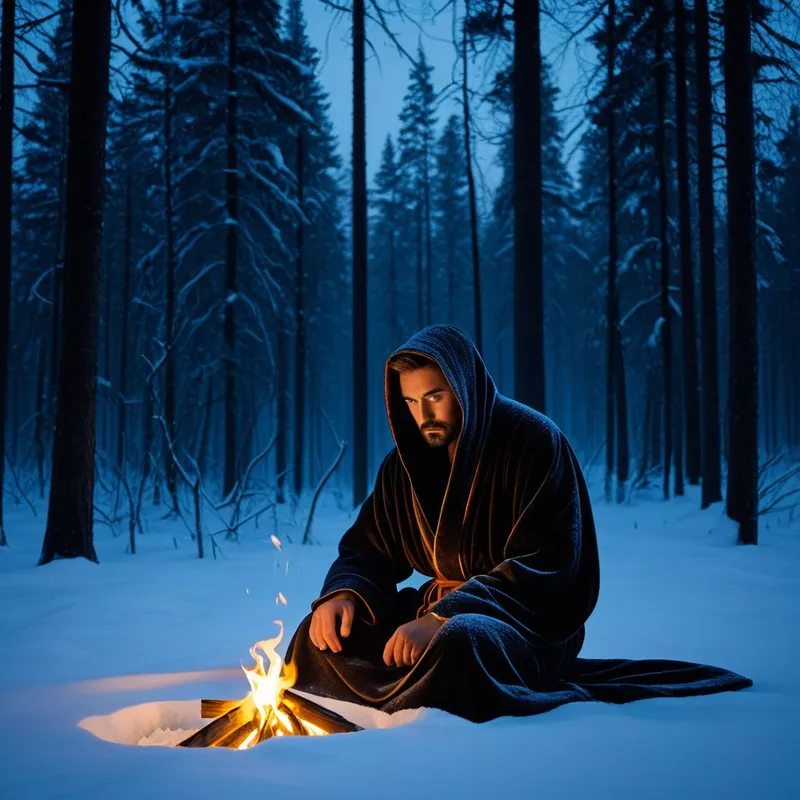
It began not with a sight, but with a presence. A heaviness in the air, a scent of musk and damp earth carried on a wind that did not rustle the leaves. The seeker, huddled by a meager fire, felt the gaze before they saw it. From the wall of shadows between the ancient trunks, two points of liquid amber light emerged. Then, the massive, rolling shape of the Great Bear resolved from the gloom. It did not charge or roar. It simply was, a mountain of fur and quiet power, its breath pluming in the cold air.
Terror, pure and instinctual, froze the seeker’s blood. This was the edge, the moment where the self could shatter. But beneath the terror, something else stirred—a recognition. The bear lowered its great head, its dark eyes holding not malice, but a deep, unfathomable knowing. It turned and took a single, deliberate step back into the forest, then paused, looking back.
The call was not spoken, but felt in the marrow. The seeker rose on trembling legs, leaving the false safety of the fire’s circle. They followed the bear as it moved with a slow, deliberate grace through the moon-dappled woods. It led them to a hidden cave, its entrance veiled by roots, and there it stopped. Inside, in the absolute dark and silence, the seeker sat. The bear’s presence filled the space, a warm, grounding force. In that darkness, without sight or sound, the visions came.
They were not dreams, but truths. They saw the bear’s strength as the power of deep introspection, of healing sleep during winter’s trial. They felt its ferocity as the courage to protect what is sacred. They understood its solitude not as loneliness, but as sovereignty. The bear showed them their own hidden strength, their capacity for quiet healing, and the sacred boundaries of their own soul. When dawn’s first light touched the cave’s mouth, the bear was gone. But the seeker was not alone. They carried the bear’s essence within them now, a silent, powerful companion. They returned to their people walking a different earth, seeing with new eyes, their hollow longing filled with the quiet, resonant power of their animal spirit guide.
Cultural Origins & Context
The concept of the animal spirit guide, or totem, is not a single, monolithic myth but a foundational thread woven through the diverse tapestry of many Indigenous North American cultures. From the Lakota and Ojibwe to the Haida and Navajo, variations of this relationship with the more-than-human world form a core spiritual ecology. These narratives were not mere stories for entertainment; they were lived philosophy, transmitted orally through elders and shamans during rites of passage, seasonal ceremonies, and most profoundly, the vision quest.
The guide’s appearance was often the pivotal moment in a young person’s quest for identity and purpose, marking their transition into spiritual adulthood. The myth served a critical societal function: it encoded ecological wisdom, teaching respect for and interdependence with all life. It also provided a dynamic model of the self, where identity was not a fixed, human-centric construct, but a relational field sustained by connection with the attributes of other creatures—the eagle’s vision, the wolf’s loyalty, the salmon’s determination.
Symbolic Architecture
At its heart, this myth symbolizes the encounter between the conscious ego and the instinctual, archetypal soul. The human seeker represents the conscious mind, which has become alienated from its own deep, natural ground. The wilderness is the psyche itself—vast, unknown, and teeming with autonomous life. The animal guide is the embodied symbol of a specific complex of instincts and wisdom from the unconscious, the collective unconscious, made manifest.
The guide does not come to the one who is full of answers, but to the one who has become an empty vessel in the wilderness of their own becoming.
The initial terror is crucial; it represents the ego’s resistance to being re-organized by a power greater than itself. The guide’s non-aggressive but imposing presence symbolizes that this psychic content cannot be ignored or conquered, only acknowledged and followed. The act of following is the act of trust in the psyche’s own navigational intelligence, surrendering the illusion of conscious control. The cave represents the descent into the unconscious, the womb-like space where the old self dissolves and the new, guided self is conceived in darkness.
The Dreamer's Resonance
When this mythic pattern erupts in the modern dreamscape, it signals a profound somatic and psychological crossroads. To dream persistently of a specific animal—especially one that evokes powerful fear, fascination, or comfort—is often the psyche’s attempt to restore a severed connection. The dream animal is not a pet or a simple symbol; it behaves with its own agency, often leading, watching, or confronting the dreamer.
This manifests a process where an instinctual or spiritual function, long repressed by the demands of modern, hyper-rational life, is demanding integration. The somatic feeling might be one of awe, primal fear, or deep, unfamiliar calm. Psychologically, the dreamer is undergoing what the myth ritualized: a call to leave the crowded "village" of their habitual identity and venture into the inner wilderness. The animal’s behavior in the dream provides clues: is it wounded, leading you somewhere, attacking, or offering something? Each interaction is a piece of dialogue with a forgotten part of the soul.

Alchemical Translation
The myth models the complete arc of psychic individuation. The seeker’s initial longing is the nigredo, the darkening, the sense of something missing. The journey into the wilderness is the conscious engagement with the shadow and the unknown. The terrifying appearance of the guide is the confrontation with a powerful archetype in its raw, unintegrated form.
The alchemy occurs not in mastering the animal, but in allowing the animal to master you—to reshape your perception from within.
Following the guide is the albedo, the whitening, where one submits to the guidance of the unconscious. The cave vision is the citrinitas, the yellowing or illumination, where the essence of the guide is understood and internalized. The return to the community is the rubedo, the reddening, where the integrated wisdom is brought back into conscious life, not as a secret, but as a new mode of being. The modern individual’s "community" may be their relationships, work, or creative expression. The guide becomes an inner compass, a source of the specific strength—be it the resilience of the bear, the adaptability of the coyote, or the perspective of the eagle—required for their unique journey toward wholeness. The spirit animal is thus the ally in the most sacred alchemy: the transformation of a fragmented person into an integrated, ensouled human, rooted once more in the ancient conversation between the human heart and the wild world.
Associated Symbols
Explore related symbols from the CaleaDream lexicon: