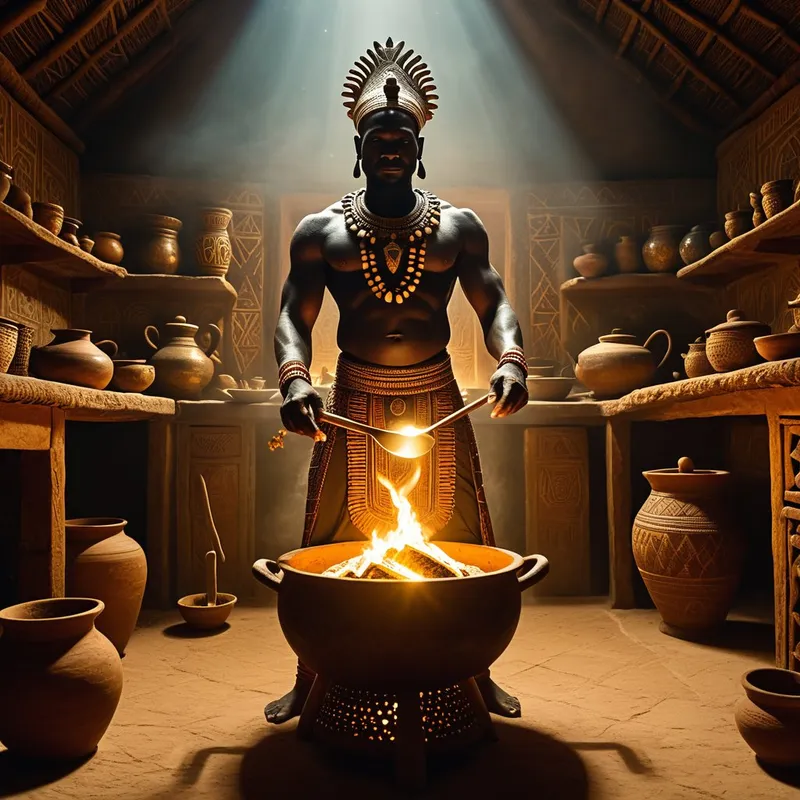
Ancestral Cooking Myth Meaning & Symbolism
A myth where memory becomes a sacred spice, transforming loss into a nourishing legacy that feeds the soul across generations.
The Tale of Ancestral Cooking
Listen. There is a story that does not begin with “once upon a time,” but with a scent on the wind. It begins in the hold of a ship that was a mouth, swallowing a people whole. In that darkness, where the salt of the sea mixed with the salt of tears, the first forgetting happened. Names, faces, the shape of the riverbank where you washed, the song your mother sang while pounding yam—all were stolen by the roaring abyss.
But the soul is a stubborn pot. It holds its heat.
In that darkness, an elder, a woman whose name the waters had taken, pressed her hands to her heart. She did not pray to gods she could no longer see; she prayed to her own hands. She began to cook. With no fire, no pot, no ingredient, she cooked. She remembered the feel of okra between her fingers, its slick promise. She recalled the exact smoky perfume of groundnut stew over a three-stone hearth. She summoned the memory of scotch bonnet’s fiery kiss and the cool, round weight of a coconut. She blended these memories in the bowl of her spirit.
And the memory became a spice. A single, luminous grain, glowing like a captured ember. She called it Àṣẹ.
She passed this grain, not from hand to hand, but from soul to soul, a silent communion in the dark. When they finally stumbled onto strange, hostile land, bound in iron, the memory-spice was all they carried. The first thing they did, when they could, was build a fire. They found what the land offered—bitter greens, strange tubers, scraps. Into the pot it went. And then, the keeper of the grain would close their eyes, reach into that inner sanctuary, and sprinkle in the memory.
The pot would sigh. The air would change. The scent that rose was not of the meager ingredients, but of home. It was the ghost of a flavor, a nourishment that fed the belly and the spirit in equal measure. It was defiance. It was a map drawn in aroma. To eat of this pot was to remember you were not just a body to be broken, but a story to be continued. The act of cooking became the altar, the cook the priest, and the shared meal the communion that stitched a broken people back into a living tapestry.
Cultural Origins & Context
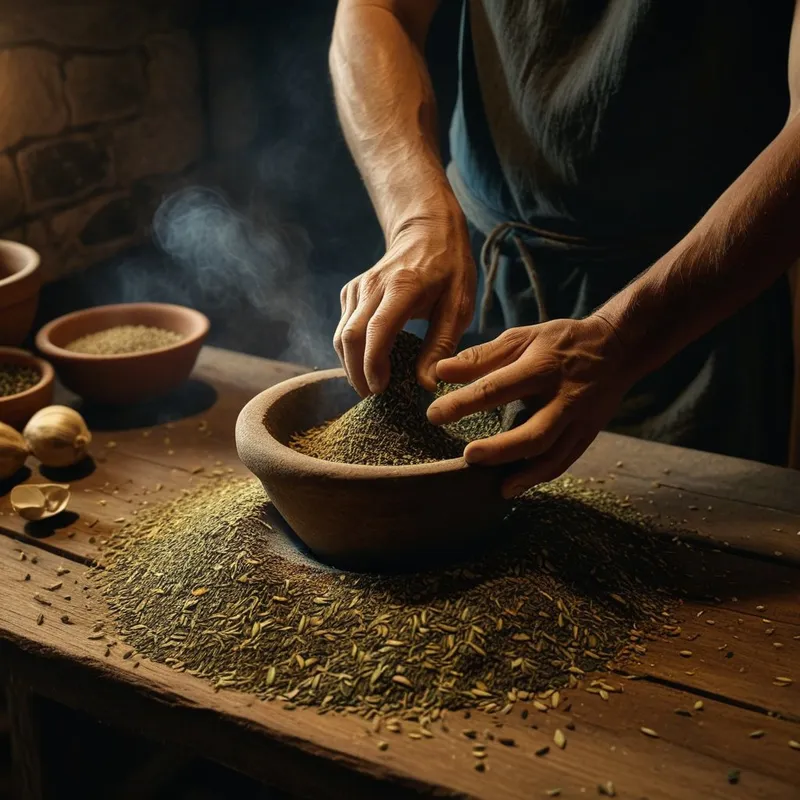
This is not a myth with a single author or a sacred text. It is a lived mythology, born in the crucible of the Middle Passage and forged on plantations across the Americas and the Caribbean. Its “bards” were the cooks—overwhelmingly women—who transformed meager rations and foraged scraps into sustenance. The myth was passed down not in epic verse, but in the silent language of hands: the pinch of thyme, the slow stir of a roux, the taste-test that judged not just flavor, but spiritual adequacy.
Its societal function was nothing less than the preservation of identity and the creation of community under conditions designed to annihilate both. In the Kongo worldview, which profoundly influenced Diaspora spirituality, the ancestors are a living presence. To prepare food with intention was to feed them, and in turn, to be guided and protected by them. The kitchen became a liminal space—a bridge between the material world of survival and the spiritual world of memory. This myth provided a framework for resilience, teaching that the most powerful magic is not escape, but profound, creative transformation of what is present.
Symbolic Architecture
At its core, the myth of Ancestral Cooking is an alchemy of memory into matter. The stolen past is the Shadow—a vast, painful repository of loss. The act of cooking is the conscious ego’s effort to engage that Shadow. The humble, available ingredients represent the constrained realities of the present, the “given” circumstances of one’s life.
The memory-spice is the transcendent function, the psychic catalyst that transforms the lead of trauma into the gold of meaning.
The Àṣẹ-grain symbolizes concentrated intention and will. It is the psychic energy required to face the Shadow and extract from it not despair, but a usable essence. The pot is the vessel of the Self, where opposites (past/present, loss/survival, memory/ingredient) are held together under the heat of attention. The resulting meal is the symbol of the integrated psyche—nourishing, whole, and capable of sustaining life and community. The cook is the archetypal Creator, who does not create ex nihilo (from nothing), but from the broken pieces of history.
The Dreamer's Resonance
When this myth stirs in the modern dreamer, it often manifests as dreams of kitchens, forgotten recipes, or feeding others. The somatic experience is crucial: the dreamer may wake with a phantom taste on their tongue, a profound sense of hunger, or the visceral feeling of stirring a pot.
Psychologically, this signals a process of reclaiming personal and ancestral history. The dream kitchen is the psyche’s workshop. Searching for a lost ingredient represents the search for a missing part of one’s identity or personal history. Dreaming of feeding a crowd with a meager meal points to the dreamer’s attempt to nourish their community or their own multifaceted psyche with limited emotional or spiritual resources. The presence of a guiding, faceless elder figure is the Senex or ancestral archetype emerging, offering the “spice” of wisdom—if the dreamer is willing to do the hard, hot work at the stove.

Alchemical Translation
For the individual, the myth models the entire journey of individuation. We all sail in our personal ships of forgetting, disconnected from our inner origins. Our traumas, family secrets, and cultural dislocations are the “strange land.”
The first step is to acknowledge the hunger—the soul’s craving for its own authentic flavor.
The “available ingredients” are our conscious personality, our wounds, our daily life. The alchemical work begins when we dare to “build a fire”—to apply sustained, focused attention (therapy, art, meditation, deep reflection) to our inner world. We must then “find the memory-spice,” which is the painful yet necessary process of confronting our personal and inherited Shadow. This is the nigredo, the blackening, the descent into the dark hold of our own history.
The act of “sprinkling it in” is the sacred integration. It is not about being consumed by the past, but using its essence to transform the present. The slow simmering is the patience required for psychic change. The final “meal” is the achieved state of greater wholeness—a personality nourished by all of its history, capable of creativity and deep connection. You become both the cook and the feast, the one who transforms and the one who is transformed, sustaining yourself and your world with the hard-won recipe of your own becoming.
Associated Symbols
Explore related symbols from the CaleaDream lexicon: