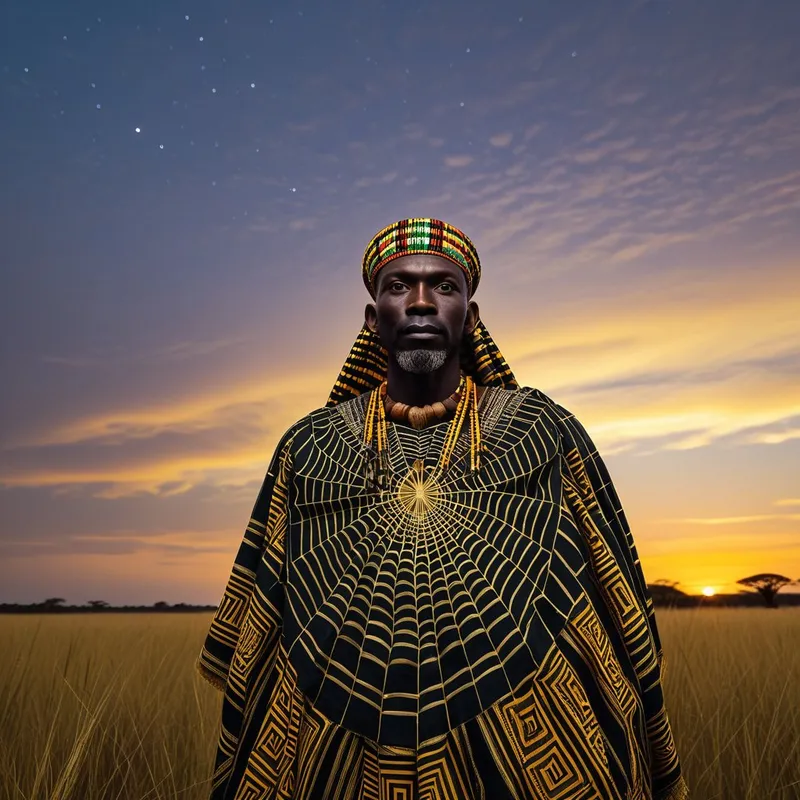
Anansi the Spider Myth Meaning & Symbolism
A cunning spider-god uses wit, not strength, to claim the world's stories, embodying the creative power of the marginalized and the trickster's transformative role.
The Tale of Anansi the Spider
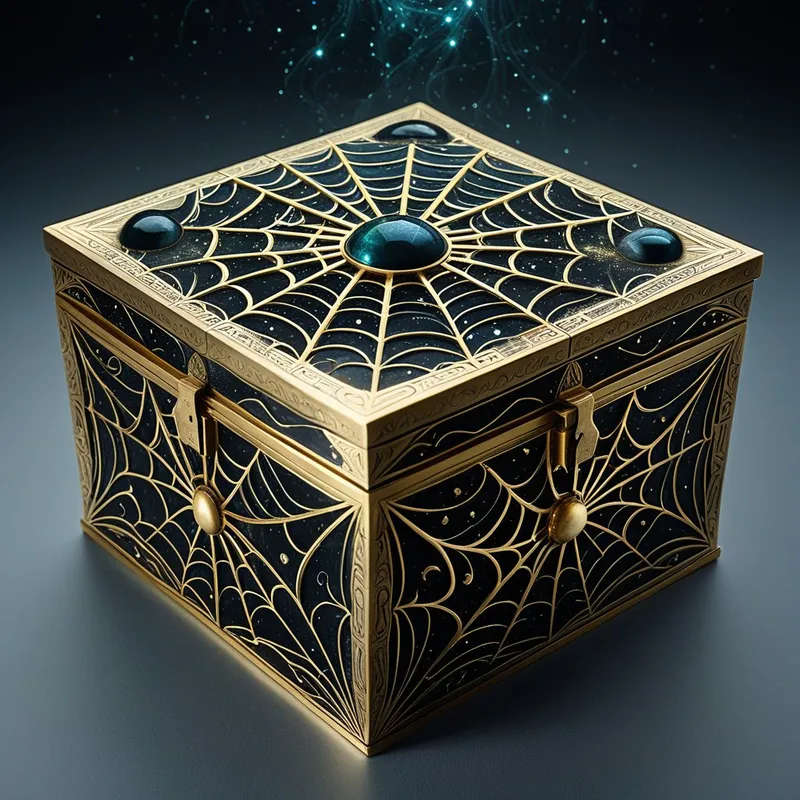
In the time before time, when the world was still soft and the sky was close enough to touch, all the stories of the world belonged to Nyame, the Sky Father. They were not for the ears of humans or the creatures of the earth. They were kept in a great brass box, high in the heavens, and the world below was a quieter, simpler place.
But in the forests of what would become Ghana, there lived a being of great ambition and even greater cunning: Anansi. He was not large like the elephant, nor strong like the leopard. He was a spider, small and seemingly insignificant, but his mind was a labyrinth of clever schemes. He looked up at Nyame’s glittering kingdom and felt a deep hunger—not for food, but for the stories. He knew that whoever held the stories held the true power, the wisdom to make men laugh, weep, and understand their own hearts.
So Anansi spun a single, impossibly long thread and climbed to the court of Nyame. The Sky God looked down upon the tiny petitioner and laughed a sound like distant thunder. "You wish to buy my stories, Anansi? The price is not gold or grain. Bring me Onini the Python, who is so long he can be measured by no man. Bring me Osebo the Leopard, whose teeth are like daggers. Bring me the Mmoboro Hornets, whose sting brings madness, and bring me Mmoatia the Fairy, who is invisible and never seen. Do this, and the stories are yours."
The creatures of the forest heard this and shook their heads. It was an impossible task, a divine joke. But Anansi did not despair. He scuttled back to earth, his eight eyes gleaming with plots.
First, he went to his wife, Aso, and whispered. Then, he found Onini the Python stretched beside a path. "Great Python," Anansi said, "there is a argument between my wife and I. She says you are shorter than this palm branch. I say you are longer. Will you let us measure you to settle it?" Vain and curious, Onini agreed to stretch out straight beside the branch. As he did, Anansi quickly tied him to the branch with silken cords. "Thank you for helping me settle the argument," Anansi said, carrying the bound python to Nyame.
Next, he dug a deep pit on the leopard’s path. When Osebo fell in, Anansi offered a weak vine to help him out. As the leopard climbed, Anansi quickly lowered a strong rope. Grateful, Osebo grabbed it, only to be hoisted up and trapped in a web-sack. "I am helping you, great Leopard," Anansi chittered, delivering him to the sky.
For the hornets, Anansi took a calabash of water and poured some over himself and some over a large leaf. He called to the hornets, "Is it not raining? Why stay in your exposed nest? Come into this dry calabash!" Thinking him wise, the entire swarm flew in, and Anansi sealed the opening.
Finally, for Mmoatia the Fairy, Anansi carved a wooden doll and smeared it with sticky sap. He placed it by a stream with a bowl of pounded yam. When the invisible fairy came to eat, her hands stuck fast. She kicked, and her feet stuck. She cried out, and Anansi, who had been waiting, gently wrapped her in his web.
One by one, the impossible captives were laid before Nyame. The Sky Father’s laughter ceased. He looked at the small, triumphant spider and saw not size, but immense cleverness. True to his word, Nyame opened the great brass box. He poured all the stories—of heroes and fools, of creation and trickery, of love and loss—not down to a king or a warrior, but down to Anansi the Spider. And from that day, all stories belong to Anansi, and he shares them with all who have the wit to listen.

Cultural Origins & Context
The myth of Anansi is rooted deeply in the oral traditions of the Akan people of Ghana and the Ivory Coast. He is known as Kweku Anansi, with "Kweku" meaning Wednesday, the day of his birth according to Akan tradition. This was not a myth confined to ritual priests; it was a living, breathing narrative currency of the people. Stories of Anansi were told in the evening by grandmothers, by hunters around fires, and by parents to children. They functioned as both entertainment and essential social pedagogy.
Through Anansi’s exploits—his triumphs and, crucially, his frequent failures and humiliations—complex societal values were transmitted. His tales taught lessons about the power of intelligence over brute force, the importance of resourcefulness, and the potential dangers of greed and over-cleverness. The stories traveled across the Atlantic during the transatlantic slave trade, transforming and enduring in the Caribbean and the American South as "Aunt Nancy" or "Anansi stories," becoming a vital vessel for preserving cultural identity, covertly critiquing power structures, and asserting psychological resilience under oppression.
Symbolic Architecture
Anansi is the quintessential trickster archetype, a psychological force of chaos and creativity. He symbolizes the underdog principle, the marginalized intelligence that must use cunning to navigate a world of established, overwhelming power (Nyame, the python, the leopard).
The web is not a trap, but a mind; each silken strand a thought, a possibility, a path through an impossible world.
His spider form is profoundly symbolic. The web represents the interconnected network of society, communication, and fate itself. Anansi is both the weaver and a node within the web, demonstrating that influence comes not from central authority but from strategic connection and manipulation of the existing threads of relationship and circumstance. The act of winning the stories is the ultimate alchemical goal: the transformation of hidden, hoarded knowledge (Nyame’s box) into communal, circulating wisdom. Anansi does not destroy the powerful creatures; he captures them through understanding their natures—the python’s vanity, the leopard’s desperation, the hornets’ fear, the fairy’s hunger. This reflects a deep psychological truth: we integrate our own overpowering "beasts" (complexes) not by fighting them head-on, but by out-thinking them, by understanding their hidden logic.
The Dreamer's Resonance
When the pattern of Anansi weaves its way into modern dreams, it often signals a confrontation with a seemingly insurmountable problem or power structure in the dreamer’s waking life. This could manifest as dreaming of being very small in a room of giants, or of being entangled in a complex, sticky web that is also somehow a map or a circuit board.
The somatic feeling is one of constraint paired with latent potential—a frustrating puzzle that holds its own solution. Psychologically, the Anansi dream asks: Where are you relying on brute force or feeling powerless, when what is required is a shift in perspective, a clever re-framing? The dream may present absurd or impossible tasks (the "capture" of a leopard, the "measuring" of a python), mirroring life’s overwhelming challenges. The Anansi energy within the psyche is activating, urging the dreamer to stop struggling against the scale of the problem and start looking for the leverage point, the unspoken rule to bend, or the vanity of the opponent to exploit. It is the dream of the underdog preparing to use wit as a weapon and a tool.

Alchemical Translation
The individuation process, the journey toward psychic wholeness, is not a heroic conquest but often a trickster’s journey. It requires the Anansi-within to outmaneuver the tyrannical, outdated structures of the personal shadow and the collective archetypes that hold us captive.
The first act of self-creation is not to build a fortress, but to steal the stories that have been told about you, and begin to spin your own.
Nyame’s hoarded box represents the latent, unused potential of the Self, locked away by the inner "sky god" of rigid morality, parental complexes, or cultural conditioning. The four impossible creatures are the powerful, autonomous complexes that guard this treasure: the crushing Python of obligation, the predatory Leopard of rage or ambition, the swarming Hornets of anxiety, and the elusive Fairy of intuition or spirit we can never seem to grasp. The heroic ego cannot defeat them. The Anansi principle must.
The alchemical work is in the clever, non-violent capture. To bind the Python of obligation, one must "measure" it—examine its true length and hold, seeing its vanity. To trap the Leopard of rage, one must offer it a "way out" that actually leads to containment and conscious integration. This is the transmutation: turning brute, unconscious forces into conscious, narrative assets. When all four are presented to the higher Self (Nyame), the box opens. The stories—the right to author one’s own meaning, to understand one’s own life not as a series of battles lost but as a clever, weaving narrative—are claimed. We become, like Anansi, not rulers of a static kingdom, but weavers and tellers of our own ever-unfolding tale.
Associated Symbols
Explore related symbols from the CaleaDream lexicon: