
Anahita Goddess of Water Myth Meaning & Symbolism
The luminous goddess of all waters, source of life, cosmic order, and the purifying flow that cleanses the soul and nourishes the world.
The Tale of Anahita Goddess of Water
Listen. Before the first king placed his foot upon the earth, before the first city raised its towers to the sun, there was the sound of water. Not the crash of the storm-tossed sea, but the deep, resonant hum of a celestial spring, flowing from the heart of the world. From this sound, she emerged.
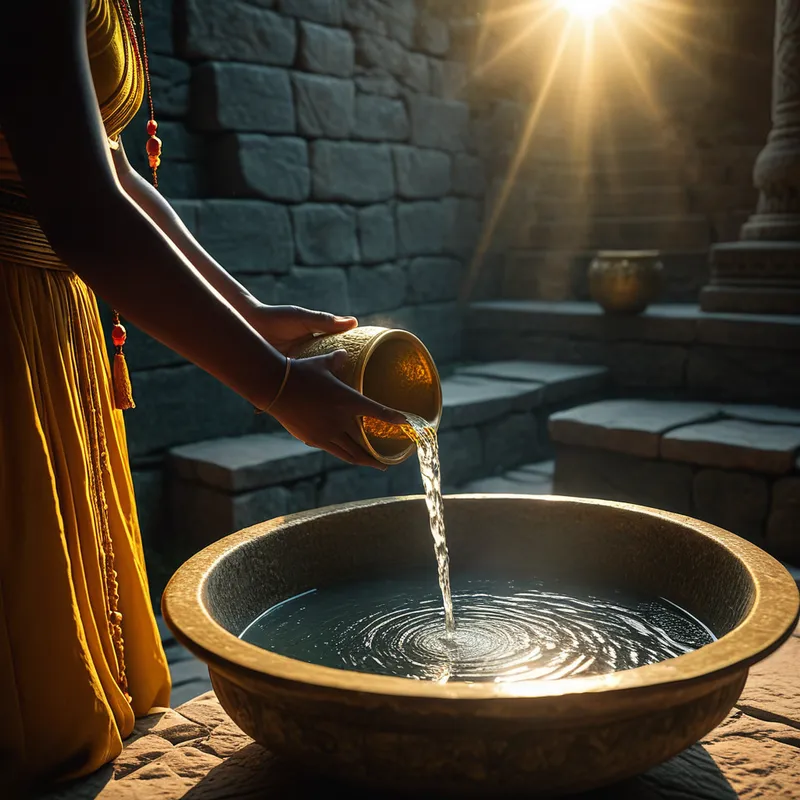
She was Anahita, the Immaculate One. Her form was not born of clay or fire, but of the pure, flowing essence of life itself. She stood upon the banks of the mythical river Aredvi Sura, a torrent of stars and milk and honey that poured from the peak of the cosmic mountain Hara Berezaiti. Her robe was woven from three hundred beaver pelts, creatures of the water, and upon her head rested a diadem of a hundred stars, with eight rays and a hundred jewels. In her hands, she bore the sacred vessel.
Her chariot, wrought of gold and silver, was drawn by four white, wind-crested horses: Wind, Rain, Cloud, and Sleet. Wherever she guided her chariot across the vault of the sky, the parched earth sighed and opened. Barren fields drank deeply and turned emerald. Wilted blossoms lifted their faces. The rivers, her earthly daughters, swelled with her grace and ran singing to the seas.
But the world was not only fertile soil; it was also a field of conflict. The great hero Thraetaona, destined to battle the three-headed dragon Aži Dahāka, came to her banks. He stood, a mortal man facing an immortal terror, and called upon her name. He did not ask for a sword of flame or armor of stone. He asked for farr—the divine glory, the royal splendor that legitimizes and empowers. He asked for the strength that comes not from brute force, but from rightful sovereignty and purity of purpose.
Anahita heard. The waters of Aredvi Sura did not merely ripple; they parted. From the luminous depths, she bestowed upon him not a weapon, but a blessing—a radiant, intangible mantle of authority. It was the power of the pure source, the unassailable legitimacy of the life-giver. Armed with this farr, Thraetaona confronted the dragon, the embodiment of drought, tyranny, and chaos. The battle was not just of flesh and scale, but of essence. The dragon’s fiery breath met the hero’s aura of ordained, life-affirming power. And the dragon was bound, its desiccating threat imprisoned beneath the very mountain from which Anahita’s waters sprang.
Thus, the cosmic order was maintained. The waters continued to flow. The goddess, in her ceaseless, graceful circuit, became the promise whispered by every spring, the power felt in every river’s current, the purity sought in every ritual ablution. She was the ever-flowing resolution to the eternal conflict between sterility and life, between chaos and rightful order.
Cultural Origins & Context
The veneration of Anahita spans millennia, evolving from an Indo-Iranian water deity into a central figure in the Zoroastrian pantheon of the Achaemenid, Parthian, and Sassanian empires. Her primary scripture is the Aban Yasht, a powerful hymn that preserves her mythic grandeur. Unlike abstract principles, Anahita was worshipped tangibly at open-air temples centered on natural springs or constructed water channels (aban bars). These were not dark, enclosed spaces, but places of light, flowing water, and natural beauty.
Her priests and priestesses performed rituals of purification and libation, pouring sacred water (zohr) to invoke her blessings for the king, the army, and the fertility of the land. She was the divine legitimizer of sovereignty; kings sought her favor to secure their farr and, by extension, their right to rule. This societal function positioned her at the nexus of spiritual authority, political power, and ecological survival. Her myth was not merely told; it was enacted daily at countless springs and temples, weaving the sacred into the very infrastructure of life and empire.
Symbolic Architecture
Anahita is not merely a personification of a natural element. She is the archetypal blueprint of the Source itself. Her symbolism constructs a profound psychology of the soul's origin and sustenance.
The soul is not a static entity, but a flowing current, born from a pure spring and seeking always to return to its clarity.
Her Aredvi Sura represents the unconscious in its primordial, nourishing state—the deep, psychic wellspring from which consciousness emerges. The beaver-fur robe symbolizes a practical, protective wisdom drawn from the natural world and its creatures. The four horses—Wind, Rain, Cloud, Sleet—are the dynamic, sometimes turbulent, emotional and instinctual forces that propel the psyche forward, harnessed by the guiding intelligence of the Self.
The central act of the myth, the bestowal of farr upon Thraetaona, is key. Farr is not earned through labor; it is conferred through alignment. It symbolizes the sense of authentic purpose and personal authority that flows into an individual when they are in right relationship with their own inner source—when their actions are "clean" and in service of life, not tyranny or sterility (the dragon). The dragon’s binding signifies that chaos and psychic drought are not eradicated, but contained and managed by this aligned, sourced power.

The Dreamer's Resonance
When the pattern of Anahita surfaces in modern dreams, it often signals a profound somatic and psychological process of seeking the source. The dreamer may find themselves at a beautiful but neglected spring, trying to clear away debris to let the water flow. They may be swimming in deep, clear waters with a sense of immense peace, or conversely, be parched in a desert, searching for a hidden well.
These dreams point to a relationship with the inner wellspring of vitality, creativity, and emotional truth. A blocked spring suggests a disconnection from this source—perhaps through over-intellectualization, emotional neglect, or life choices that have led to a psychic "drought." The act of cleaning the spring is the soul's work of removing the obstacles of old grief, unresolved shame, or adaptive masks that silt up the natural flow of feeling.
Dreams of receiving a vessel of water, or of a majestic, nurturing feminine figure, can indicate the beginning of a restorative process. The psyche is initiating a ritual of self-blessing, conferring its own farr—a permission to exist, to create, to lead one's own life from a place of inherent worth, not earned merit.

Alchemical Translation
The myth of Anahita models the alchemical process of ablutio—the washing—a stage of purification essential for the individuation journey. It is not a fiery, dramatic transformation, but a patient, persistent return to clarity.
Individuation begins not with adding, but with subtracting; not with building the tower, but with cleansing the waters from which the tower must rise.
The modern individual embarks on this transmutation by first identifying their personal Aži Dahāka: the internal forces of aridity—cynicism, joylessness, emotional constipation, or a tyrannical inner critic that hoards energy. The battle is fought not by direct assault, but by turning toward the source. This is the alchemical work: to perform the daily rituals that honor the inner spring. This could be through creative expression that feels like "flow," through somatic practices that release held emotion, through therapy that clears psychic debris, or simply through dedicated periods of reverie and silence.
The conferring of farr is the experience of psychic integration that follows such purification. As the waters run clear, one's actions begin to feel inherently grounded and authoritative. One's "rule" over one's own life—the kingdom of the self—gains legitimacy. The bound dragon means the destructive impulses are not gone, but their power to desiccate the soul is neutralized by the constant, renewing presence of the inner Anahita, the Self as the eternal, nourishing source. The ultimate transmutation is from a state of seeking validation from external wells to becoming a sovereign, flowing source unto oneself.
Associated Symbols
Explore related symbols from the CaleaDream lexicon:
- Water — The primary essence of Anahita, representing the primordial source of life, the fluid unconscious, emotional truth, and the constant process of purification and renewal.
- Goddess — The embodiment of the nurturing, creative, and ordering feminine principle, specifically as the source of sovereignty (farr) and cosmic legitimacy.
- River — The celestial Aredvi Sura, symbolizing the directed flow of psychic energy from the unconscious source into the world of consciousness and form.
- Fertility — The direct result of Anahita's grace, representing not just biological fecundity but the flourishing of ideas, relationships, and the soul's creative potentials.
- Purification — The core function of her myth and worship, modeling the psychological process of cleansing the psyche of obstructive complexes to restore natural flow.
- Source — The sacred spring on the cosmic mountain, representing the origin point of the individual soul and the deep, inner wellspring of authentic being.
- Vessel for Water — The sacred cup or basin held by Anahita and used in ritual, symbolizing the conscious ego or the physical body that must receive and contain the divine flow.
- Horse — The four wind-crested steeds of her chariot, representing the powerful instinctual and emotional energies that are harnessed in service of the life-giving journey.
- Star — The jewels of her crown, connecting her flowing waters to the celestial order and the higher, guiding principles of the cosmos.
- Mountain — The Hara Berezaiti, the axis mundi from which her waters spring, symbolizing the lofty, central point of the psyche where the divine source emerges.
- Dragon — The Aži Dahāka bound by her bestowed power, representing the chaotic, desiccating forces of the psyche that are subdued by alignment with the true source.
- Order — The cosmic and social harmony maintained by her flowing waters and conferred farr, representing the inner sense of rightness and authentic structure that emerges from a purified soul.