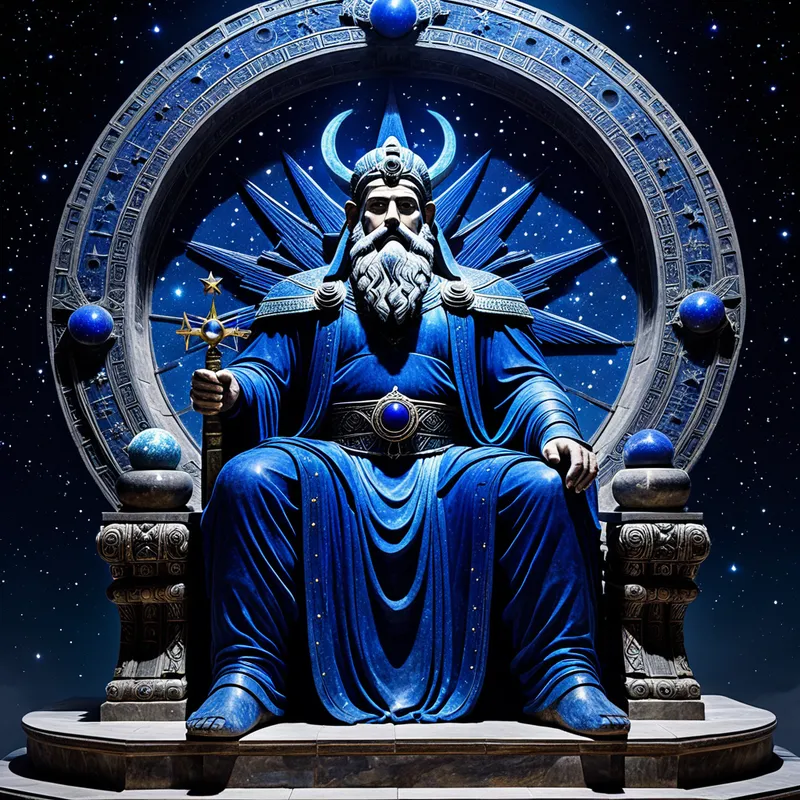
An the Sky God Myth Meaning & Symbolism
The story of An, the primordial sky, who separated heaven and earth, established cosmic order, and receded into a distant, silent authority.
The Tale of An the Sky God
In the beginning, there was no name for sky, nor a word for earth. There was only the Abzu, the sweet waters, and the Tiamat of salt, mingled in a single, dark, and formless deep. From this union, the first mountains were born, and upon them, the universe was conceived.
And the universe was An. Before the sun learned its path, before the moon knew its phases, An was. He was not a god in a place; he was the place itself—the boundless, star-seeded dome, the upper firmament of pure, terrifying potential. His consort was Ki, the solid ground, the fertile flesh of the world. For an age that cannot be measured, An and Ki were one, a single, mountainous mass of sky and soil, heaven and earth pressed together in a silent, fertile embrace. All the younger gods, the Anunnaki, stirred within this unity, crowded and restless.
Then came the breath of change, not a storm, but a decision woven into the fabric of being. It was the will of An himself, or perhaps the will of his first-born, Enlil. The story whispers both. From the core of the unified mass, a force like a great, silent wind began to rise. It was the spirit of separation, of definition. An, the sky, began to lift. It was a slow, cosmic sigh. He drew himself upward, not in flight, but in an eternal, majestic recession.
The sound was the groaning of continents settling and the music of the first space being created. Where An’s body had lain upon Ki, now there was the Lil, the atmosphere, the breathable world. Ki remained below, now defined, now knowable as the tangible earth. An receded to his proper domain, becoming the high, vaulted ceiling of the world, adorned with the fixed stars as his unchanging decrees. He took his seat upon the Dulkug, the cosmic mountain, the pivot of the sky. In his hands, he clasped the Rod and Ring, the symbols of just measure and eternal rule.
And there he remains. He is the silent witness, the distant father. The storms are his children’s quarrels; the rain is his distant blessing. He established the Me, the divine laws that govern all things from kingship to basket-weaving, and then he entrusted the active rule of the world to Enlil, and later, to the clever Enki. An became the source of all authority, yet he exercises none directly. He is the numinous, untouchable height, the origin point of all order, gazing down upon the bustling, suffering, glorious world he made possible by stepping away.
Cultural Origins & Context
This myth is etched into the very foundation of human civilization, originating in the city-states of ancient Sumer in the 3rd millennium BCE. It was not a single story in a book, but a living cosmological truth embedded in temple rituals, royal hymns, and the epic narratives like the Enuma Elish. The tellers were the gala priests and the scribes in the towering ziggurats, who sought to explain and sanctify the structure of their universe.
Its societal function was profound. It established a cosmic blueprint for hierarchy and order. Just as An, the high king, delegated authority to Enlil, the earthly king (Lugal) was seen as ruling by An’s decree, mediating between the distant divine will and the people. The myth justified social structure, kingship, and the very architecture of their world—the ziggurat was a literal attempt to reach the Dulkug, to bridge the chasm An’s withdrawal had created.
Symbolic Architecture
An represents the archetype of the primordial father and the principle of cosmic order. He is not a god of dynamic action, but of static, overarching authority. His primary act—separation—is the fundamental act of consciousness.
Creation is not merely making something new; it is the act of distinguishing one thing from another, of drawing a boundary in the chaos. An’s withdrawal is the first act of definition, giving birth to the space where life and experience become possible.
Psychologically, An symbolizes the superordinate principle of the Self in its most transcendent form. He is the internalized image of ultimate authority, the source of the inner laws (Me) that govern our psyche—our core values, ethics, and sense of cosmic justice. His distance reflects a psychological truth: the ultimate governing center of the psyche is often remote, silent, and not involved in daily conflicts. It simply is, providing the unchanging "sky" under which the drama of the ego (the active gods like Enlil) plays out.
The Dreamer's Resonance
When this myth stirs in the modern soul, it often manifests in dreams of vast, empty skies, distant thrones, or silent, authoritative figures who observe but do not intervene. One may dream of a magnificent but abandoned council chamber, or of a powerful but absent father. The somatic feeling is one of awe mixed with a profound sense of existential loneliness or cosmic scale.
This dream pattern signals a process of encountering the inner ruler archetype in its transcendent, non-personal form. The psyche is grappling with the concept of a higher order, a foundational law, or a distant source of meaning. It may reflect a life phase where one is seeking a larger framework for their existence, or feeling the weight of their own authority and the need to establish inner order. The "withdrawal of An" in a dream can mirror a necessary psychological step: the distancing from a suffocating parental complex or the creation of internal space for one's own sovereignty to develop.
Alchemical Translation
The individuation process modeled by An’s myth is not one of heroic conquest, but of profound recognition and alignment with a pre-existing, majestic order. The alchemical work is in the separation and the acceptance of distance.
First, the separatio: the individual must perform An’s act within themselves. This means consciously differentiating the "heaven" of one's spiritual aspirations, values, and inner laws from the "earth" of one's instincts, personal history, and bodily existence. It is the difficult work of creating inner space (Lil) between what is eternally true for the soul and what is temporally true for the personality.
The goal is not to become the distant, silent sky-god, but to build a ziggurat of consciousness that can, at times, touch that realm and bring its decrees back down to earth.
Then, the stabilitas: learning to let the supreme authority within recede to its proper, distant throne. This is the transmutation of the ego’s need for control. One does not become the ultimate ruler; one learns to rule one's personal domain (the ego) in accordance with the remote, often silent, directives of the Self (An). The triumph is a quiet sovereignty, where one’s actions are in harmony with a cosmic pattern one did not create but can consciously embody. The psychic metal lead—the confusion of being fused with undifferentiated parental or traditional authority—is transmuted into gold: a personal life structured by a transcendent, impersonal order that grants true freedom within its vast, starry bounds.
Associated Symbols
Explore related symbols from the CaleaDream lexicon:
- Sky — The primary manifestation of An, representing transcendent authority, cosmic order, and the vast, impersonal container of all existence.
- Mountain — Symbolizes the Dulkug, the axis mundi connecting heaven and earth, and the throne of the distant god.
- Crown — The emblem of ultimate, divinely-sanctioned kingship and authority that flows from An to the earthly ruler.
- Order — The fundamental Me established by An, the cosmic laws that structure reality and human society.
- Father — An as the primordial, archetypal father figure, the source of legitimacy and the often-distant source of law.
- Temple — The human attempt to reach the divine through the ziggurat, a architectural echo of the mountain-throne of An.
- Circle — Reflects the wholeness of the cosmos An oversees and the unbroken, eternal nature of his rule and the celestial spheres.
- Stone — The enduring, unchanging nature of An's decrees and the foundation of the cosmic order he instituted.
- Star — The fixed points in An's celestial dome, representing the eternal, unchanging laws and decrees of heaven.
- Thunder — The audible manifestation of divine authority in the atmosphere, often associated with Enlil, but originating from the celestial realm of An.
- Sumerian Tablet — The medium upon which the laws (Me) and stories of An's order were recorded, making the cosmic knowledge tangible.