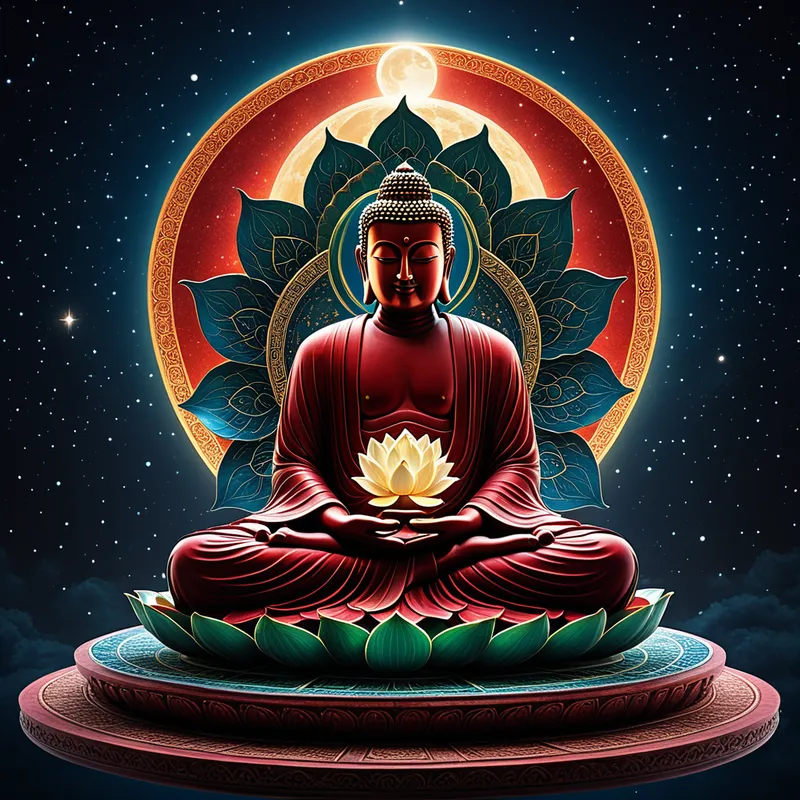
Amitabha Pure Land Myth Meaning & Symbolism
The story of Amitabha Buddha, who vowed to create a radiant realm accessible to all who call his name with sincere faith, offering liberation from suffering.
The Tale of Amitabha Pure Land
In a time beyond time, when the universe was a tapestry of countless worlds, there lived a king. His heart, though noble, was heavy with the sight of the world's endless sorrow—the cycle of birth, aging, sickness, and death that gripped all beings in its iron wheel. He renounced his throne, casting aside his crown for the simple robes of a monk, and took the name Dharmakara.
For eons, Dharmakara studied the teachings of the Buddha Lokesvararaja, his mind becoming a vast ocean of wisdom. He wandered through Buddha-fields, realms of unimaginable purity crafted by the compassion of other enlightened ones. Yet, a profound question burned within him: Could there be a realm even more sublime, a path even more accessible, for beings lost in the thick fog of their own confusion and pain?
Standing before Buddha Lokesvararaja and the entire cosmic assembly, Dharmakara’s resolve crystallized. His voice, resonant with the power of countless lifetimes of practice, did not speak—it thrummed through the fabric of reality itself. He made a vow. Not one, but forty-eight great vows. He vowed that if he attained perfect Buddhahood, his Buddha-land would surpass all others in beauty and ease. He vowed that any being, upon hearing his name with sincere faith and aspiration, and reciting it even ten times, would be reborn there. He vowed that in his land, no one would hear the names of the three lower realms of suffering. He vowed that all who were born there would dwell in a state of unwavering progress toward enlightenment, their bodies made of light, their minds free from distraction, nourished by the very Dharma that fell like rain.
For countless more ages, Dharmakara labored. He accumulated immeasurable stores of merit and wisdom, purifying his mind of the subtlest obstructions. And then, the moment of fulfillment dawned. Dharmakara the monk was no more. In his place stood Amitabha, the Buddha of Boundless Light, his body the color of a radiant sunset, his lifespan measureless, his compassion infinite. And his vow manifested as a realm: Sukhavati.
Sukhavati is not a place as we understand it. It is a dimension woven from the very fabric of enlightened intention. The ground is soft and yielding, made of gold and jewels. Lakes of seven gems, filled with waters of eight perfect qualities, are fringed with sands of gold. Trees of lapis lazuli and coral rise in ordered rows, their leaves and branches rustling with teachings tailored to each listener. Celestial birds sing the sounds of the Dharma. A gentle breeze carries the scent of heavenly flowers. There is no suffering, no evil, not even the word "no." Those reborn there emerge not from a womb of pain, but from the heart of a lotus blossom that opens upon a serene lake, their forms luminous, their minds instantly receptive to truth. And at the center of it all, upon a lion-throne supported by peacocks, Amitabha presides, radiating a light so profound it illuminates all Buddha-fields, constantly calling, constantly welcoming, his ancient vow an ever-open door.
Cultural Origins & Context
The myth of Amitabha and Sukhavati, while central to many East Asian Buddhist traditions, holds a distinct and vital place within Tibetan Buddhism. It arrived via the great translation movements from India, finding fertile ground in the Tibetan spiritual landscape. Here, it was not merely a devotional story but was integrated into the highest philosophical and tantric systems.
The myth is preserved in sutras like the Sukhavativyuha, but in Tibet, its transmission was often oral and experiential. Lamas would teach it as a profound upaya, or skillful means, for those daunted by the complex path of Vajrayana. Its societal function was multifaceted: it provided a tangible object of faith and aspiration for the common person, a profound meditation object for the yogi, and a sophisticated philosophical teaching on the nature of mind and reality for the scholar. The practice of nembutsu or buddhanusmriti (mindfulness of the Buddha) became a cornerstone of devotional practice, often intertwined with complex visualizations described in texts like the Bardo Thodol, where Amitabha appears as a crucial figure in the post-death state, offering a path to liberation.
Symbolic Architecture
The Pure Land is not a geographical destination to be reached after death, but a symbolic map of the enlightened mind's intrinsic qualities. Amitabha, the Buddha of Infinite Light, represents the unconditioned, radiant nature of consciousness itself—our own buddha-nature, which is inherently luminous and compassionate.
The vow is the architecture of intention, and Sukhavati is the landscape that intention builds when it is utterly purified of self-concern.
Dharmakara's forty-eight vows symbolize the complete dedication of one's entire being—body, speech, and mind—toward the welfare of others. His transformation into Amitabha signifies the alchemical moment when personal aspiration (bodhicitta) matures into its full fruition as enlightened activity. Sukhavati's features are not mere fantasy; they are direct symbols. The jeweled ground is the foundation of unwavering faith and wisdom. The lakes are the mind's clarity. The wish-fulfilling trees represent the Dharma's adaptability to each being's needs. Rebirth from a lotus signifies spiritual birth unstained by the mud of karmic confusion.
The Dreamer's Resonance
When this myth surfaces in modern dreams, it often speaks to a profound psychological process of seeking refuge and integration. To dream of a radiant, peaceful land inaccessible by ordinary means may indicate a deep yearning for an inner sanctuary—a part of the psyche that feels untouched by life's trauma, chaos, or "samsara."
Dreaming of calling a name into a void and receiving an answer of light can reflect a somatic reaching for a core, authentic self beyond the constructed ego. It is the psyche's intuition of a fundamental wholeness that exists beneath layers of shadow, anxiety, and fragmentation. The dream may emerge during periods of burnout, grief, or existential crisis, acting as a compensatory image from the Self, offering a vision of healing and unconditional acceptance. The somatic sensation is often one of deep relief, a release of tension, as if a burden of self-maintenance has been lifted.

Alchemical Translation
The myth of Amitabha's Pure Land models the individuation process as a journey from the personal, striving ego of Dharmakara to the transpersonal, radiant Self of Amitabha. Dharmakara represents the heroic ego that recognizes the suffering of the personal and collective psyche and makes a solemn vow to transform it. This vow is the commitment to the therapeutic or spiritual journey itself.
The alchemy occurs in the space between the vow and its fulfillment—the long, often dark work of confronting the shadow, integrating complexes, and dissolving the ego's rigid boundaries.
The "recitation of the name" is the modern equivalent of a unifying practice—be it mindfulness, active imagination, therapy, or creative work—that repeatedly aligns consciousness with its deeper, more essential nature. It is the act of remembering who we are beneath the noise. Sukhavati, then, is the state of psychic integration achieved. It is not a static paradise but a dynamic inner landscape where all aspects of the psyche are harmonized. The "jewels" are the integrated insights; the "Dharma-rain" is the continual flow of meaning from the unconscious to the conscious mind. Rebirth in the Pure Land symbolizes the profound shift in identity from being a sufferer trapped in personal history to being a participant in a transpersonal, meaningful process—a citizen of the liberated psyche.
Associated Symbols
Explore related symbols from the CaleaDream lexicon:
- Light — The primary essence of Amitabha, representing the innate luminosity and clarity of the fundamental mind, which dispels the darkness of ignorance and suffering.
- Lotus — Symbolizes the potential for pure enlightenment (the flower) to arise unstained from the muddy waters of samsaric existence and karmic confusion.
- Vow — The sacred promise of Dharmakara, representing the power of focused intention and compassionate resolve to architect a new reality, both spiritual and psychological.
- Landscape — Sukhavati itself is the ultimate symbolic landscape, a terrain of the mind crafted from perfected qualities like joy, clarity, and unwavering progress toward wholeness.
- Door — The name of Amitabha, recited with faith, is envisioned as an open door to Sukhavati, symbolizing an accessible threshold to a transformed state of consciousness.
- Rebirth — Not a literal reincarnation, but the psychological process of being "born anew" into a more integrated, authentic, and liberated mode of being.
- Heart — Represents the seat of sincere faith and aspiration, the inner faculty that calls out to and recognizes the radiant reality of the Pure Land within.
- Water — The serene, eight-qualitied lakes of Sukhavati symbolize the mind's potential for perfect calm, reflective clarity, and the nourishment of profound truth.
- Tree — The jeweled wish-fulfilling trees represent the growth of wisdom and the Dharma's ability to provide exactly what is needed for each individual's spiritual development.
- Bird — The celestial birds whose songs are teachings symbolize how, in a purified mind, every perception and experience naturally points toward truth and liberation.