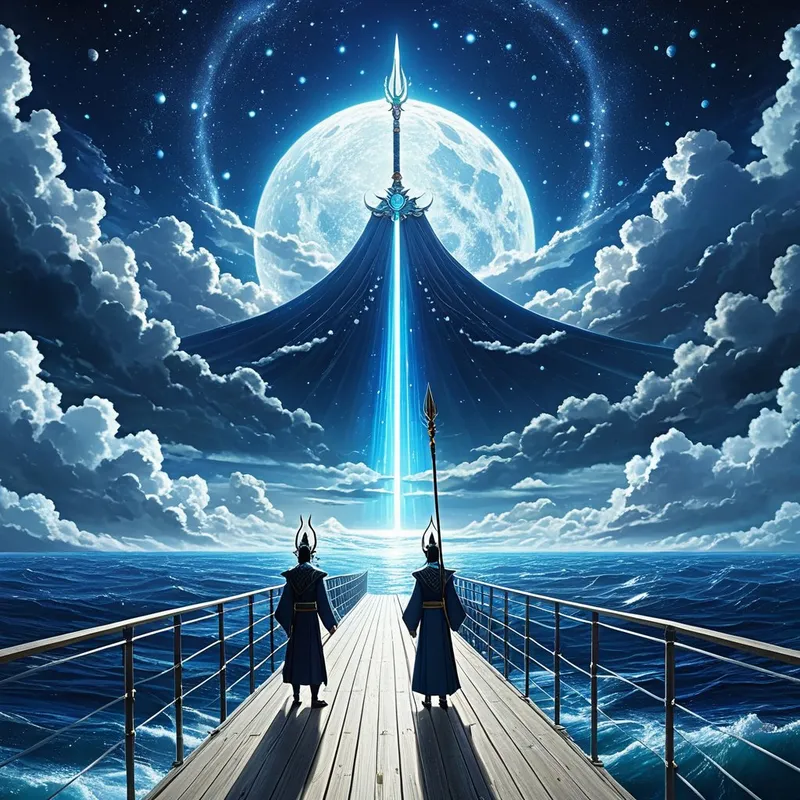
Ame-no-Nuhoko Myth Meaning & Symbolism
The myth of the celestial spear used by the primordial deities to stir the chaotic brine, from which the first solid land of Japan was born.
The Tale of Ame-no-Nuhoko
In the time before time, when the world was a formless, shifting brine, a silence heavier than any mountain lay upon existence. Above the oily, heaving sea stretched the High Plain of Heaven, and upon its border stood the Floating Bridge, a threshold between the unformed and the potential. Here, the two primordial deities, Izanagi and Izanami, were commanded to solidify the land below.
They peered into the abyss, a ceaseless, groaning churn of grey waters beneath a starless sky. No bird cried, no wind stirred—only the slow, thick lap of primordial soup against the ether. Into this pregnant void, they lowered the Ame-no-Nuhoko. It was no weapon of war, but a tool of divine artistry, its shaft of polished celestial stone, its tip adorned with jewels that caught the faint, cold light of the not-yet-sun.
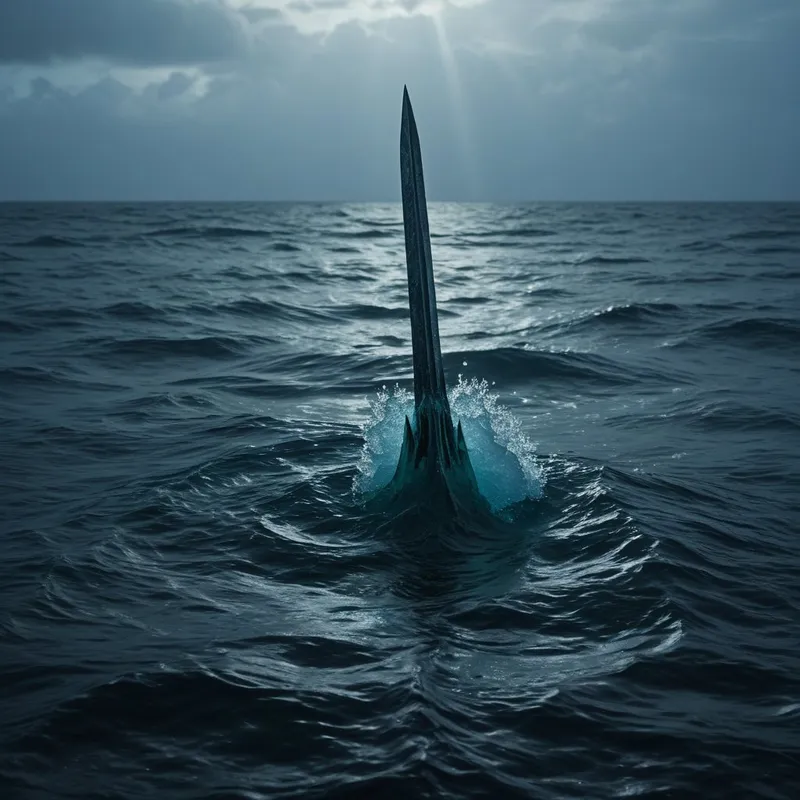
The spear-point pierced the skin of the sea. A sound like a sigh, deep and ancient, shuddered through the cosmos. Izanagi and Izanami, their hands firm upon the bridge’s rail, began to stir. They churned the brine. Around the jeweled tip, the waters resisted, then yielded, beginning to spiral—a slow, deliberate vortex in the heart of chaos. The motion was a prayer, a coaxing, a demand. They lifted the spear.
Dripping from its tip was not mere saltwater, but a substance both liquid and solid, dark and glistening. It fell back, but it clung to itself. It coagulated. Where it fell, the sea grew still and thick. Again, they lowered the spear, stirring, lifting. And again. Each withdrawal brought up more of the substance, until it accumulated, piling upon itself in the midst of the vast ocean. The endless grey was broken by a single, trembling point of solidity. The churning ceased. There, in the quiet that followed the great stirring, lay the first island, Onogoro-shima. It was a clump of earth born from the marriage of spear and sea, the first fixed point in a formless universe. Upon this newborn land, the deities descended, and the work of the world began.
Cultural Origins & Context
This foundational myth is recorded in Japan’s oldest extant chronicles, the Kojiki (712 CE) and the Nihon Shoki (720 CE). These texts were not mere storybooks but political and cosmological documents, commissioned by the imperial court to establish a divine lineage for the sovereign and a sacred geography for the nation. The tale of Ame-no-Nuhoko served as the cosmic prelude to this national history, rooting the Japanese archipelago—and by extension, its people and ruler—in a direct, intentional act of celestial creation.
Passed down by court scribes and ritualists, the myth functioned as a societal anchor. It explained the very existence of the land as a deliberate, orderly process emanating from the heavenly realm (Takamagahara). This stood in contrast to chaotic or accidental creation myths found elsewhere. The narrative established a paradigm: order is brought forth from chaos through ritualized, purposeful action—a principle that deeply informed Shinto practices, state rituals, and the perceived relationship between the human, natural, and divine worlds.
Symbolic Architecture
The Ame-no-Nuhoko is far more than a magical tool; it is the ultimate symbol of the differentiating principle. In the undifferentiated, homogenous chaos of the primordial sea (a classic symbol of the unconscious, the unmanifest, the massa confusa), the spear introduces distinction. It is the first “this, not that.” Its verticality—lowered from the bridge of heaven—represents the axis mundi, the connection between spirit (heaven) and potential matter (sea).
The act of churning is not destruction, but invocation. It is the conscious mind engaging the unconscious depths, not to conquer, but to summon form from the formless.
The jewels on its tip signify the inherent value and latent structure within chaos. The resulting island, Onogoro-shima, is the nascent Self—the first conscious complex to coalesce from the oceanic unconscious. This is not a battle myth but a creative, almost alchemical procedure. The conflict is not against a monster, but against entropy and non-being. The triumph is the birth of a point of reference, the foundational platform from which all further identity and exploration can proceed.
The Dreamer's Resonance
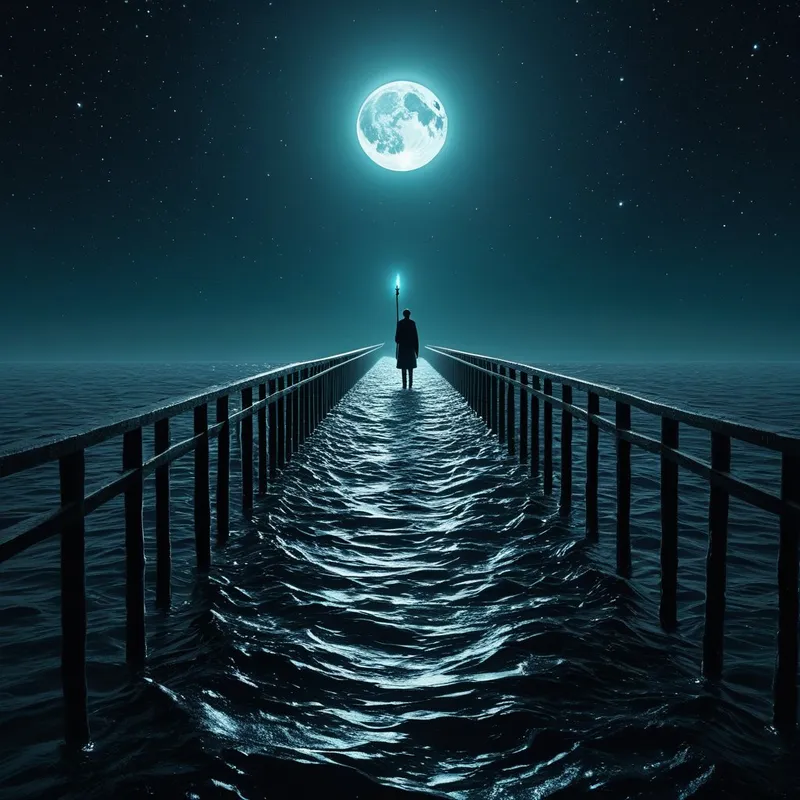
When this mythic pattern stirs in the modern psyche, it often manifests in dreams of profound beginnings or re-orientations. One might dream of standing at the edge of a vast, dark body of water—a lake, an ocean, a void. There is a tool at hand: a rod, a key, a simple stick. The dreamer feels compelled to plunge it into the depths and stir. The water may thicken, change color, or yield a strange, solid object.
Somatically, this can correlate with feelings of gestation, of something “coagulating” in one’s life—a new idea, a career path, a sense of self that is finally taking shape after a long period of fluid uncertainty. Psychologically, this dream signals the active engagement of the ego (the spear-wielder on the bridge) with the chaotic, fertile material of the unconscious (the sea). It is the psyche’s own ritual to birth a new psychic structure. The anxiety in the dream is not of danger, but of profound responsibility and the awe of creation. The dreamer is not running from a shadow but calling one forth, in order to give it land to stand on.
Alchemical Translation
For the individual on the path of individuation, the myth of Ame-no-Nuhoko models the essential first phase of psychic transmutation: the opus contra naturam, the work against nature’s state of unconsciousness. Our personal “primordial sea” is the inherited, undifferentiated state of our psyche—a mix of familial complexes, cultural conditioning, and unlived potential. To live authentically, we must perform our own churning.
Individuation begins not with a journey outward, but with a deliberate plunge inward. The spear is the focused question, the therapeutic insight, the courageous act of introspection that disturbs the tranquil surface of our habits.
The “Floating Bridge of Heaven” is the liminal, observant state of consciousness required for this work. From this vantage point, we lower our intent into the murky waters of our inner world. The churning is the often uncomfortable process of analysis, reflection, and active imagination—stirring up memories, emotions, and shadow elements we have allowed to remain fluid and unseen. The “island” that forms is the nascent, integrated complex: a clarified value, a reclaimed talent, a more cohesive sense of identity that was previously dissolved in the general brine of the psyche.
This myth assures us that creation is an act of graceful intervention, not violent conquest. The solid ground of a realized Self is not found, but formed—coagulated drop by drop from the chaos we courageously engage. Every act of conscious choice, every moment of deep reflection, is a lowering of the celestial spear, a participation in the ongoing creation of our own world.
Associated Symbols
Explore related symbols from the CaleaDream lexicon: