Amaterasu's Loom Myth Meaning & Symbolism
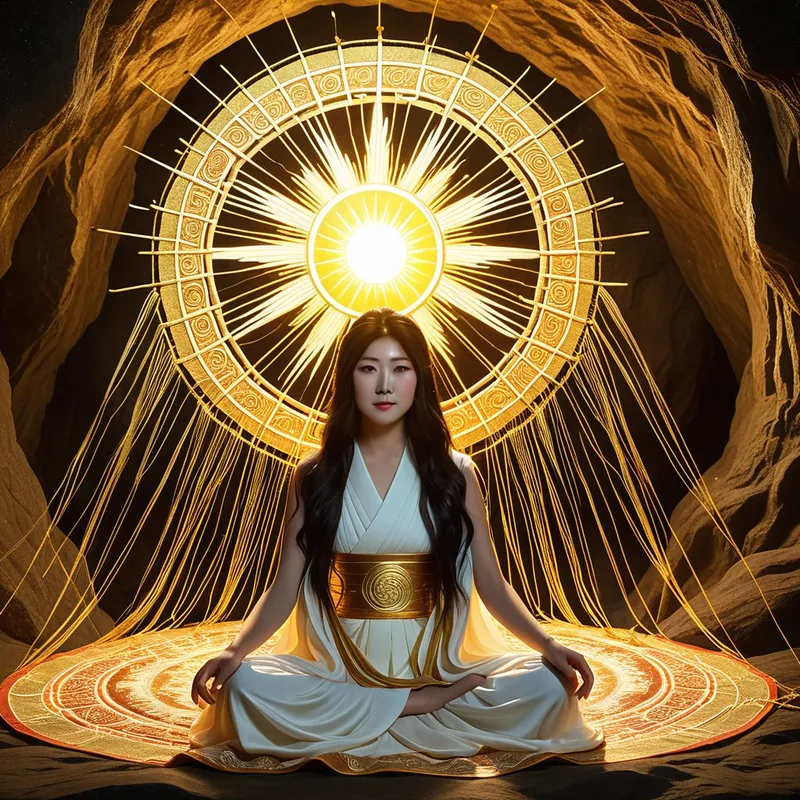
The sun goddess Amaterasu retreats into a cave, plunging the world into darkness, until a sacred dance at a divine loom lures her light back to the world.
The Tale of Amaterasu's Loom
Listen, and hear the tale of the time the world went dark, not from the setting of the sun, but from its turning away.
In the Takamagahara, the radiance of Amaterasu-Ōmikami was the source of all life and order. Her light defined the day, nurtured the rice, and revealed the truth in all things. She was a weaver, her sacred loom a focus of divine intent, where she wove the patterns of the world. Beside her was her brother, Susanoo-no-Mikoto, a force of wild energy and tumultuous change.
But conflict brewed. In a rage of unchecked passion, Susanoo laid waste to Amaterasu’s rice fields, defiled her sacred halls, and in a final, grievous insult, flung the flayed corpse of a heavenly pony through the roof of her weaving hall. One of Amaterasu’s handmaidens, startled at her loom, was struck by the shuttle and died.
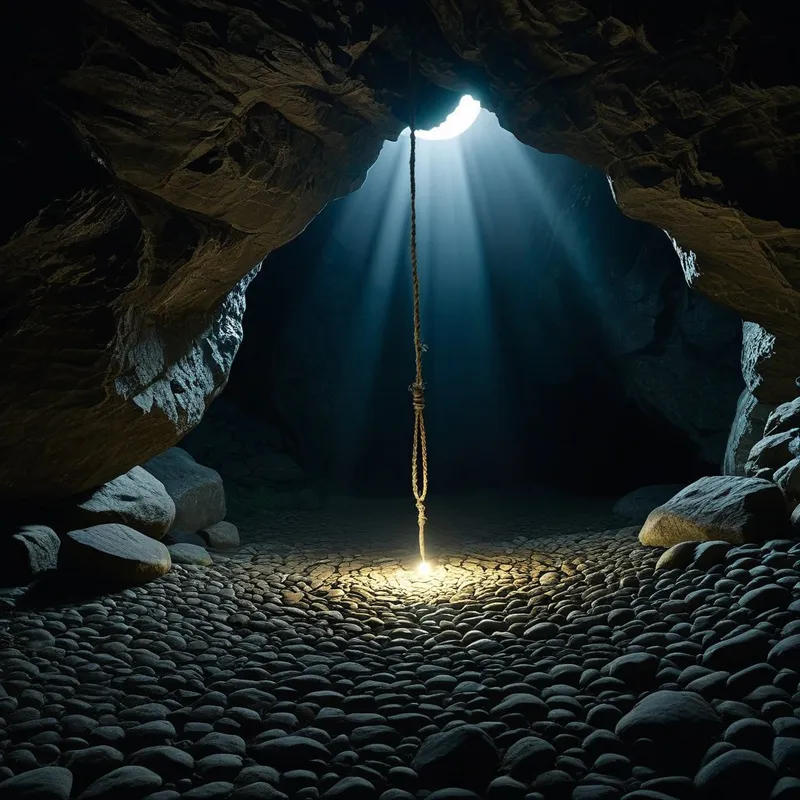
A profound silence fell, colder than any winter. Amaterasu did not rage. She turned inward. The light that sustained the heavens dimmed in her eyes. Without a word, she rose from her loom, the half-woven celestial pattern abandoned, and retreated to the Ama-no-Iwato. She sealed the entrance with a mighty stone, and the universe was plunged into an absolute, suffocating darkness. Chaos reigned. The eight-hundred myriads of kami wailed in confusion, their forms lost to each other in the void.
Desperation gave birth to cunning. The assembled kami devised a plan. They gathered outside the cave mouth. Ame-no-Uzume-no-Mikoto placed a large overturned tub before the sealed entrance. Upon it, she began to dance. Not a graceful, celestial dance, but a wild, stomping, ecstatic performance. She pounded her feet, shook her body, and let her garments fall away in divine abandon. The laughter of the gods rolled like thunder, shaking the very rock of the cave.
From within her stony solitude, Amaterasu heard the uproar. A flicker of curiosity, alien in the deep freeze of her withdrawal, stirred. What could possibly provoke such merriment in this eternal night? Peering through a crack she made in the stone, she saw her own dazzling reflection in a Yata-no-Kagami the gods had hung from a sakaki tree. "What is this radiant deity?" she wondered, stepping closer, drawn by her own obscured light.
In that moment of captivated self-recognition, the god Ame-no-Tajikarao seized the rock door and flung it aside. Another god stretched a shimenawa behind her, barring her return. The light of the sun flooded back into the world, and life, order, and clarity were restored. Amaterasu returned to her loom, and the dance of creation began anew.
Cultural Origins & Context
This foundational myth is recorded in Japan’s oldest chronicles, the Kojiki (712 CE) and the Nihon Shoki (720 CE). These texts were not mere storybooks but political and cosmological documents, crafted to establish the divine lineage of the imperial family, who claim direct descent from Amaterasu. The myth was preserved and performed by ritual specialists, likely serving multiple societal functions: it explained the cosmic necessity of the sun, validated the authority of the ruling clan, and provided a sacred narrative for agricultural and New Year renewal rituals. The Shinto tradition, with its focus on ritual purity, communal harmony (wa), and the immanence of the sacred in nature (kami), finds a core parable in this story. It is a myth about the fragility of cosmic and social order and the specific, often unconventional, rituals required to restore it.
Symbolic Architecture
The loom is the central, silent protagonist. It is not merely a tool but the very apparatus of cosmic order. To weave is to create pattern from chaos, to interlace separate threads into a meaningful whole. Amaterasu at her loom represents consciousness in its creative, sustaining, and world-making function.
The withdrawal into the cave is not a defeat, but a necessary descent into the unformed potential of the psyche, where the existing pattern has become unbearable.
The cave, the Ama-no-Iwato, symbolizes the unconscious itself—a womblike, containing darkness. Amaterasu’s retreat is a profound psychological movement: the conscious ego, overwhelmed by the shadow (represented by Susanoo’s chaotic violence), withdraws its illuminating energy. The world goes dark because we cease to project meaning onto it. The abandoned, half-finished weaving on the loom is the frozen, incomplete state of a life or a psyche whose creative process has been traumatically interrupted.
The resolution is alchemical. It does not come from force or pleading, but from lure. The mirror (Yata-no-Kagami) reflects not her familiar self, but her own divine essence, forgotten in her identification with wounding. It is the lure of the Self, the total, integrated psyche. The ecstatic dance of Ame-no-Uzume is the critical catalyst—it is the uninhibited expression of the life force, the instinctual body and its joyous chaos, which finally stirs the withdrawn spirit. Laughter, not logic, opens the door.
The Dreamer's Resonance
When this myth stirs in the modern dreamer, it often manifests as dreams of abandoned creative projects, rooms that are suddenly sealed off, or a pervasive, inexplicable dimming of one’s inner light. You may dream of trying to fix a broken machine that produces light, only to find the power source is missing. Or you may be in a familiar house that has a new, dark basement you are afraid to enter—the Ama-no-Iwato of your personal psyche.
Somatically, this can feel like a creative paralysis, a deep fatigue unrelated to physical exertion, or a sense of being "walled in" by circumstances or your own emotions. Psychologically, it is the process of a complex being activated—often a wound related to one’s creative expression being violated, mocked, or met with destructive chaos (the Susanoo energy, which can be internal or external). The dream-ego, like Amaterasu, has retreated to a place of supposed safety, but at the cost of all vitality. The healing movement, hinted at in dreams, may involve an unexpected, even "foolish" impulse—a sudden urge to dance, to make art without purpose, or to look upon oneself with a curious, almost alien wonder.

Alchemical Translation
The myth of Amaterasu’s Loom is a masterful map of the individuation process, specifically the crisis and resolution of the nigredo, the blackening, where the old conscious attitude dies. The conscious mind (Amaterasu), identified with its luminous, orderly function, is confronted by the shadow (Susanoo) in its most raw and destructive form. The ego’s first and necessary response is withdrawal. This is not failure, but the beginning of a deeper work.
The cave is the alchemical vessel. The darkness is not the enemy, but the prima materia—the essential, unformed substance of the Self.
Within that darkness, a transmutation occurs, catalyzed by the most unexpected archetype: the Trickster-Reveller (Ame-no-Uzume). In our personal alchemy, this is the moment we stop trying to "think" or "force" our way out of depression or stagnation. It is the spontaneous, embodied act that breaks the spell—the foolish poem written in the middle of the night, the absurd decision that makes no logical sense but feels utterly alive. This is the dance on the tub.
The mirror is the culminating symbol of self-recognition. It represents the capacity for introspection, not as narcissism, but as the awe of encountering the totality of one’s being, light and shadow integrated. The final step is the commitment to weave again. To return to the loom of daily life, of relationship, of craft, and to resume the work of creation, not from a naive innocence, but with the hard-won knowledge of the cave and the liberating memory of the dance. The pattern you weave thereafter contains the darkness as a necessary thread, giving depth and contrast to the light.
Associated Symbols
Explore related symbols from the CaleaDream lexicon: