Alcheringa the Dream Time Myth Meaning & Symbolism
The sacred, timeless epoch when ancestral beings sang the world into existence, forming the laws of life, land, and spirit for all time.
The Tale of Alcheringa the Dream Time
Before the world was as you know it, there was a great, formless sleep. Not a void, but a pregnant quiet, a deep and humming potential. This was the beginning of the Alcheringa. From within this sleep, the Ancestors stirred. They were not gods as you might imagine, but mighty beings of dual nature: the Rainbow Serpent, the Emu Man, the Kangaroo Women, the Honey Ant Ancestors. They were the essence of all things to come, dreaming themselves awake.
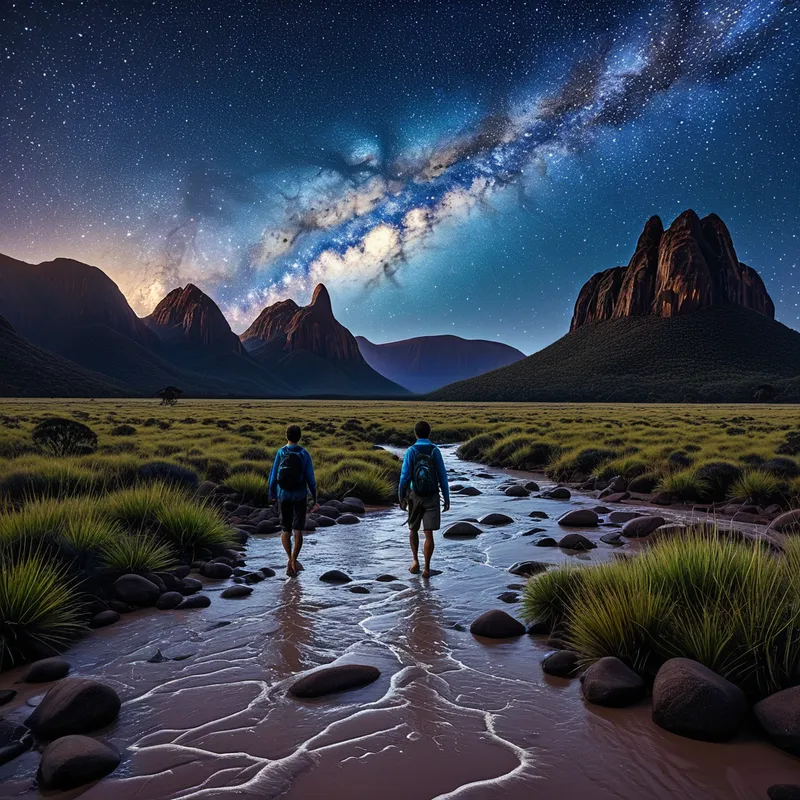
They emerged from the earth itself, or descended from the star-dusted sky, and began their great Tjukurrpa, their walking. Where the Rainbow Serpent slid, her massive body carved out the riverbeds, her scales scattering to become the glittering stones in the creek. Where she rested, she left deep, water-filled hollows that became billabongs. The Emu Man strode across the plains, and with each step, the red earth trembled and formed dunes and valleys. He sang, and his song called the first grasses from the ground.
But this was not mere landscaping. It was a singing. Every action was a verse in an eternal song. The Kangaroo Women danced, and the rhythm of their feet set the heartbeat of the land. They fought, and their spilled blood became the red ochre in the cliffs. They loved, and their unions formed the sacred sites where life force pools even today. They hunted and were hunted, and in their deaths, they transformed utterly—not into nothing, but into the very features of the world: that rock is the frozen body of the Lizard Man; that mountain range is the sleeping form of the Crocodile Ancestor.
The great conflict was not of war, but of establishing Law. The Ancestors, in their journeys, defined what was to be. They decreed how people should marry, how to find food, which ceremonies must be performed to keep the world in balance. They set the stars in their courses and tied the seasons to the movements of animals. When their work in one place was done, they often “went in.” Some sank into the earth, becoming a waterhole or a stone. Others ascended into the sky, becoming a constellation. But they did not leave. They became the Law, sleeping within the land they shaped, their presence as tangible as the wind and as permanent as the hills. The Alcheringa did not end. It simply changed form, from active creation to eternal presence, a Dreaming that is both past and forever now.
Cultural Origins & Context
Alcheringa (or Altjira, or more broadly, the Dreaming) is the foundational spiritual and philosophical framework for hundreds of distinct Aboriginal Australian language groups and nations. It is not a single, unified myth but a vast, continent-spanning tapestry of interconnected songlines, stories, and laws that explain the origin and nature of all reality.
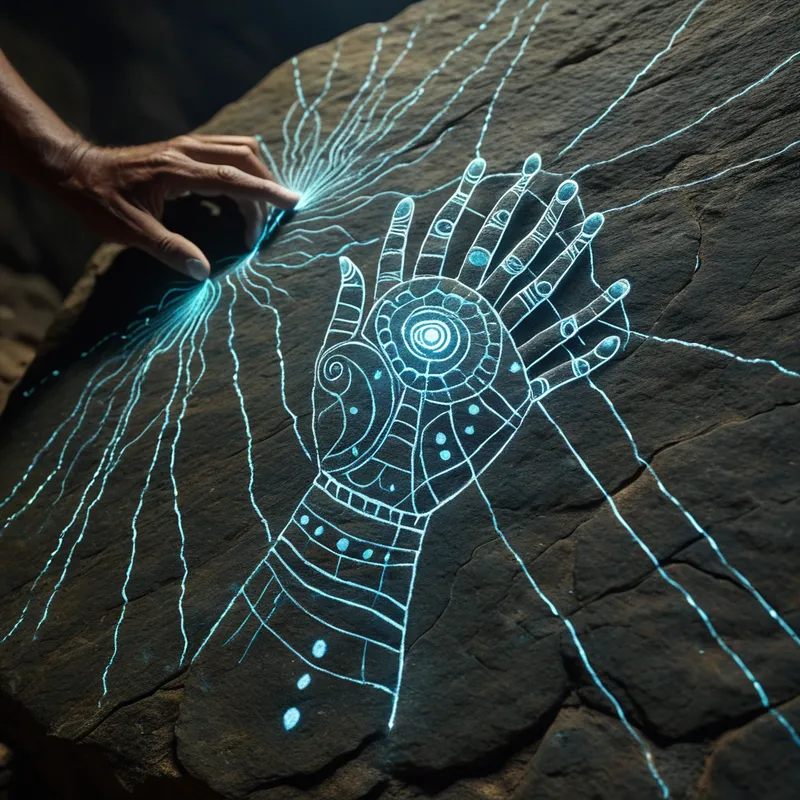
This knowledge was—and is—not contained in books but carried in living memory, passed down through generations via intricate oral traditions. Elders are the custodians, teaching through song, dance, ceremony, and art. The stories are encoded in the landscape itself; to know the story of the Rainbow Serpent is to know the path of the river, the location of the waterhole, the type of fish that live there, and the ceremony required to ensure their abundance. Its societal function is total: it is map, legal constitution, historical record, moral code, and spiritual guide. It connects every individual, through clan and totem, directly back to the creative actions of a specific Ancestor, rooting identity and responsibility in the eternal Alcheringa.
Symbolic Architecture
The Alcheringa is not a "myth" in the sense of a fictional story about the past. It is a symbolic architecture for understanding a living, conscious universe. Psychologically, it represents the primordial, undifferentiated state of the psyche—the unconscious—from which all forms of consciousness and identity emerge.
The Ancestral Beings symbolize the archetypal patterns, the primal drives and instincts (hunting, mating, journeying, creating) that structure psychic life. Their transformation into landscape features symbolizes the process by which dynamic psychic energy becomes structured into the complexes, habits, and enduring patterns that form the "topography" of an individual's personality.
The world was not made and abandoned; it is continuously dreamed into being. So, too, the self is not a static artifact but a living songline, constantly sung by the ancestral patterns within.
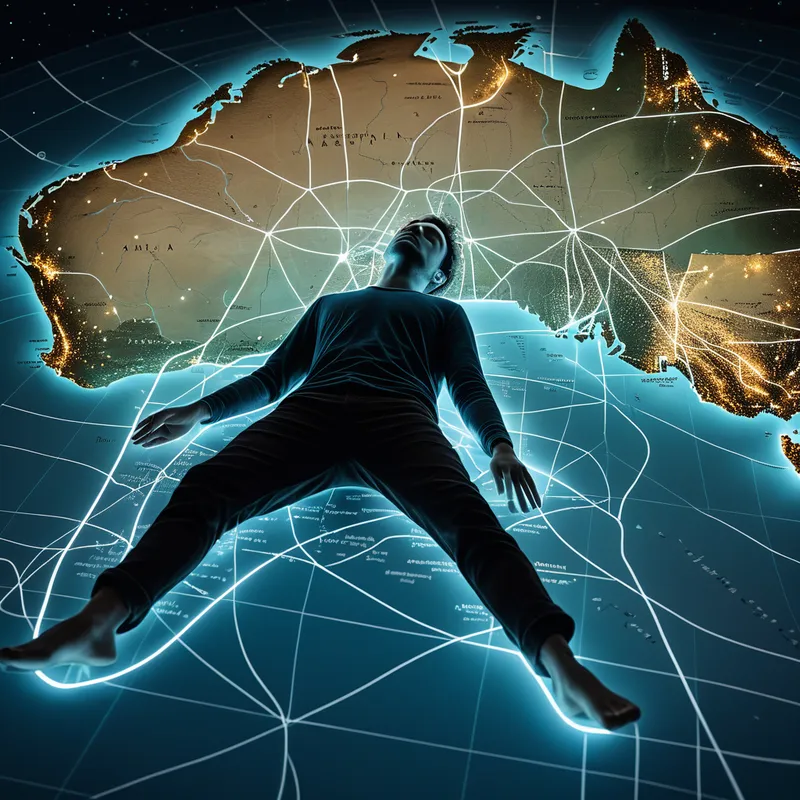
The Tjukurrpa, or songlines, represent the connective tissue of meaning. They symbolize the narrative thread of a life, the path of individuation that links disparate experiences (the mountains, the deserts, the waterholes of our soul) into a coherent, purposeful whole. To lose connection to the songline is to experience psychic disorientation and spiritual death.
The Dreamer's Resonance
When a modern dreamer encounters the pattern of the Alcheringa, they are not dreaming "about" Aboriginal culture. They are touching the archetypal layer of creation itself. Such dreams often feature a profound sense of participation in the forming of one's own world.
You may dream of walking across a barren, yet strangely familiar, inner landscape, and with each step, causing plants to grow or streams to flow. You may encounter vast, numinous animals who impart silent knowledge. You may find yourself singing a wordless song that causes the dream environment to shift and solidify. These are somatic experiences of the creative Self at work. The psychological process is one of active imagination at its most fundamental: the ego participating in the world-forming activity of the deeper psyche. The dreamer is undergoing a process of re-origination, where old, rigid structures of identity are softened back into potential, ready to be re-sung, re-dreamed into a more authentic form. It is the psyche's way of returning to its own source code to debug and update the system.
Alchemical Translation
The alchemical process mirrored in the Alcheringa is the opus magnum itself: the creation of the psychic diamond, the enduring Self, from the prima materia of unconscious potential. The journey of the Ancestors is the journey of individuation.
First, the nigredo: the formless sleep, the chaos of un-lived potential. Then, the albedo: the emergence of the archetypal figures, the first distinctions. Their epic journeys and struggles represent the citrinitas, the hard work of confronting and engaging with inner opposites—the hunter and the hunted, the lover and the fighter. Their final transformation, "going in" to become permanent features of the landscape, symbolizes the rubedo: the reddening, the point where the psychic transformations become a permanent, living structure within the personality.
Individuation is not about becoming something new, but about discovering the eternal songline you have always been walking, and learning to sing it consciously.
For the modern individual, the alchemical translation is this: Your life is a Tjukurrpa. Your traumas, joys, relationships, and passions are the places where your inner Ancestors fought, loved, and created. The goal is not to escape this landscape but to learn its songlines—to understand how the "rock" of your depression or the "river" of your creativity came to be there. By walking these inner songlines with respect and attention (through therapy, art, reflection, ritual), you do not just remember the Dreaming; you actively sustain it. You become a co-dreamer of your world, responsible for singing it into continued, harmonious existence. You move from being a tourist in your own psyche to being its custodian.
Associated Symbols
Explore related symbols from the CaleaDream lexicon:
- Dream — The foundational substance of reality in Alcheringa, representing the unconscious potential from which all conscious forms and laws emerge.
- Snake — Directly connected to the Rainbow Serpent, symbolizing primal creative power, the shaping of the world, and the cyclical nature of life and death.
- Water — Represents the life-giving and shaping force of the Ancestors, as seen in the rivers and billabongs created by their movements, symbolizing emotional and spiritual sustenance.
- Earth — The literal and spiritual body formed by the Ancestors, representing the tangible reality of law, memory, and identity that holds the imprint of the Dreaming.
- Journey — The essential action of the Tjukurrpa, symbolizing the path of creation, discovery, and the process of individuation that maps meaning onto existence.
- Song — The creative act and the Law itself, representing the vibrational pattern that structures reality and connects all things across time and space.
- Circle — Symbolizes the eternal, cyclical nature of the Dreaming, where past, present, and future are co-existent, and all journeys return to their source.
- Root — Represents the profound, unbreakable connection between people, law, and identity to the specific landscape and Ancestors formed during the Alcheringa.
- Spirit — The enduring presence and consciousness of the Ancestral Beings within the land, symbolizing the animated, sacred nature of all creation.
- Law — The immutable patterns of relationship and responsibility established during the Dreaming, representing the innate ordering principles of a healthy psyche and society.
- Time Travel Device — A modern analogue for the Dreaming itself, which is not linear time but a sacred eternal now that can be accessed through ceremony, story, and dream.