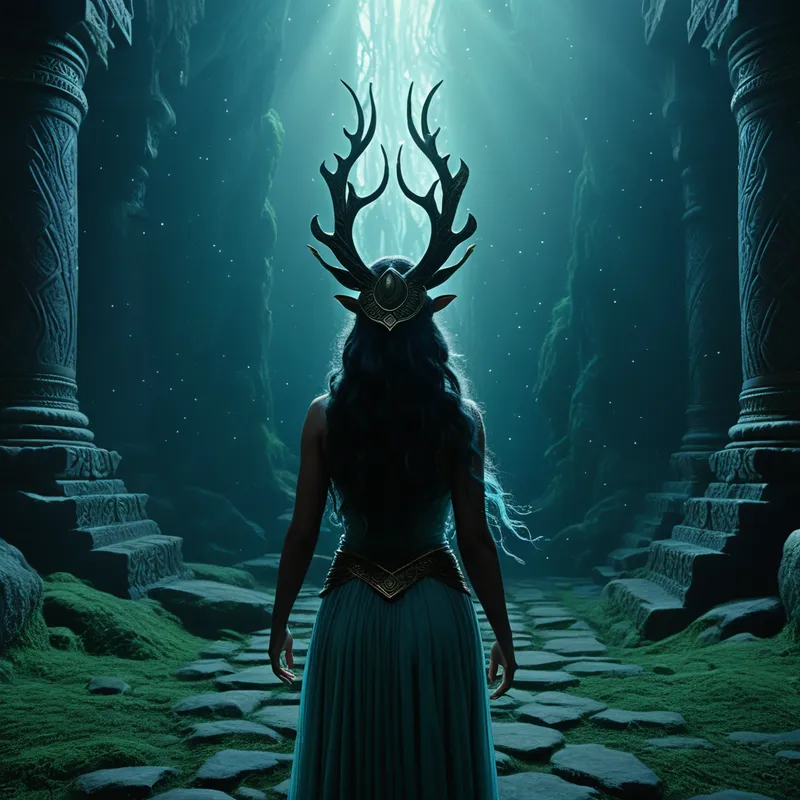
Al-Uzza the Goddess of Venus
A powerful Arabian goddess of Venus worshipped as both a war deity and love figure, embodying celestial power in pre-Islamic mythology.
The Tale of Al-Uzza the Goddess of Venus
In the time before the dawn of a single God, when the desert breathed with many spirits, the people of the Hijaz looked to the sky. There, in the velvet expanse, a light would appear—not the harsh, fatherly sun, nor the cool, reflective moon—but a star that held the horizon in the moments between day and night. They called her Al-Uzza, “The Most Mighty.” She was the morning and the evening star, the planet Venus, and she was no distant spark. She was a presence.
Her sanctuary was not a city of men, but a grove of acacia trees in a place called Nakhlah, a green secret held in the palm of the arid land. There, in the dappled light, her sacred stone stood, anointed with blood and whispered desire. Pilgrims would journey through the searing emptiness, drawn by her dual promise. Warriors came before battle, their hands not clasped in prayer for mercy, but raised in invocation for ferocity, for the ruthless strength to conquer. They saw in her cold, brilliant light the gleam on a spear-point, the unblinking eye of a predator. She was the patroness of the clan of Quraysh, the fierce heart of their resolve.
Yet, in the same breath, with the same star, lovers and seekers of beauty would come. They saw in her gentle radiance the first light to greet a beloved’s face, the promise of union, the intoxicating pull of attraction that could forge alliances as surely as war could break them. Her priests were not austere monks, but a lineage of soothsayers, the Kahin, who channeled her chaotic, poetic wisdom in trance. Her rites were not silent; they were filled with the circumambulation of her grove, the casting of sacred arrows for divination, the ecstatic cries that blurred the line between agony and ecstasy.
Her most sacred act was one of terrifying intimacy: the sacrifice. Not just any offering, but the wasm, the ritual blood-letting upon her stone, a covenant written in life’s essence. And in her most profound and dreadful mystery, it was said she demanded the Fara’, the firstborn son. This was not a myth of distant antiquity but a living, trembling thread in the fabric of belief—a testament to her unbearable cost, the ultimate price for her celestial favor. She was the giver of life’s greatest passions and its most profound surrenders.
Then came the seismic shift. The Prophet Muhammad, bearing the revelation of the One, entered Mecca in triumph. He sent Khalid ibn al-Walid to the grove at Nakhlah. The account is stark, historical, yet throbs with mythological finality: Khalid struck down her priestess, who cried out in defiance, “O Uzza, a defense for your worshipper!” He then dismantled her sanctuary, cut down her sacred trees, and shattered her idol. The Most Mighty was declared overthrown, a taghut (false god). Her star remained in the sky, but her voice in the hearts of the people was to be silenced, her grove left to the whispering sand.
Cultural Origins & Context
Al-Uzza did not emerge in isolation. She was the youngest and most potent member of a pre-Islamic divine triad, the “daughters of Allah”: Al-Lat (the Earth Mother), Manat (the Goddess of Fate and Time), and Al-Uzza, the celestial one. This triad represented a comprehensive cosmology—earth, time, and the cosmos—with Al-Uzza holding the most explicitly astral identity as the embodiment of Venus.
Her worship was central, particularly around Mecca and among the Quraysh tribe. The Kaaba itself, before its purification for monotheism, contained her idol, a place of honor indicating her supreme status. Her association with acacia groves points to a deep, animistic layer of Arabian religion, where divinity resided in specific, powerful places (haram)—a fusion of the arboreal and the astral. She was a borderland deity, worshipped at the liminal spaces between settlements, just as her star ruled the liminal hours of dawn and dusk. This positioning outside the ordered space of the community hints at her nature: she was the necessary, dangerous power from beyond, invoked for protection, victory, and fertility, but always with an awareness of her terrible price.
Symbolic Architecture
Al-Uzza’s symbolism is a constellation of fierce contradictions, held in the single point of a planet’s light. She is the ultimate archetype of the anima in its most potent and undomesticated form—not merely the soul-image of love, but the soul-image of passionate, destructive, and creative force.
She is the Mirror that does not flatter, but reveals the true nature of desire: is it for creation or for conquest? Her light shows the warrior his hidden vulnerability and the lover his latent aggression.
Her duality is not a neat balance but a tense, dynamic polarity. The Love she governs is not passive affection but an irresistible magnetic pull, a force of nature as capable of binding tribes in marriage as it is of sparking vengeful raids. The War she sponsors is not the ordered campaign of a sun god, but the swift, merciless strike of a desert ambush, fueled by the heat of blood and honor. She is celestial, yet her most sacred sites were groves and stones—a Tree rooted in the Earth, reaching for the Star. This vertical axis connects the chthonic (the sacrificial blood, the dark grove) with the cosmic (the planet Venus), making her a goddess of the entire world-pillar.
The demand for the firstborn son, the Fara’, is the ultimate symbol of this tension. It represents the sacrifice of one’s future, one’s lineage, one’s most cherished creation, to the very power that also grants fertility and victory. It is the psyche’s recognition that profound creativity and profound destruction are fed from the same deep, archetypal well.
The Dreamer's Resonance
To encounter Al-Uzza in the inner landscape is to confront a power that refuses to be categorized. She is the emotional force that overwhelms rational boundaries. In a man’s psyche, she may appear as the captivating, formidable feminine figure who commands total allegiance, sparking both creative fervor and ruinous obsession. In a woman’s psyche, she is the embodiment of a fierce, autonomous feminine potency that transcends the roles of mother or maiden—she is the sovereign of her own desire and destructive capacity.
Her resonance today is felt wherever passion holds a double edge. She is the exhilarating startup venture that demands the sacrifice of all personal relationships (the Fara’ of modern life). She is the social justice cause that inspires both boundless love for humanity and a warrior’s rage against injustice. She is the artistic pursuit that is both a lover’s embrace and a brutal, all-consuming battle. When one feels simultaneously drawn and repelled by a powerful desire, when love feels like a form of combat, and striving for a goal requires a piece of one’s soul—the star of Al-Uzza is rising in that personal firmament. Her silencing in the historical narrative mirrors the modern psyche’s attempt to suppress these raw, ambivalent powers in favor of a more “ordered” self, often at great cost to vitality.

Alchemical Translation
The alchemical process mirrored in Al-Uzza’s myth is the nigredo—the blackening, the dissolution, the necessary death of an old form. The smashing of her idol was not merely an iconoclastic act but a profound psychological operation on a cultural scale. It was the forced integration of a powerful, autonomous archetypal force into a new, monolithic structure of consciousness (monotheism).
The grove at Nakhlah represents the vas or sealed vessel of transformation. Within it, the opposites of love and war, earth and star, life and sacrificial death, were held in a tense, creative union. The prophetic decree to destroy it was the shattering of that vessel, releasing its contents—its potent, chaotic energy—to be, in theory, subsumed and re-organized under a single, transcendent principle.
Yet, archetypes cannot be killed; they only change form. The alchemical translation of Al-Uzza is her sublimation. Her celestial aspect is absorbed into the awe of God’s creation. Her warrior aspect is channeled into the concept of jihad. Her generative aspect is sanctified within marriage. But the raw, untamed, personally demanding voice of the goddess—the one who spoke through the Kahin and demanded ultimate sacrifices—is driven into the shadow. To work with her alchemically today is to retrieve that voice from the shadow, not to worship it literally, but to acknowledge its power as an essential component of a whole psyche. It is to perform the coniunctio oppositorum (union of opposites) within oneself, holding the Lover and the Warrior in conscious, respectful tension.
Associated Symbols
Explore related symbols from the CaleaDream lexicon:
- Star — The celestial body of Venus, a beacon of paradoxical light governing both the tender approach of dawn and the conclusive closure of dusk.
- Love — Not merely affection, but the formidable magnetic force that binds and breaks, mirroring Venus’s gravitational pull on the human heart.
- Warrior — The embodiment of focused, ruthless strength invoked before battle, representing the archetypal will to confront and overcome.
- Sacrifice — The ultimate offering, epitomized by the Fara’, where what is most cherished is surrendered to the divine in a covenant of terrible intimacy.
- Tree — The sacred acacia grove of Nakhlah, a living temple where heaven met earth, representing rootedness and a connection to animistic power.
- Stone — The anointed idol or betyl, the focal point of ritual and blood-offering, a conduit for the numinous and a testament to enduring presence.
- Mirror — The reflective quality of Venusian light, revealing the true, often contradictory, nature of one’s deepest desires and intentions.
- Blood — The vital essence offered in the wasm ritual, symbolizing the life-force given in exchange for power, fertility, or favor.
- Shadow — The repressed, potent aspect of the feminine and of passionate force, silenced by historical change but persisting in the unconscious.
- Celestial Bridge — Venus as the luminous connector between the realms of day and night, consciousness and unconsciousness, love and strife.
- Lover — The archetype of passionate union and magnetic attraction, one half of the potent duality held within the goddess’s domain.
- Chaos — The raw, ecstatic, and unpredictable power channeled by her priests, the necessary disorder that precedes and underlies all creation.