
Akua Gods of Hawaii Myth Meaning & Symbolism
A mythic saga of primal forces, where the Sky Father and Earth Mother are separated, birthing the world and the gods who shape it through sacred struggle.
The Tale of Akua Gods of Hawaii
In the beginning, there was Pō. Not an emptiness, but a deep, fecund night, a womb of potential where all things were one. From this eternal dark, life stirred. The great Ao was born, and with it, the first ancestors of all.
There was Wākea, the vast, endless sky, and Papa, the solid, nurturing earth. For an age beyond counting, they lay in a tight, loving embrace. In that union, all was potential, but nothing was distinct. No forest could grow, no bird could fly, no human could walk upon the land, for the land was not free. The world was a closed seed.
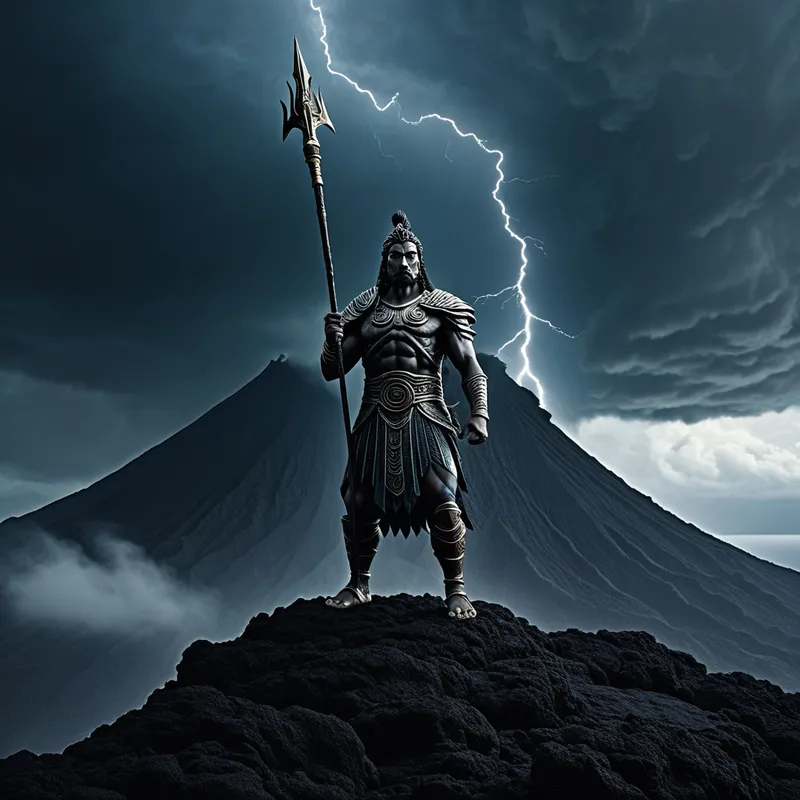
But within the seed, a longing grew. A divine restlessness. The sky yearned to stretch, to hold the sun and moon. The earth yearned to bear fruit, to feel rain upon her soil. Their children, the first Akua, stirred in the closeness. Among them was the powerful Kū, whose nature was to stand firm, to cut, to build. He felt the pressure of the boundless unity as a prison.
With a cry that was both sorrow and necessity, Kū acted. Some say he pushed with immeasurable strength. Others whisper that it was the sky himself, Wākea, who began to rise. The sound was the first sound: a groan of rock, a sigh of wind, the tearing of roots from soil. The sacred embrace was broken. Wākea ascended, becoming the dome of heavens. Papa settled, becoming the foundation of islands.
In that great separation, the world was born. Light flooded the space between them. The first winds, the Mālie and Koʻolau, rushed into the void. Rain, the tears of the parting, fell upon Papa and gathered into the first springs. From their union now expressed through separation came forth the bounty: Kanaloa of the deep ocean, Lono of the clouds and cultivated fields, and a host of others.
But creation is not a single act. It is a perpetual dance. The Akua shaped the raw material of this new world. Kū, the transformer, used his strength to carve valleys and lift mountains. Pele, whose heart is liquid earth, traveled in search of a home, digging pits of fire and building new land from her own body, her conflicts with her sister Namaka defining the boundary between land and water. This was not a peaceful genesis, but a passionate, often violent, forging. The world was sung, fought, and loved into being by the Akua, forever children of that first, necessary separation.
Cultural Origins & Context
This cosmological narrative is the foundation of Kanaka Maoli identity, encoded in oli, hula, and moʻolelo. It was not merely a story of the past but a living framework for understanding the present. The chanters (kāhuna) and historians (kūʻauhau) were the keepers of these truths, reciting genealogies (moʻokūʻauhau) that directly linked the aliʻi (chiefs) and the land (ʻāina) back to Wākea and Papa.
The societal function was profound. It established the sacred relationship between the people and the ʻāina—the land was not a resource, but a familial ancestor, Papa herself. It justified the stratified social structure, as the chiefs were seen as direct descendants of the Akua. More importantly, it provided a spiritual ecology: every mountain (mauna), wind, and rain shower was an embodiment of an Akua, making the entire world a temple and every action a potential interaction with the divine. The myth was a map of reality, teaching proper conduct (pono) by illustrating the consequences of imbalance and the sacred origins of all life.
Symbolic Architecture
At its core, the myth maps the fundamental psychic process of differentiation. The primordial unity of Pō and the embrace of Wākea and Papa represent the unconscious, undifferentiated state of the self—a state of potential but no identity.
The birth of consciousness is always an act of sacred violence, a separation from the womb of the unconscious to create the space where a world can exist.
The act of separation, led by forces like Kū, symbolizes the necessary "cut" that consciousness must make. It is the painful but essential distinction between self and other, inner and outer, thought and feeling. The resulting "void" is not emptiness, but the sacred space of life and experience—the realm of Ao. The ongoing conflicts among the Akua, like Pele's fiery creation, represent the internal struggles that shape our individual psyche: passion versus calm, assertion versus yielding, creation versus destruction. The Akua are not remote gods but archetypal personifications of the powerful, often conflicting, forces within the human soul.
The Dreamer's Resonance
When this mythic pattern stirs in the modern dreamer, it often manifests as dreams of profound separation or creation. One might dream of pushing away from a suffocating embrace, or of a landscape violently tearing itself apart to form new continents. There may be dreams of being trapped in a dark, comfortable space that suddenly becomes claustrophobic, necessitating a desperate, forceful escape.
Somatically, this can feel like a pressure in the chest or a cracking in the joints—the body echoing the mythic rupture. Psychologically, the dreamer is likely at a threshold where an old, unified identity (a relationship, a career, a self-concept) must be broken apart to allow for new growth. The dream is not a warning, but a reflection of an internal, archetypal process already underway: the Self, like Kū, initiating the difficult but necessary work of differentiation to create a more complex and authentic psychic landscape.
Alchemical Translation
The individuation journey mirrors the Hawaiian cosmogony perfectly. We begin in our personal Pō, a state of unconscious identification with family, culture, or persona. The first alchemical step is the separatio, the painful realization that to become whole, we must first distinguish ourselves from the primal unity.
Individuation is not about becoming perfect, but about becoming distinct, allowing the internal Akua—our war god, our fire goddess, our peaceful farmer—to each have their domain and their voice.
The rising of Wākea represents the development of conscious awareness and perspective (the "sky" of the mind). The grounding of Papa is the embodiment of that awareness in the physical and emotional reality of one's life. The ongoing battles of the Akua within are the internal conflicts we must mediate—not to eliminate one force in favor of another, but to find the pono, the right balance, where each sacred power is honored. The goal is not to return to the undifferentiated embrace, but to become a living archipelago, a complex world born of that sacred separation, where the internal elements are in dynamic, creative tension, generating the unique landscape of the individual soul.
Associated Symbols
Explore related symbols from the CaleaDream lexicon:
- Sky — The domain of Wākea, representing consciousness, perspective, father-principle, and the limitless potential of the mind after separation from the primal unity.
- Earth — The body of Papa, symbolizing the unconscious, foundation, mother-principle, fertility, and the grounded reality that nourishes all manifested life.
- Separation — The central, sacred act performed by Kū, representing the necessary psychological differentiation that creates the space for individual identity and experience.
- God — The Akua themselves, embodying the archetypal, personified forces of nature and the psyche that engage in the perpetual work of world-building.
- Mountain — The physical manifestation of the gods' actions, particularly of Kū's strength and Pele's passion, representing aspiration, stability, and the enduring results of internal struggle.
- Fire — The essence of Pele, symbolizing transformative passion, creative-destructive force, purification, and the volatile energy that forges new land from old forms.
- Ocean — The realm of Kanaloa and Namaka, representing the deep, unknown unconscious, emotional depths, and the primordial waters that both oppose and complement the fire of creation.
- Creation — The ultimate outcome of the mythic process, depicting genesis not as a peaceful thought but as a dynamic, often violent, engagement between opposing divine forces.
- Order — The structured world that emerges from the chaos of primal unity, represented by the distinct domains of sky, earth, and sea, and the established roles of the Akua.
- Chaos — The fertile, undifferentiated state of Pō and the initial embrace, the necessary precursor to order, holding all potential within its dark womb.
- Journey — The path of the gods, like Pele's search for a home, symbolizing the soul's process of seeking its rightful place and purpose through trials and transformations.
- Temple — The entire created world, as understood in the myth, where every element is an embodiment of the divine, making all of life a sacred space for interaction with the Akua.