Akkorokamui Myth Meaning & Symbolism
A colossal, healing octopus deity of Ainu myth, embodying the wrath and mercy of the sea, demanding respect and offering profound transformation.
The Tale of Akkorokamui
Listen, and let your spirit travel to the mist-shrouded coasts of Hokkaido, where the sea does not merely lap at the shore but speaks in the voice of ancient gods. Here, the water is a realm of immense, unseen presences. The Ainu people knew this truth in their bones. They knew the sea-god Repun Kamuy ruled these depths, and within his domain dwelled beings of terrible and beautiful power.
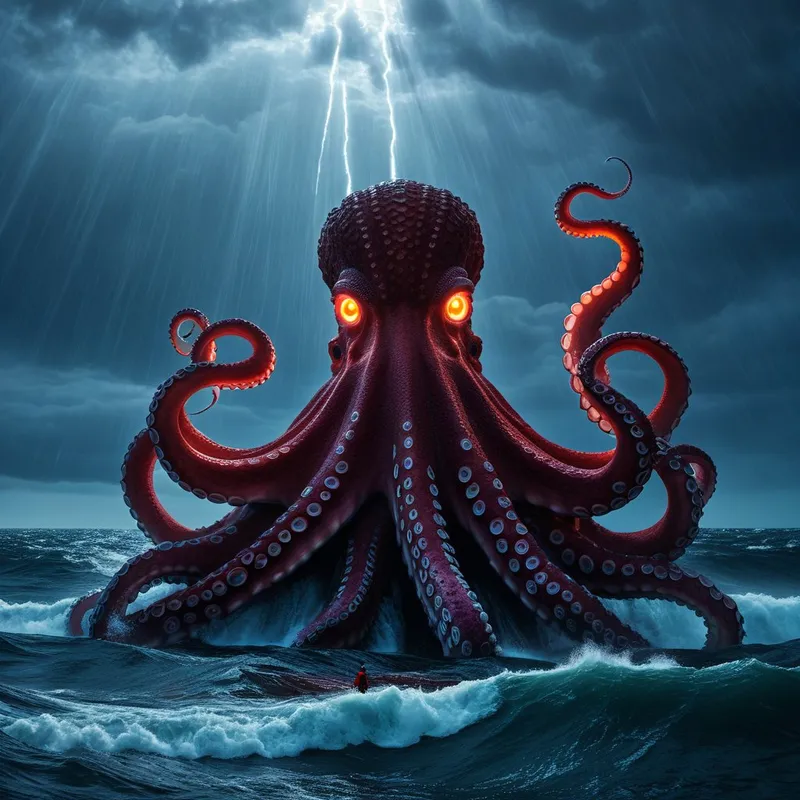
Among them was Akkorokamui. It was not a mere beast, but a kamuy—a deity. Its body was a mountain of living flesh, a blazing scarlet that could be seen through the clear waters like a submerged sunset, stretching the length of valleys. Its eyes held the dark, knowing depth of the abyss, and its eight arms could embrace a bay or crush a fleet.
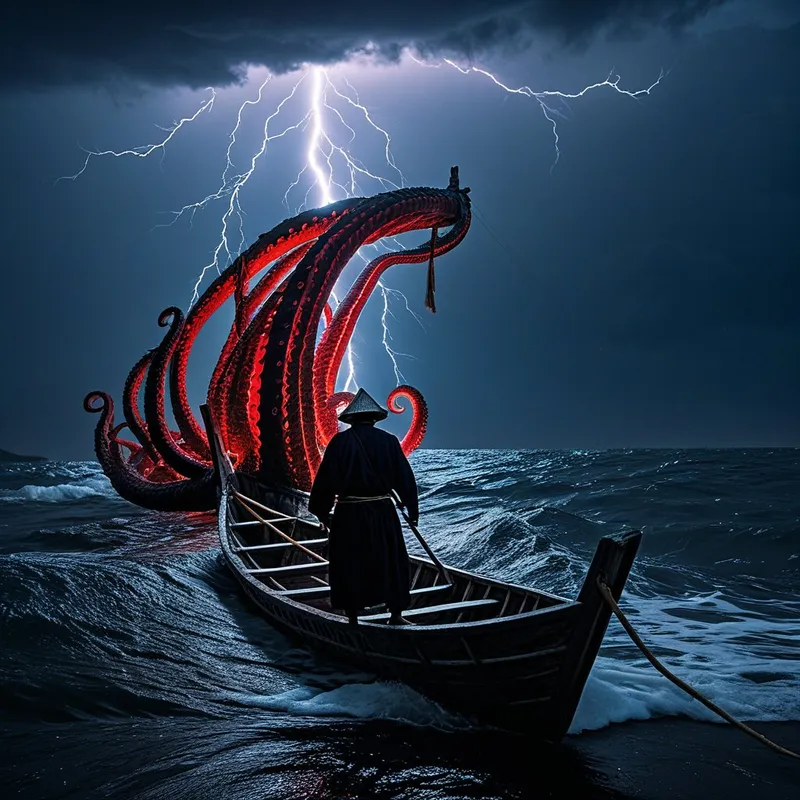
The story is told of a fisherman, a man skilled but perhaps too bold in his harvest from Repun Kamuy’s realm. Day after day, he took from the sea without the proper prayers, without the sacred inau offerings of gratitude. The sea’s patience, vast as it was, grew thin. One evening, as he sailed home, the weather turned. The wind became a scream; the waves rose like black cliffs. His boat was a leaf in a maelstrom.
From the heart of the storm, the sea itself erupted. Not with water, but with a limb of living coral and muscle. A tentacle, thicker than the oldest tree, slick and powerful, rose from the depths and seized the boat. The fisherman felt the wood groan, heard the crash of the sea, and knew the stories were true. This was the wrath of the kamuy. But as he awaited his end, a strange calm descended. The crushing grip did not shatter him. Instead, the colossal limb, glowing with its own eerie light, held him with a terrifying precision. He saw the immense, intelligent eye of Akkorokamui regard him from the deep—not with malice, but with an overwhelming, impersonal judgment.
The tentacle drew him down, not to drown, but into the deity’s embrace. In that submerged, luminous hold, a miracle transpired. The fisherman, who had been wounded in the storm, felt a searing warmth. The lacerations on his arms, the broken bone in his leg—they knit together under the touch of the sacred skin. The very flesh of the god was medicine. After what felt like an eternity and a moment, he was released, deposited gently on the rocky shore, whole and healed. The storm had vanished. The sea was calm. And forever after, he carried the story: the sea gives, but it also takes. It judges, but it can also heal. To receive its mercy, one must first respect its terrible power.
Cultural Origins & Context
The myth of Akkorokamui is not a tale from the classical Yamato canon, but a vital strand in the oral tradition of the Ainu. Passed down through generations by elders and storytellers, it was not mere entertainment but a functional cosmology. It explained the capricious, abundant, and dangerous nature of the sea surrounding Hokkaido, known as the Okhotsk.
In the Ainu worldview, everything in nature—animals, plants, rivers, storms—possesses a kamuy (spirit or god). Akkorokamui is the kamuy of the giant octopus or squid, a being that physically embodies the dual essence of the sea itself. The myth served as an ecological and ethical guide. It codified the practice of iyomante, the ritual sending-back of animal spirits with gratitude and offerings. To take a life, even a fish’s, without proper ritual was to invite the imbalance that the fisherman experienced. The story enforced a protocol of respect, a way of maintaining sacred reciprocity with a world that was profoundly alive and sentient.
Symbolic Architecture
Akkorokamui is a master symbol of profound ambivalence, a unity of opposites that the psyche instinctively recognizes. It is not a monster to be slain, but a deity to be understood.
The true healer often first appears in the guise of the wounder; the medicine is found within the very substance of the poison.
Its colossal, red, octopus form symbolizes the unconscious itself—vast, alien in its intelligence, capable of overwhelming the fragile vessel of the conscious ego (the fisherman’s boat). The tentacles represent the enveloping, sometimes suffocating, grasp of complex emotions, traumas, or instincts from the deep. To be seized by Akkorokamui is to be confronted by a power far greater than oneself.
Yet, this is not a destructive encounter. The brilliant red color, often associated in Ainu culture with the divine and the vital, signals its sacred nature. Its flesh that heals is the core symbol. The myth tells us that the very power that can crush us also contains the precise antidote to our suffering. The wound and the cure emanate from the same source. This speaks to a deep psychological truth: our most profound healing often requires a descent into the heart of our pain, a confrontation with the aspects of ourselves we have feared or rejected. The “medicine” is not applied from the outside, but activated from within the encounter itself.
The Dreamer's Resonance
When the pattern of Akkorokamui stirs in the modern dreamer, it signals a profound somatic and psychological process of encounter with the Shadow. To dream of a giant octopus or squid is to dream of being grasped by something from the deep unconscious.
The somatic experience in the dream is key: the feeling of being held, restrained, or pulled under is not necessarily violent, but it is inescapably powerful. It may correlate with feelings of being overwhelmed by a life situation, a relationship, or a buried emotion like grief or rage. The dream is the psyche’s way of staging this confrontation. The tentacles might represent entwining dependencies, the grip of old habits, or the complex, multi-faceted nature of a problem that seems to have a “hold” on the dreamer.
If the dream moves beyond fear into a state of awe or, remarkably, into a sensation of healing within the grasp, it marks a critical shift. It means the ego is beginning to recognize that this overwhelming force is not purely antagonistic. It contains a transformative potential. The dreamer is in the process of discovering that within their deepest struggle lies the blueprint for their own restoration.
Alchemical Translation
The myth of Akkorokamui is a perfect map for the alchemical stage of nigredo and the beginning of albedo. The journey of individuation—becoming whole—requires this terrifying, healing embrace.
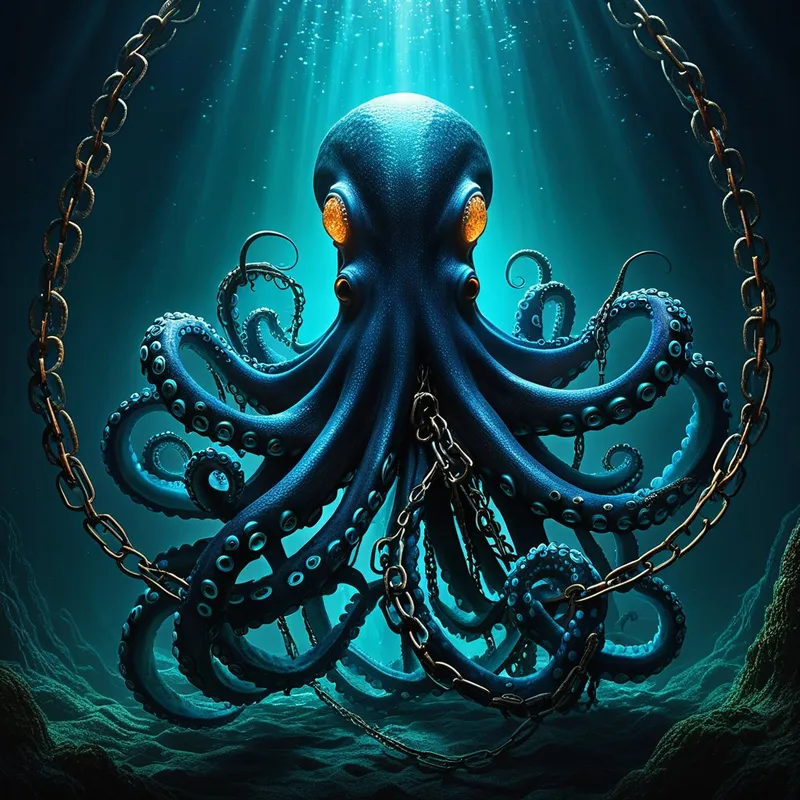
The fisherman’s arrogant, unconscious taking represents the unexamined life. The storm is the crisis that inevitably arises, the psyche’s rebellion against one-sidedness. Being seized by the deity is the nigredo: the dark night of the soul, the feeling of being dissolved, overpowered by depression, anxiety, or meaninglessness. One is pulled into the murky, pressurized depths of the self.
Individuation does not mean climbing a mountain alone, but being courageously held by the deepest sea within, until one learns to breathe its strange water.
But here, in the myth’s genius, the albedo begins not after the release, but within the grasp. The healing flesh of Akkorokamui symbolizes the moment of insight, the flash of understanding that the darkness itself is transformative. The wound—the feeling of brokenness—is the very site where the psyche starts to produce its own luminescence, its own medicine. The ego does not defeat the unconscious; it is humbled, healed, and altered by it.
To integrate Akkorokamui is to achieve a new relationship with the depths. One learns to send the inau of conscious attention and respect into one’s own inner sea. One no longer just “fishes” from the surface for ego-gratification, but learns to navigate the depths with reverence, knowing that the power that can capsize you is the same power that can make you whole. The goal is not to kill the octopus, but to recognize it as a sacred part of one’s own vast, mysterious, and healing nature.
Associated Symbols
Explore related symbols from the CaleaDream lexicon: