Aji Saka Myth Meaning & Symbolism
A mythic hero from Java brings civilization, defeats a demon king, and establishes cosmic order through sacrifice and sacred knowledge.
The Tale of Aji Saka
Listen, and hear the tale from a time when the world was raw and kingdoms were ruled by appetite. In the land of Medang Kamulan, a shadow fell across the rice fields. The king, Dewata Cengkar, was no mortal ruler. A curse of ravenous hunger coiled in his belly. Each dawn, he demanded a tribute not of gold or grain, but of human flesh—one of his own subjects, chosen by lot, to sate his monstrous hunger. The kingdom wept. The air grew thick with the smell of fear and the sour tang of despair. The people were like ripe fruit, trembling on the branch, waiting to be plucked and consumed.
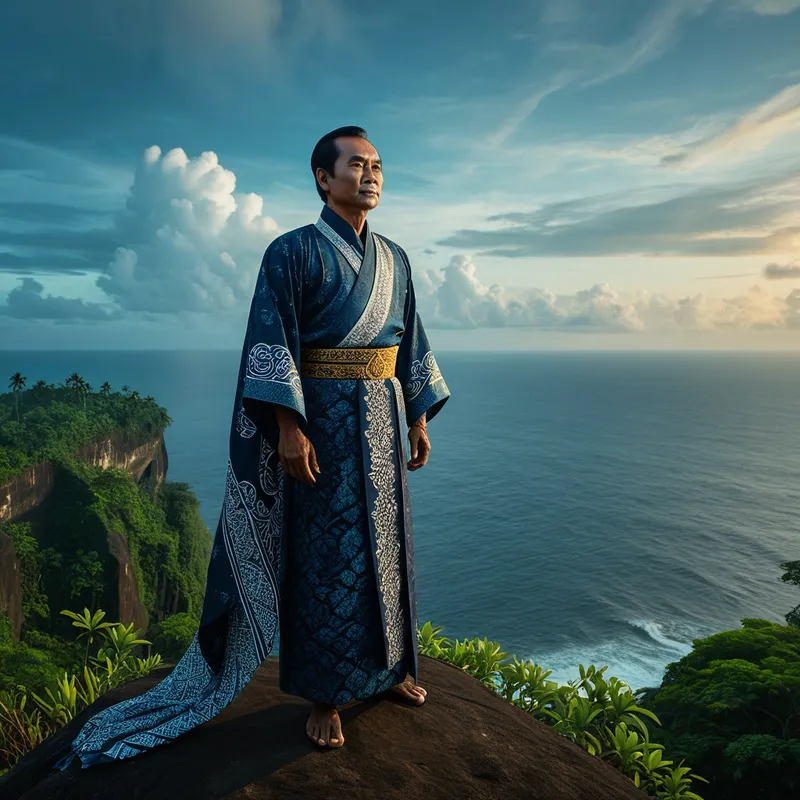
From across the churning Laut Jawa, a light was kindled. His name was Aji Saka. He was a prince of wisdom, his bearing calm as a deep lake, his eyes holding the patience of the ancient banyan trees. He heard the silent scream of the oppressed land and knew his dharma. With him traveled two loyal, inseparable servants, their bond as tight as the weave of a fine kain.
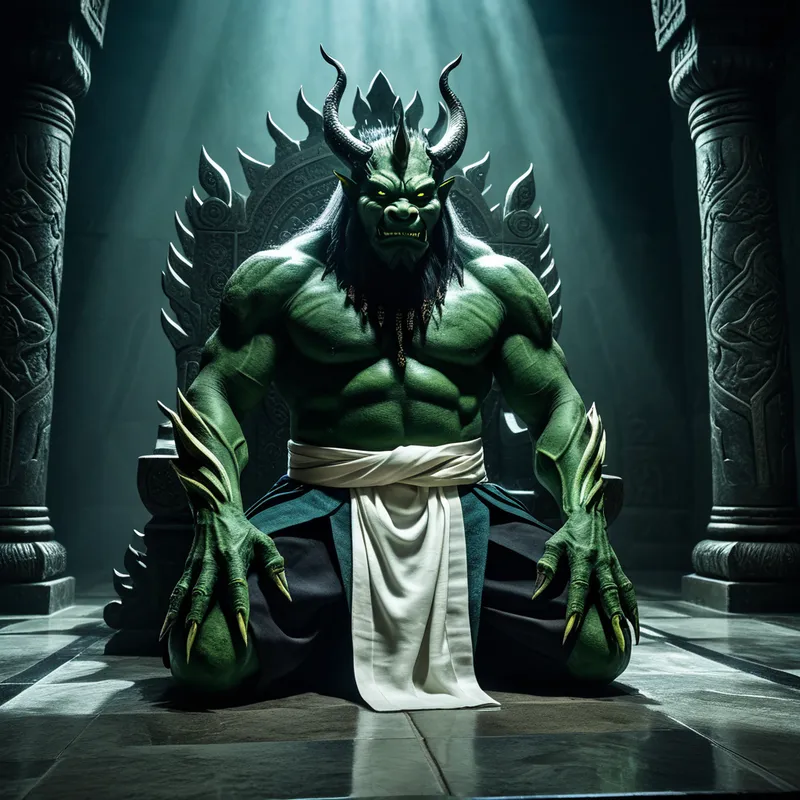
Aji Saka sailed to the blighted shore. He walked unflinching into the court of the devourer-king. The throne room reeked of old blood and damp stone. Dewata Cengkar, a figure of swollen power and green-tinged skin, eyed the newcomer not as a threat, but as a meal. "You come to offer yourself?" the king rumbled, saliva glistening.
"I come to offer a bargain," Aji Saka replied, his voice a clear bell in the murky hall. "Grant me a measure of land. Only the ground covered by my own headcloth."
A greedy laugh echoed. Such a tiny prize for a king who owned all he surveyed! The demon agreed. Aji Saka untied his sacred, white iket headcloth. He laid one end at his feet. Then he began to walk.
He walked, and the cloth unfurled behind him, a stream of pure white against the dark earth. He walked past the courtyards, past the gates, through the fields. A murmur became a roar among the people who trailed him, hope a fragile bird taking flight in their chests. He walked until the cloth stretched taut, a single white line across the horizon. Dewata Cengkar, sensing trickery but bound by his word, stood at the other end, his claws flexing.
"Take your land!" the king snarled.
Aji Saka gave a final, gentle pull.
The earth itself answered. The ground beneath Dewata Cengkar’s feet tore away—a great slab of soil and rock, bound by the magic of the cloth and the hero’s righteous intent. With a roar that shook the sky, the demon king was hurled from the cliff’s edge, down, down into the waiting maw of the Laut Kidul. The waves, commanded by the sea goddess, rose and swallowed him whole. The hunger was ended by the boundless deep.
The people hailed their savior. Aji Saka, now king, did not merely rule. He brought tata krama. He taught the arts of cultivation, of law, of community. And from his wisdom sprang the greatest gift: a system of writing, the sacred Hanacaraka. But from this pinnacle of order, a final, sorrowful lesson was born. His two faithful servants, left to guard his powerful heirloom keris, fell into a fatal dispute over its ownership. Their conflict ended in their mutual demise.
Aji Saka returned to find them both dead. In his profound grief, he immortalized them. He fashioned the first letters of the Javanese alphabet from their names and their fate: Ha-na-ca-ra-ka meaning "There were two messengers," Da-ta-sa-wa-la telling "They fought each other," Pa-da-ja-ya-nya "Equally powerful in battle," Ma-ga-ba-tha-nga "Both became corpses." Thus, from loyalty, conflict, and sacrifice, the very means of recording knowledge—and the story itself—was born.
Cultural Origins & Context
The myth of Aji Saka is a foundational narrative for the Javanese people, the dominant ethnic group on the island of Java, Indonesia. It is not a fossilized relic but a living story, transmitted orally through generations of dalang (puppet masters) in wayang kulit performances, and recorded in ancient chronicles like the Serat Aji Saka. Its primary function was etiological—it explained the origins of Javanese kingship, civilization, and, most famously, the Hanacaraka script itself.
The myth served as a cultural anchor, justifying the divine-right-like authority of later Javanese rulers who claimed descent from Aji Saka's cosmic order. It marked the transition from a pre-civilized, chaotic, even cannibalistic state (zaman edan) to an era of law, agriculture, and literacy (zaman tata). The story was told not just as history, but as a moral and cosmological framework, teaching that legitimate power derives from wisdom, self-sacrifice, and the establishment of harmony, and that even civilization has a tragic cost.
Symbolic Architecture
At its heart, Aji Saka is a myth about the imposition of conscious order upon unconscious, devouring chaos. Dewata Cengkar represents the untamed, predatory Shadow of a land—the raw, instinctual realm that consumes without discrimination. Aji Saka is the archetypal hero consciousness that ventures from a developed center (his homeland) into the chaotic periphery to perform a task of redemption.
The white headcloth is the supreme symbol of this transformation. It is not a weapon of force, but a tool of measure, boundary, and intellect. It represents the power of the idea, of agreement and law, to defeat brute appetite. It turns the demon’s own greed against him, using a bargain to create a fatal container.
The tragic death of the two servants is the myth’s most profound psychological insight. It signifies that the very act of creating order and culture inevitably generates internal conflict. The servants represent complementary but opposing forces within the psyche (perhaps duty and desire, or two facets of loyalty) that, when left unattended by the integrating consciousness (Aji Saka), can turn destructive. Their death is the necessary sacrifice that makes the alphabet—the structure for meaning itself—possible. Order is born from the resolution of conflict, and memory (writing) is born from loss.
The Dreamer's Resonance
When this myth stirs in the modern psyche, it often manifests in dreams of confronting a vast, overwhelming, and consuming force. This could be a monstrous figure, a tidal wave, or a suffocating institution. The dreamer feels like a potential sacrifice to this devouring anxiety or obligation. The Aji Saka pattern emerges if, within the dream, the dreamer finds a simple, elegant, or intellectual "tool"— a spoken truth, a drawn line, a negotiated term—that begins to redefine the boundaries of the threat.
Conversely, one might dream of two close companions or two parts of oneself locked in a fatal, irresolvable argument over a prized object (a keris, a jewel, a title). This somaticizes the internal civil war that precedes a major integration. The grief felt upon waking is not just for the lost figures, but for the innocence lost in realizing one's own capacity for inner conflict. The dream is a psychic drama urging the dreamer to return to the center of their being, to acknowledge the conflict, and to transmute it into a new structure—a "script" for living.
Alchemical Translation
The individuation journey modeled by Aji Saka is the civilizing of the inner wilderness. We all harbor a Dewata Cengkar within—a ravenous complex of old wounds, untamed instincts, or childish demands that consumes our psychic energy. The heroic ego-task is not to annihilate this force (it is hurled into the sea, the collective unconscious, where it remains as potential), but to depose it from its tyrannical throne through cunning, consciousness, and contract.
The alchemical solve et coagula is perfectly illustrated: first, the dissolution of the old, chaotic order (the demon-king); then, the coagulation of a new, conscious order (the kingdom, the alphabet).
The subsequent inner conflict between the "servants"—our sub-personalities or competing values—is a necessary, if painful, stage. The prized keris is the nascent, whole Self. The parts of the psyche fight for sole ownership of this wholeness, unable to see that it belongs to the totality. Their mutual demise is the death of their separate, egoic claims. From this sacrifice, the true, lasting structure is born: not a fleeting feeling of wholeness, but a durable, legible "alphabet" of the Self. We learn to write our own story with the letters forged in that internal conflict, creating a conscious life narrative out of the raw material of chaos and sacrifice.
Associated Symbols
Explore related symbols from the CaleaDream lexicon:
- Hero — The conscious ego that ventures into chaos to establish order and meaning, embodying the will to transform both the world and the self.
- Sacrifice — The necessary surrender, often of innocence or internal harmony, required to forge civilization, knowledge, and a coherent identity.
- Order — The cosmic and psychological principle of structure, law, and balance that emerges from the confrontation with devouring chaos.
- Ocean — The realm of the collective unconscious, which receives and contains the deposed chaos, a place of both danger and profound potential.
- Serpent — The devouring, chthonic force of untamed nature and unconscious instinct, represented by the monstrous hunger of the demon king.
- Dragon — A symbol of the primal, chaotic power that must be overcome for a new era of consciousness to begin.
- Writing — The structured knowledge and cultural memory born from conflict and sacrifice, the tool that codifies and transmits the new order.
- Cloth — The boundary-making, measuring tool of intellect and agreement, which transforms a simple object into an instrument of destiny.
- Mountain — The stable, enduring foundation of kingship and law that is established after the tumultuous battle with chaos.
- Death — The transformative end that makes new beginnings possible, seen in the demise of both the tyrant and the loyal servants.
- Journey — The necessary voyage from a known center into the unknown periphery, where the great work of transformation must occur.
- Shadow — The repressed, devouring aspect of the self or the collective that must be acknowledged and integrated or deposed.