Aido-Hwedo the Rainbow Serpent Myth Meaning & Symbolism
The cosmic serpent who shaped the world, carrying the weight of existence, embodying the primal unity of chaos and order, water and earth.
The Tale of Aido-Hwedo the Rainbow Serpent
In the time before time, there was only the great, silent Nun. From this watery darkness, the first thought stirred. It was Mawu-Lisa, the great one who is both mother and father, moon and sun, night and day. And with them came their companion, the first being of all: Aido-Hwedo.
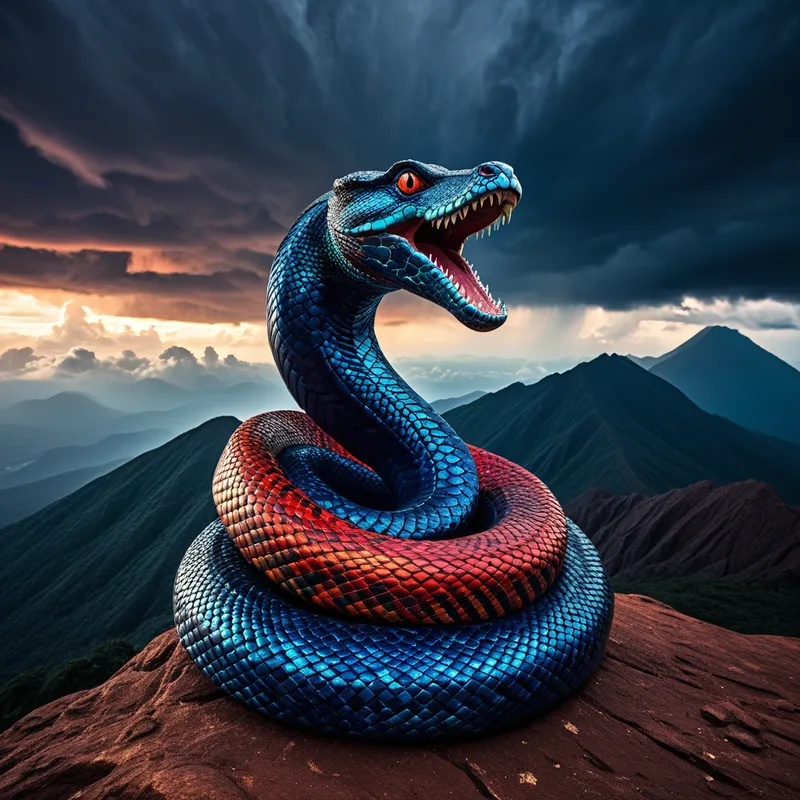
Aido-Hwedo was vastness given form, a serpent whose coils could encircle the universe, whose scales held every color that ever was or would be. When Mawu-Lisa wished to create the world, they did not command from afar. They rode upon the great serpent’s head. Where Aido-Hwedo’s massive body slithered and pressed through the formless waters, it carved out the valleys and the riverbeds. Where it lifted its colossal form, mountains were pushed up from the deep. The earth itself was shaped by the serpent’s passage.
Mawu-Lisa, with careful hands, began to place all the things of the world upon this new, wet earth: trees of immense height, animals of every kind, stones that held fire within. But the earth was soft, unstable. It groaned and shifted under the weight of creation. Seeing this, Mawu-Lisa knew what must be done. They took the mountains they had just formed—the hardest, heaviest stones—and placed them upon the back of the faithful Aido-Hwedo. “You must bear this,” they said, their voice the sound of wind and thunder. “You must coil yourself beneath the world, and hold it steady.”
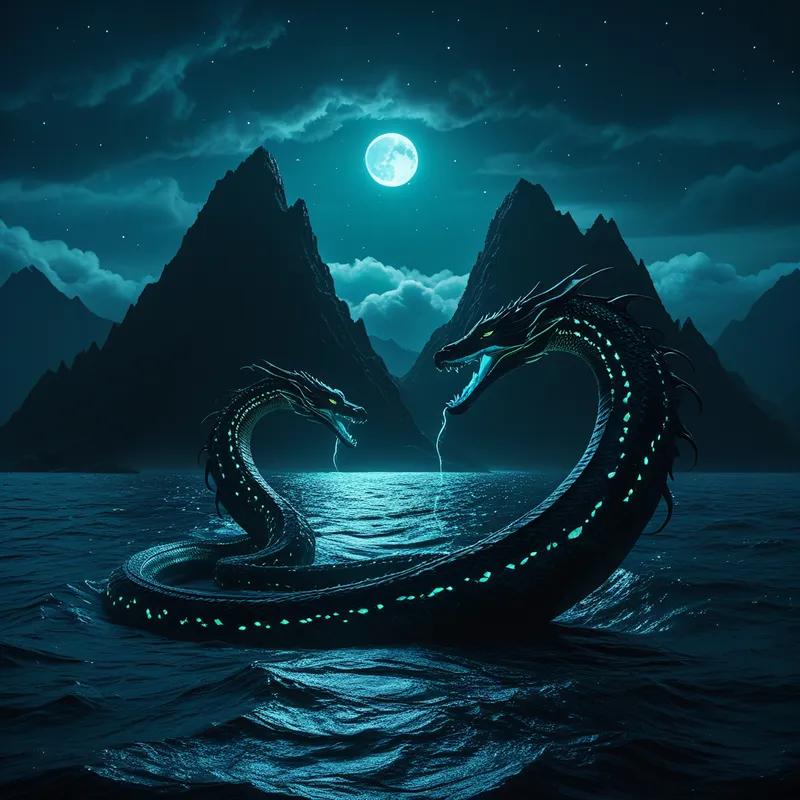
And so Aido-Hwedo, the radiant one, the first mover, took the ultimate burden. It coiled its endless body beneath the crust of the earth, a living foundation. The weight was immense, a constant, grinding pressure. To cool the fiery heat of this labor, Mawu-Lisa commanded the oceans to rise and cover the serpent. Now, Aido-Hwedo rests in the deep, eternal waters, the world balanced upon its back.
When the strain becomes too great, the serpent shifts. That is when the earth trembles. And when it moves, its iridescent skin, glimpsed through the veil of water and storm, arcs across the sky. People look up and whisper: “There is Aido-Hwedo. The world-bearer is moving. Remember the foundation of all things.” The rainbow is not just a trick of light; it is the sigh of the cosmos, the flash of the serpent who carries us all.
Cultural Origins & Context
The myth of Aido-Hwedo originates primarily among the Fon and Ewe peoples of West Africa, in the region that is now Benin, Togo, and Ghana. It is a cornerstone of the Vodun cosmology, a complex system of belief that acknowledges a vast pantheon of spirits (Vodun) under a supreme, often distant creator.
This was not a myth confined to priests alone; it was a living narrative told by elders and griots, a story that explained the very nature of the physical world. Its function was profound: to provide a cosmological map that linked the visible (the earth, mountains, rainbows) to the invisible (the sustaining, divine force beneath). It taught that stability is not passive, but an active, living sacrifice. The myth served as a reminder of the delicate, dynamic balance of creation, where even the ground beneath one’s feet is supported by a conscious, straining divinity. It contextualized natural phenomena—earthquakes as adjustments, rainbows as revelations—within a sacred, interconnected framework.
Symbolic Architecture
Aido-Hwedo is the ultimate symbol of primordial unity and the necessary tension that sustains existence. The serpent is not a monster to be slain, but the foundational matrix of life itself.
The Rainbow Serpent is the archetypal union of opposites: the chthonic (earthly, subterranean) and the celestial, embodied in one being that is both the foundational mud and the arching, ethereal light.
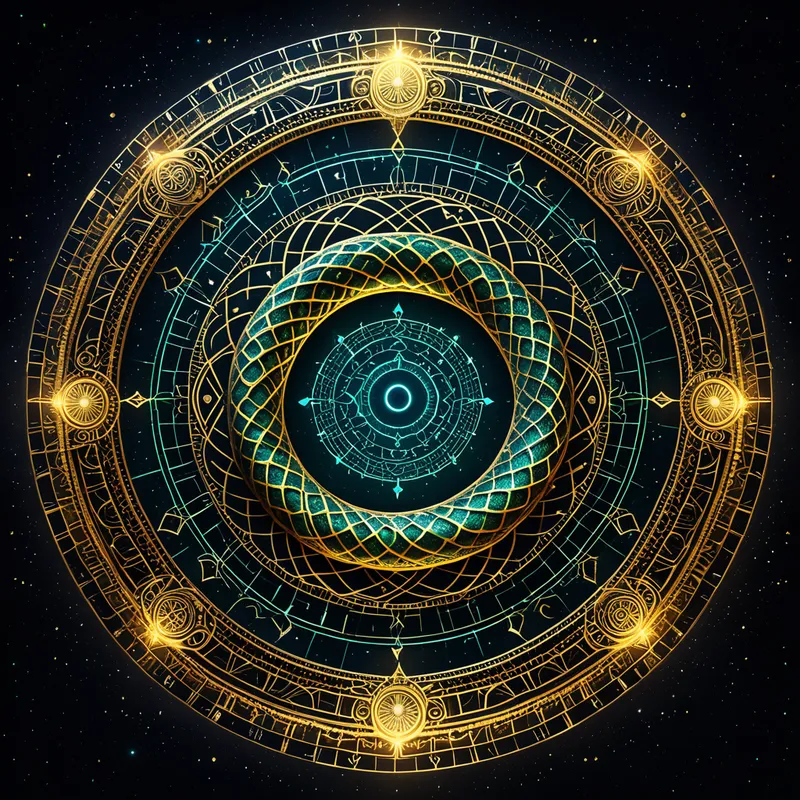
Its coiled posture beneath the earth mirrors the Ouroboros, symbolizing the cyclical, self-contained nature of the cosmos. The Rainbow is its visible aspect—beauty, promise, and covenant—while its hidden body represents the immense, often unconscious, labor that makes beauty possible. Psychologically, Aido-Hwedo represents the foundational structures of the psyche: the instinctual, bodily, and ancestral layers of the unconscious that support the conscious ego (the “world” we experience). We walk upon this psyche, often unaware of the colossal, dynamic forces that bear its weight.
The Dreamer's Resonance
When Aido-Hwedo surfaces in modern dreams, it often signals a profound encounter with the foundational Self. Dreaming of a serpent coiled beneath your house or your body points to a somatic awareness of the deep, structural psyche feeling the strain of a life burden. It is the dream of the foundation shaking.
A rainbow appearing in a dream after a period of turmoil or heavy “labor” may be the psyche’s revelation of Aido-Hwedo—a sign that the supportive, transformative power of the unconscious is actively engaged, even if the process feels burdensome. Dreaming of carrying an impossible weight, or of the ground becoming liquid, can be a direct resonance with this mythic pattern. The dreamer is not being crushed, but is in touch with the archetypal reality of bearing their own world, their own life. The somatic process is one of deep pressure and potential release, where old structures must be felt and adjusted to accommodate new growth.

Alchemical Translation
The journey of Aido-Hwedo is the alchemical blueprint for Individuation. It begins with the prima materia—the formless Nun, the chaotic waters of the unconscious. The first act of consciousness (Mawu-Lisa) is not to reject this chaos, but to ride it, to partner with the primal, serpentine energy of life (Aido-Hwedo).
The great work is not to escape the burden of self, but to consciously take it upon the back of the soul, to coil your deepest nature into a foundation that can support the life you are called to create.
The “mountains” placed upon the serpent are the hard, enduring values, responsibilities, and truths we must integrate. This is the opus, the labor. The “ocean” that cools the strain is the healing, reflective power of the emotional and symbolic life—dreams, art, relationship. The final stage is not a static perfection, but a dynamic, living balance. The tremors (anxieties, depressions, crises) are not failures, but adjustments of this deep structure. The rainbow is the transcendent function—the momentary, beautiful glimpse of the whole system working, a promise that the labor of becoming oneself is sacred, visible, and inherently beautiful. To individuate is to become both the bearer and the borne, to feel the weight of your own existence and see, occasionally arcing across your inner sky, the brilliant proof of its meaning.
Associated Symbols
Explore related symbols from the CaleaDream lexicon:
- Rainbow — The visible sigh of Aido-Hwedo, representing the covenant between the divine burden and celestial beauty, the promise after the storm of creation.
- Serpent — The primal, coiling energy of life and the unconscious that forms the foundation of all manifested reality.
- Earth — The world that is both created and borne by the serpent, symbolizing the tangible reality and the psyche that requires support.
- Mountain — The weight of responsibility, structure, and enduring truth that must be borne by the foundational self.
- Ocean — The cooling, enveloping, and unconscious emotional waters that soothe the strain of bearing the world’s weight.
- Rainbow Serpent — The complete archetype of Aido-Hwedo itself, the ultimate symbol of unified opposites and cosmic sustenance.
- Circle — Reflecting the serpent coiled beneath the world, representing cyclicality, wholeness, and the self-contained nature of existence.
- Chaos — The primordial Nun, the formless waters from which the serpent and all order emerges, representing the necessary raw material of creation.
- Order — The structured world built by Mawu-Lisa and sustained by the serpent’s labor, representing the psyche’s need for stability atop dynamic forces.
- Dream — The modern, internalized ocean where the serpent’s movements and rainbows are revealed as messages from the foundational psyche.
- Journey — The original slithering of Aido-Hwedo that carved the world, symbolizing the path of creation that shapes the landscape of the soul.
- Root — The deep, anchoring, and often hidden support system of the serpent, analogous to ancestral and instinctual connections that ground our being.