Ah Puch God of Death Myth Meaning & Symbolism
The skeletal Lord of the Underworld, Ah Puch, presides over decay and renewal, a necessary shadow in the cycle of life and the psyche's transformation.
The Tale of Ah Puch God of Death
Listen. The night is not empty. In the deep, where the roots of the World Tree drink from waters older than the sun, there is a kingdom of silence. This is Xibalba, and its lord is Ah Puch.
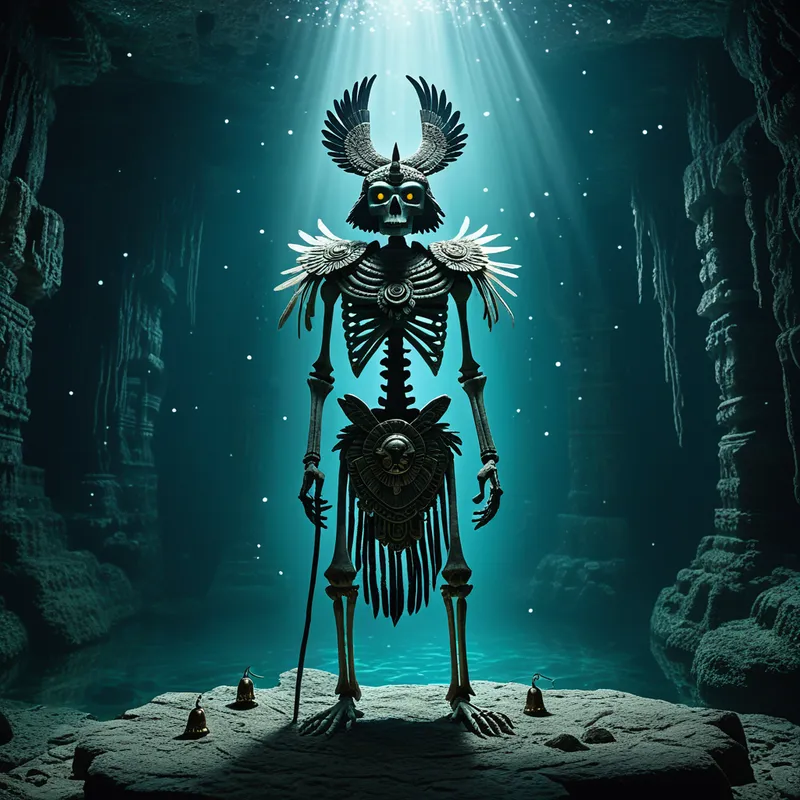
He is not a king of gold, but of bone. His body is a lattice of stars picked clean, a cathedral of absence. Owl feathers, dark as a cave’s breath, cloak his shoulders, and with every movement, the bells tied to his flesh chime a sound like breaking pottery. His eyes are not eyes, but voids where the light of the living world goes to die. They are fixed on the thin membrane between his realm and ours, watching for the moment the soul’s thread frays.
He does not ride a chariot of fire, but a litter borne by phantom dogs and shrieking owls. His procession is a cold wind that withers the maize, a scent of damp earth and rotting blossoms. When he approaches, the very air grows heavy, thick with the perfume of finality. He is the Lord of the Ninth Hell, the Master of Putrefaction, the Kisin.
His story is not one of battle, but of patient, inevitable arrival. The Hero Twins may dance through his halls, outwitting the Lords of Xibalba with cleverness and ball-play, but Ah Puch remains, unmoved. He is the canvas upon which their light is painted. When the maize god is reborn from the cracked shell of a turtle carapace, it is Ah Puch’s kingdom that provides the dark soil for the seed. He is the silence after the song, the hollow in the drum, the necessary decay that makes the forest floor rich.
His resolution is eternal. There is no final defeat for Ah Puch, for he is the finality. He is the gate that every being, from the mightiest king to the humblest farmer, must pass through. His triumph is the quiet, absolute truth that all things end, and from that ending, in the great alchemy of the cosmos, something else may—must—begin.
Cultural Origins & Context
The figure of Ah Puch emerges from the rich, complex tapestry of Classic and Postclassic Maya civilization, flourishing in the rainforests and highlands of what is now Mexico, Guatemala, Belize, and Honduras. This was not a myth told merely for entertainment; it was a vital component of a cosmological understanding where life, death, and regeneration formed an unbreakable cycle.
His imagery is starkly preserved in the codices, like the Dresden Codex, and on funerary pottery. He is depicted with a bloated, decomposing body or as a bare skeleton, often adorned with bells and owl feathers—the owl being his messenger, a creature of the night. This was not a distant, philosophical concept of death, but a visceral, immediate presence. The myth was enacted in ritual, in the architecture of tombs oriented toward the underworld, and in the daily awareness that the fertile earth itself was composed of the decayed ancestors.
The societal function was one of profound integration. By giving death a name, a face, and a place in the divine hierarchy, the Maya culture sought to domesticate the ultimate terror, to make it a part of the community’s story. Ah Puch was a reminder of the price of life, the necessary counterpart to the sun god K'inich Ajaw. To understand the order of the world, one had to understand the order of its end.
Symbolic Architecture
Ah Puch is the ultimate shadow archetype. He is not evil in a moral sense, but the embodiment of the principle of dissolution that consciousness fears and rejects: decay, ending, negation.
To meet Ah Puch is to confront the part of the self that is not eternal, the part that must die for the psyche to evolve.
His skeletal form symbolizes the essential structure stripped of all illusion—the bare truth. The owl feathers connect him to wisdom, but a wisdom that comes only in the darkness, unseen. The bells signify an announcement; his arrival is always heralded, if we dare to listen. His realm, Xibalba, is not merely a place of punishment, but the psychological cenote—the collective unconscious where all our un-lived lives, fears, and forgotten potentials sink and await transformation.
He represents the necessity of the end. In nature, there is no growth without decay. In the psyche, there is no new consciousness without the death of old attitudes, identities, and complexes. Ah Puch is the psychopomp who does not guide the soul to rest, but who holds the space for its unraveling, its return to the primordial source from which new forms can be woven.

The Dreamer's Resonance
When the pattern of Ah Puch stirs in the modern dreamscape, it signals a profound encounter with the shadow and a call for psychic death. This is not about physical mortality, but the ending of a psychological state.
You may dream of decaying buildings you once called home, of finding rooms in your house filled with black, loamy soil and bones. You might encounter a silent, skeletal figure in a crowd, or hear the distinct, hollow sound of ceramic bells in a deep forest. The somatic experience is often one of chilling cold, a feeling of profound stillness, or the scent of damp earth and mildew upon waking.
Psychologically, this is the process of compost. The dreamer is being asked to allow something—a relationship, a career identity, a long-held belief, a pattern of grief or shame—to fully die. To stop resuscitating it. The ego, which identifies with continuity, feels this as a profound threat. But the dream sends Ah Puch not as a destroyer, but as the guardian of this sacred, if terrifying, process. The dream asks: What are you clinging to that is already dead? What must rot so that something fertile can grow in its place?
Alchemical Translation
The individuation journey requires not just building the personality, but dismantling it. Ah Puch models the nigredo—the blackening, the putrefaction stage of the alchemical opus. This is where the prima materia, the raw stuff of the psyche, is reduced to its essential components through a metaphorical death.
The alchemist does not flee from the black sun of decay, but learns to sit in its dark radiance, knowing it is the first color of transformation.
For the modern individual, the "alchemical translation" of Ah Puch's myth involves a conscious engagement with endings. It is the practice of ritualized release. This could be a journaling practice where you formally "bury" an old identity, a physical act of clearing out clutter that represents a dead past, or simply the courageous inner work of ceasing to feed a narrative that no longer serves life.
The triumph is not over death, but through it. By acknowledging the Ah Puch within—the part of us that knows how to end things, to let go, to accept limits—we integrate the shadow of mortality into our living consciousness. We stop pretending we are only creatures of light and growth. We become whole by honoring the decomposer within, the one who makes space. In doing so, we transmute the terror of the end into the quiet wisdom of the cycle. We become, in part, the lord of our own underworlds, capable of presiding over necessary deaths with a solemn, sacred grace, thereby freeing energy for true rebirth.
Associated Symbols
Explore related symbols from the CaleaDream lexicon:
- Death — The core principle Ah Puch embodies, representing not just an ending but the essential transformative decay that makes renewal possible.
- Owl — The sacred messenger and familiar of Ah Puch, symbolizing wisdom found in darkness, silent observation, and the unseen truths of the night.
- Bone — The ultimate symbol of structure stripped bare, the enduring truth beneath the flesh, and the framework from which new life can be scaffolded.
- Cave — The entrance to Xibalba and the womb of the earth, representing the descent into the unconscious, the place of shadow-work and primordial return.
- Decay — The active process over which Ah Puch presides, the alchemical putrefaction that breaks down old forms to release their essence for new creation.
- Shadow — The psychological counterpart to Ah Puch, the totality of the unconscious personality which the conscious ego refuses to acknowledge.
- Door — The threshold between the worlds of the living and the dead, the liminal space where one encounters Ah Puch and must choose to face what lies beyond.
- Earth — The realm of Xibalba and the final resting place, representing the grounding, consuming, and ultimately regenerative power of the feminine principle.
- Ritual — The ceremonial means by which the Maya engaged with Ah Puch, structuring the confrontation with death to integrate it into the community's life.
- Root — The hidden, anchoring part of the self that delves into the underworld, drawing sustenance from the decayed matter of past experiences and identities.
- Dream — The modern Xibalba, the nightly descent where the psyche encounters its own lords of decay and transformation in symbolic form.
- Permadeath — The final, irreversible ending that Ah Puch represents, the absolute conclusion that creates the necessary vacuum for an entirely new beginning.