Aganyu the Volcano Myth Meaning & Symbolism
A myth of a primordial giant whose fiery rage is calmed by sacrifice, creating the first volcano and the possibility of sacred transformation.
The Tale of Aganyu the Volcano
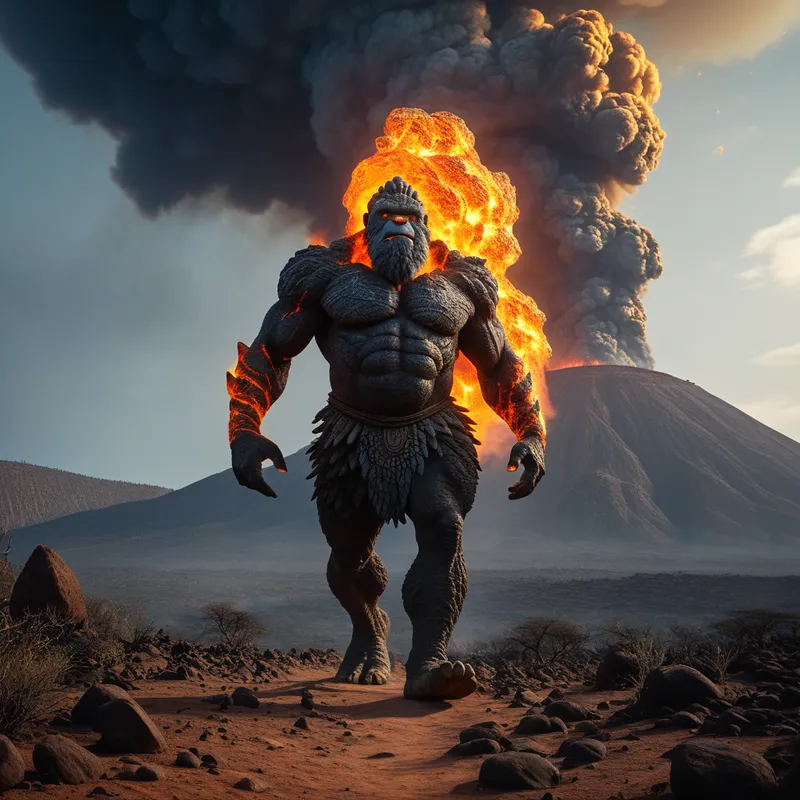
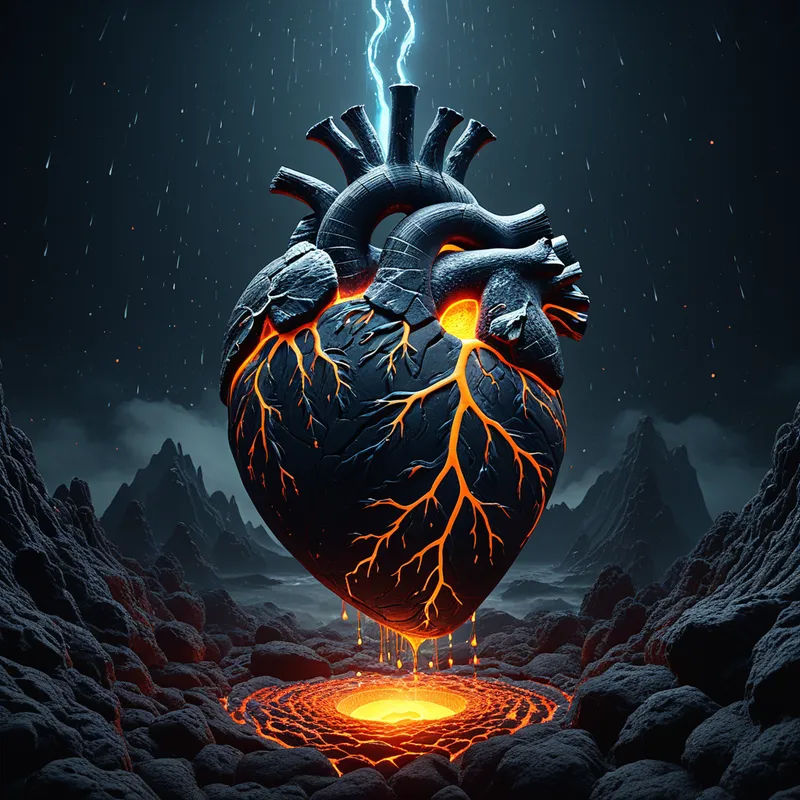
In the time before time, when the earth was young and soft, and the sky pressed close enough to whisper, there walked a being of such immense solitude that the land itself formed the contours of his grief. His name was Aganyu. He was not born but emerged, a child of the deep, silent pressures of the world. He was the earth’s first loneliness given form—a giant of living rock and soil, with veins of molten fire and a heart that beat to the slow, grinding rhythm of tectonic dreams.
For eons, Aganyu wandered the vast, empty plains. He had no voice but the rumble of shifting stone, no companion but his own shadow, which stretched for miles. This solitude curdled within him, fermenting in the heat of his own core. It was not a quiet sadness, but a roaring, building pressure. His grief was geothermal. His rage was seismic. It began as a deep, internal groaning, a heat that could find no outlet. The birds fled before his path. The rivers diverted their courses. The very air grew heavy and still, charged with the impending fury of a spirit too vast for its own form.
One day, the pressure became a scream that had no sound, only force. Aganyu stopped his endless wandering. He looked up at the distant, uncaring sky and opened his mouth. What emerged was not a cry, but the world’s first cataclysm. From his throat and from the cracks that spiderwebbed across his stony flesh erupted a torrent of pure, elemental rage: fire that was older than the sun, smoke that blotted out the dawn, and rivers of molten rock that wept from his eyes. He was not attacking the world; he was unbecoming it. He was turning himself inside out, his inner turmoil becoming the outer landscape of devastation. The earth shook and split. He was a mountain tearing itself apart.
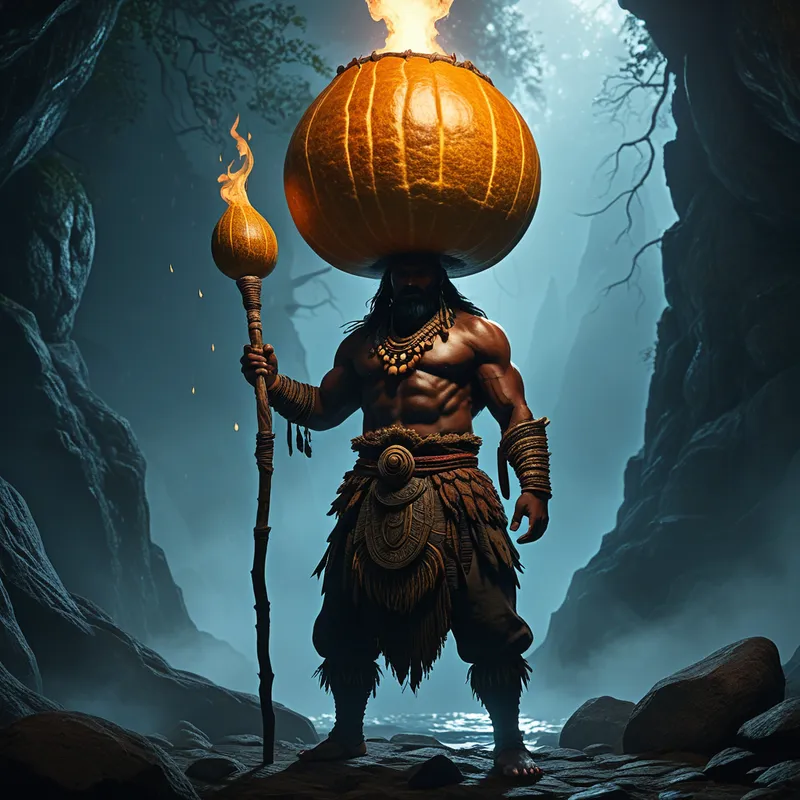
The Orisha, the divine forces of order and nature, watched from their realms. They saw not just destruction, but an agony so profound it threatened to unmake the nascent world. Force would not answer this force; it would only feed the conflagration. Then, from among them, stepped a figure of courage—some say a hunter, others a priest, a mortal touched by the divine. This one did not carry a spear to fight the fire-giant. Instead, they carried a calabash of the coolest, clearest water, drawn from a sacred spring.
The human walked into the storm of ash and heat. They stood, a speck of fragile life, before the colossus of erupting pain. They did not shout. They did not plead. They lifted the calabash and began to pour the water onto the scorched earth at Aganyu’s feet, not against him, but as an offering. A libation. A gesture of recognition. The water hissed into steam, but the act was complete. It was a signal of seeing, of acknowledging the agony without fear.
And in that moment, the impossible happened. The giant’s roaring ceased. The fiery tears slowed. Aganyu looked down, and in that small, brave act of sacred offering, he saw his own reflection—not as a monster, but as a force in terrible pain. The acknowledgment was the key. The raw, exploding rage began to change. It did not vanish, but it transformed. The fire retreated inward, cooling at the edges. The molten rock settled and hardened. The violent eruption softened into a constant, rhythmic pulse of smoke and gentle heat from a new, mighty summit.
Where the raging giant once stood, there now stood a mountain with a heart of fire—the first volcano. Aganyu did not die; he became. His rage was not destroyed, but sanctified. His fiery heart remained, but now it was contained within a vessel of stone, a sacred chimney connecting the deep, passionate heart of the earth to the realm of the sky. He became a landmark, a testament that even the most destructive forces can be alchemized into a source of awe, fertility, and connection.
Cultural Origins & Context
The narrative of Aganyu belongs to the rich oral tradition of the Yoruba people, whose worldview is centered in southwestern Nigeria and parts of Benin and Togo. This myth is not a simple etiological tale explaining volcanoes; it is a profound piece of Iwapele, the concept of good character and cosmic balance. It was likely told by Arokin and elders, not as mere entertainment, but as a foundational lesson about the nature of powerful, non-human forces (Aje) and humanity's role in the cosmic order.
In a culture where the environment is deeply sacralized—where rivers, forests, and mountains are seen as abodes of consciousness—Aganyu’s story explains the presence of a terrifying yet fertile phenomenon. It situates a volcano within a moral and psychological framework. The myth served to instruct on how to approach overwhelming power: not with matching violence, but with ritual respect (Iwa) and strategic sacrifice. It taught that some forces are too vast to control, but they can be related to, and their energy can be redirected from chaos into a stabilized, albeit potent, part of the world’s sacred geography.
Symbolic Architecture
At its core, the myth of Aganyu is a masterful depiction of untransformed psychic energy. Aganyu is the archetypal Shadow made geological: the immense, neglected, and potent aspects of the self that, when left in solitude and without integration, build pressure until they erupt catastrophically. His rage is not evil; it is primal life-force (Ashe) in its most raw and unmediated form.
The volcano is the body’s memory of a scream too big for the throat, a feeling too vast for the psyche to hold. It is trauma solidified into landscape.
The heroic figure who approaches with water performs the essential psychological act: conscious confrontation without aggression. The water symbolizes consciousness itself—cool, reflective, fluid. The offering is not an attempt to extinguish the fire, but to relate to it. This act of seeing and acknowledging is what initiates alchemy. The transformation is not from fire to ice, but from destructive, outward explosion to a contained, inward heat—a source of potential creativity and warmth. The volcano becomes a symbol of stabilized potency, where immense energy is harnessed within a structure, capable of both periodic renewal and providing fertile soil from its ashes.
The Dreamer's Resonance
When the pattern of Aganyu erupts in modern dreams, it signals a somatic crisis point. The dreamer may be experiencing dreams of earthquakes, internal explosions, or being consumed by lava. These are not prophecies of doom, but urgent bulletins from the deep psyche. The body is speaking in the language of tectonics: pressure, heat, and the imminent failure of containment.
Psychologically, this dream-epoch signifies a confrontation with a long-buried affective complex—a core of Grief, Rage, or primal shame that has been orphaned within the self. The dreamer is Aganyu, feeling the intolerable build-up of an emotion that has had no voice, no recognition, no outlet. The eruption in the dream is the psyche’s last-resort attempt to release this pressure, to finally be seen, even if it feels self-destructive. The dream is the eruption; the waking life is the critical moment to bring the "sacred water" of mindful attention to the base of the mountain.
Alchemical Translation
The individuation process modeled by Aganyu’s myth is not one of slaying dragons, but of sacred containment. It maps the journey from being possessed by a complex (the raging giant) to possessing that energy in a usable form (the volcano as a landmark of one’s character).
The first stage is Confrontation with the Colossus: acknowledging the existence of a vast, seemingly destructive force within oneself. This is the "orphan" archetype—feeling abandoned by one’s own stability, a stranger to one’s own rage.
The second is The Libation of Consciousness: This is the active, brave work of therapy, journaling, or somatic practice. It is the act of turning toward the heat with an offering of non-judgmental attention. As in the myth, this does not instantly cure, but it establishes a relationship. It says, "I see you."
The goal of psychic alchemy is not to become cool and placid, but to become a sacred mountain—a self that can contain its own profound heat and transform its eruptions into fertile ground.
The final stage is Stabilization into Sacred Geography: The rage, once a chaotic force that threatened the entire landscape of the self, becomes integrated. It transforms into a core of passion, conviction, and creative fire. It may still "smoke" or occasionally "rumble"—the integrated complex is not erased—but it now has a structure. It becomes a defining part of who you are, a source of strength and fertility, rather than a threat of annihilation. You are no longer the eruption; you are the mountain that holds the fire. This is the ultimate translation: from orphaned rage to a sovereign, contained, and potent self.
Associated Symbols
Explore related symbols from the CaleaDream lexicon:
- Volcano — The central symbol of stabilized rage and transformative power, representing the self after the alchemical process of containing primal fire.
- Fire — The raw, untamed life-force, emotion, and passion that, when unintegrated, destroys, but when contained, creates and warms.
- Mountain — The achieved structure of the self, the enduring form that contains and gives perspective to the inner fire.
- Sacrifice — The conscious act of offering one's comfort, safety, or old identity to approach and acknowledge a deep, painful truth within.
- Water — Consciousness, reflection, and the calming, fluid principle that relates to fire without seeking to destroy it, enabling transformation.
- Earth — The foundational self, the body, and the ground of being that both gives rise to and is shaped by the inner fire.
- Heart — The core of feeling and passion, which in this myth is literally a geothermal heart, symbolizing emotions of immense, primal intensity.
- Rage — The specific, potent, and often orphaned emotion that builds pressure until it demands recognition and alchemical change.
- Grief — The deep, often silent sorrow of isolation and unmet need that can ferment into the pressurized rage that Aganyu embodies.
- Journey — The long, solitary wandering of the unintegrated self, moving toward the inevitable point of crisis and confrontation.
- Stone — The hardened form of experience and the protective, containing vessel that cools from the molten state of raw emotion.
- Shadow — The entire unconscious, rejected, and potent aspect of the personality that Aganyu represents, which must be faced for wholeness.