
Aesir & Vanir Myth Meaning & Symbolism
A myth of war and sacred truce between two god-tribes, forging a unified pantheon from the marriage of order and wild fertility.
The Tale of Aesir & Vanir
Hear now of the first great strife, sung in the halls where mead steams and the fire casts long, whispering shadows. In the dawn of ages, when Yggdrasil was young and the wells of fate still ran clear, there were two tribes of gods. They did not know one another.
From the high plains of Asgard came the Aesir. Their breath was the wind that shapes clouds; their thoughts were the laws that bind promise and oath. They built walls that scraped the bellies of the clouds, halls of timber and stone where the echoes of great deeds rang forever. Odin, with his one eye that saw the weave of all things, and Thor, whose hammer was the heartbeat of the storm, were their champions. Their power was the sky—vast, ordered, and terrible in its judgment.
From the deep, fecund earth of Vanaheim came the Vanir. Their touch was the sap rising in the oak; their whispers were the secrets that make seeds swell and rivers run. They knew the turn of the seasons in their bones and the song of the soil in their blood. Freyr, who commanded the sunshine and the rain, and his twin sister Freya, mistress of Seidr, were their treasures. Their power was the earth—wild, giving, and inexhaustible in its mystery.
A shadow fell between the realms. Distrust, cold and sharp as hoarfrost, crystallized. The Aesir saw sorcery in the Vanir’s deep magic; the Vanir saw arrogance in the Aesir’s lofty decrees. Words turned to accusations, and accusations hardened into the first spear cast across the void. War, grim and relentless, was loosed. Spears of ashwood flew like sleet; enchantments twisted the very air. The walls of Asgard shook, and the orchards of Vanaheim burned.
But gods tire of endless slaughter. A truce, fragile as an early thaw, was declared. To seal it, they did as all wise beings do: they exchanged hostages. To the Aesir went the noble Vanir—Njord and his dazzling children, Freyr and Freya. To the Vanir went Hoennir and the mighty Mimir. Yet the peace was thin. The Vanir, feeling cheated, severed Mimir’s head and sent it back to Odin. The All-Father, in his grief and wisdom, preserved the head with herbs and spells, that it might forever whisper counsel to him.
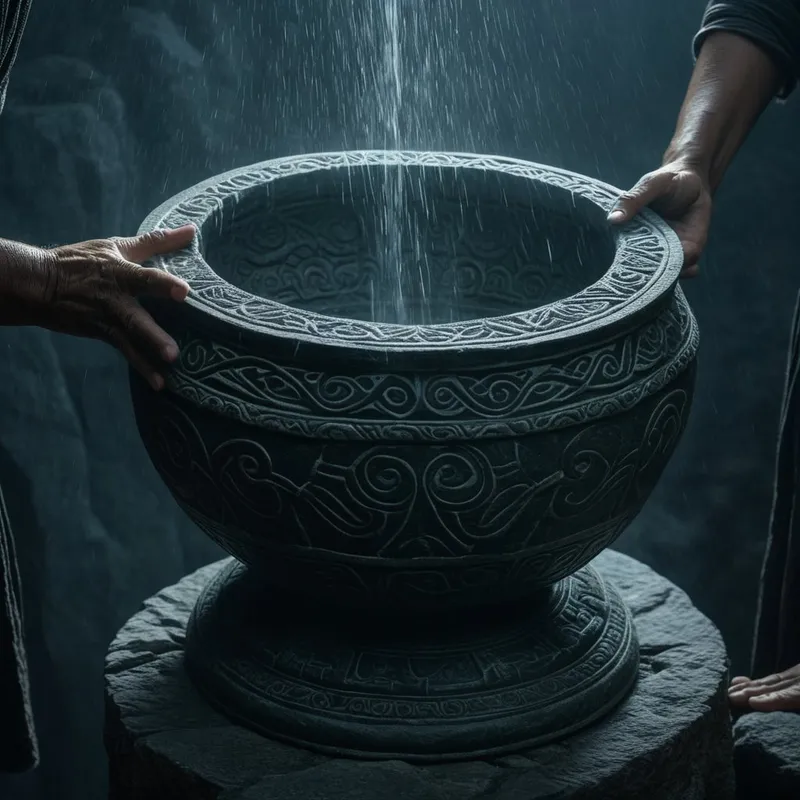
And then, the final, sacred act. All the gods, Aesir and Vanir alike, gathered at the borders of their worlds. Into a great vessel they spat, each contributing their essence, their divine breath. From that mingled spittle, that shared substance of life, was born Kvasir, the wisest of all beings. The war was over. Not with a victory, but with a creation. The tribes were joined, not conquered. From that day forth, they ruled the Nine Worlds as one.
Cultural Origins & Context
This myth reaches us through the fractured lens of the Poetic Edda and the later, more systematic Prose Edda. It was not a scripture, but a living tradition—a story told in the longhouse by the fire, recited by skalds whose words were believed to hold power. Its societal function was profound. For a culture of farmers, sailors, and warriors living at the mercy of elemental forces, the myth explained a fundamental reality: the world is governed by complementary, often conflicting, powers that must find a way to coexist.
The exchange of hostages reflects real-world Viking Age diplomacy, while the creation of Kvasir from spittle speaks to ancient rituals of oath-swearing and peace-making, where the mingling of bodily fluids (spit, blood) created unbreakable bonds. The myth served as a divine model for the necessary alliances between different tribes, between the settled farm and the wild frontier, between the structured law of the thing (assembly) and the raw, unpredictable forces of nature and fortune.
Symbolic Architecture
At its heart, the myth is a grand allegory for the architecture of the psyche and the cosmos. The Aesir represent the principle of consciousness, structure, sovereignty, and celestial order. They are the ego, the father, the sky-god, the impulse to define, defend, and build. The Vanir embody the principle of the unconscious, instinct, fertility, and earthly process. They are the body, the mother, the earth-goddess, the impulse to grow, yield, and connect through feeling and magic.
The war is not a mistake, but a necessity. Consciousness and the unconscious do not recognize each other; they initially perceive the other as a threat to their very existence.
The conflict, therefore, is inevitable. The ego’s order feels constrained by the wildness of instinct; the unconscious’s fertility feels judged and repressed by the rigid laws of consciousness. The hostage exchange is the first, clumsy attempt at integration—an intellectual understanding that each side must host a part of the other. It fails because it is superficial; Hoennir is beautiful but silent without Mimir’s counsel. The true integration is bloody and transformative: the beheading of Mimir.
The sacrifice of the "head" is the sacrifice of one-sided consciousness. Only when the old way of knowing is severed can true wisdom be preserved in a new form.
Finally, the spitting ritual is the alchemical coniunctio oppositorum—the sacred marriage. It is not a battle won, but a new substance created from the raw, shared essence of both sides. Kvasir, born from this union, symbolizes the transcendent function—the emergent wisdom that arises only when opposites are fully united, not just negotiated with.
The Dreamer's Resonance
When this myth stirs in the modern dreamer, it signals a profound internal conflict moving toward resolution. One might dream of warring factions within a single house, of a rigid, sterile city besieged by a lush, overwhelming jungle, or of trying to broker a tense peace between two powerful, disdainful families.
Somatically, this can feel like a tug-of-war in the body: tension in the head and shoulders (Aesir) versus churning in the gut or a pull toward sensual, earthy pleasures (Vanir). Psychologically, it is the process of a long-held, structured identity (a career, a rigid self-image, intellectual dogma) being challenged by repressed instincts, creative urges, or emotional needs that feel "wild" and uncontrollable. The dreamer is in the midst of their own divine war, where an old order must die so a more complete self can be born from the mingled spoils.

Alchemical Translation
The individuation journey modeled here is not one of conquering one's "primitive" side, but of initiating a sacred, often painful, treaty with it. The first step is acknowledging the civil war—the ways our conscious values war with our unconscious drives. The hostage exchange is our first attempt at integration: perhaps taking up a creative hobby (inviting the Vanir in) while keeping it neatly compartmentalized, or exploring spirituality (inviting the Aesir in) as a purely intellectual pursuit. This often fails, leaving us feeling fragmented.
The beheading of Mimir is the critical crisis. It is the moment when our old, familiar way of thinking and identifying ourselves must be sacrificed. This could be a burnout, a depression, a failure that shatters our self-concept. It feels like a death. But like Odin, we must preserve this "head"—not to cling to the old, but to learn to consult it as an oracle, a piece of wisdom detached from egoic control.
The truest peace is not negotiated; it is secreted. It emerges from the vulnerable, almost embarrassing, act of offering one's raw, unformed essence.
The final alchemy is the spitting vessel. This is the humble, bodily work of therapy, art, meditation, or deep relationship—where we offer our raw experience (our "spit") and allow it to mingle with the unknown parts of ourselves. From this vessel, a Kvasir is born: a new, guiding wisdom that is neither purely conscious nor purely instinctual, but a living synthesis. The individual becomes a unified pantheon, capable of wielding both the structured power of the spear and the fertile magic of the earth.
Associated Symbols
Explore related symbols from the CaleaDream lexicon: