Aengus Óg Myth Meaning & Symbolism
The Celtic god of love embarks on a timeless quest for a woman he sees only in dreams, navigating the liminal spaces between vision and reality.
The Tale of Aengus Óg
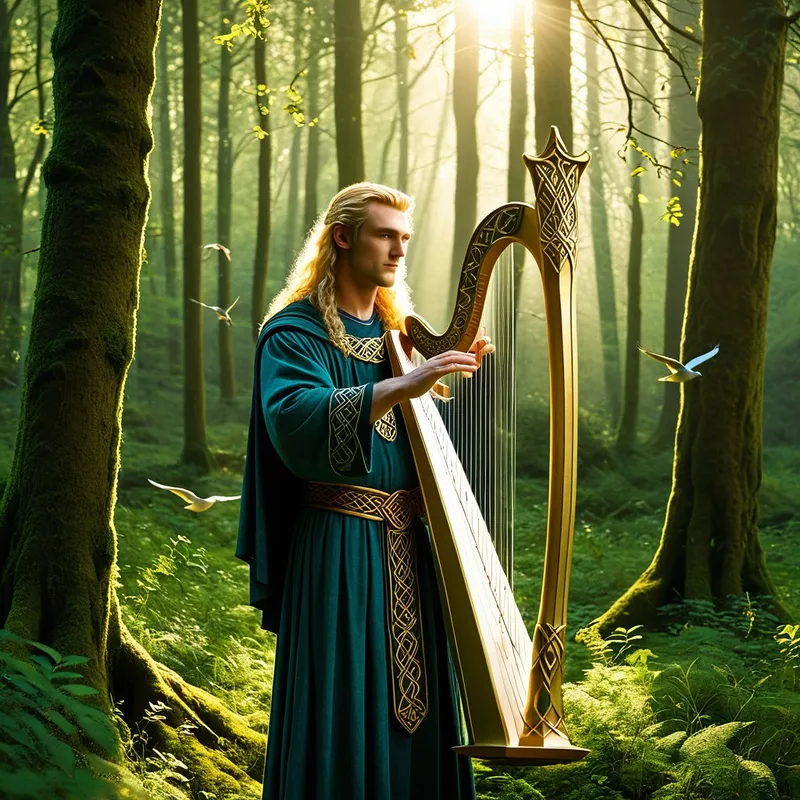
Listen, and let the fire’s glow carry you to the Tír na nÓg. In the great Brugh na Bóinne, the Dagda, the good god, lay with the river goddess Boann. From their union came a son, conceived and born in a single day. They named him Aengus, meaning “true vigor,” and he was called Óg, the young, for his beauty was such that it never faded. He was the god of love, of poetic inspiration, of youth that endures.
But even a god can know a hollow heart. For a year and a day, a vision visited Aengus in his sleep. A woman of such surpassing beauty that the very moonlight seemed woven into her hair stood by his bedside. When he reached for her, she vanished, leaving only the echo of her name in the chambers of his dream: Caer Ibormeith.
The vision became a sickness. Aengus pined, refusing food, his form growing wan. His foster-father, the Dagda, and his mother, Boann, searched all of Ireland but found no trace of such a woman. Finally, the king of the gods, Bodb Derg, was consulted. After a year of searching his own, Bodb found her: Caer, daughter of Ethal Anbuail, a prince of the sídhe of Connacht.
Yet she was no ordinary maiden. For one year, she lived as a human woman. For the next, she lived as a swan, dwelling upon the lake Loch Bél Dracon. And she was not alone. One hundred and fifty swans circled the lake, linked by silver chains, and Caer was among them. To win her, Aengus was told, he must go to the lake on the eve of Samhain and call her to him in her swan form.
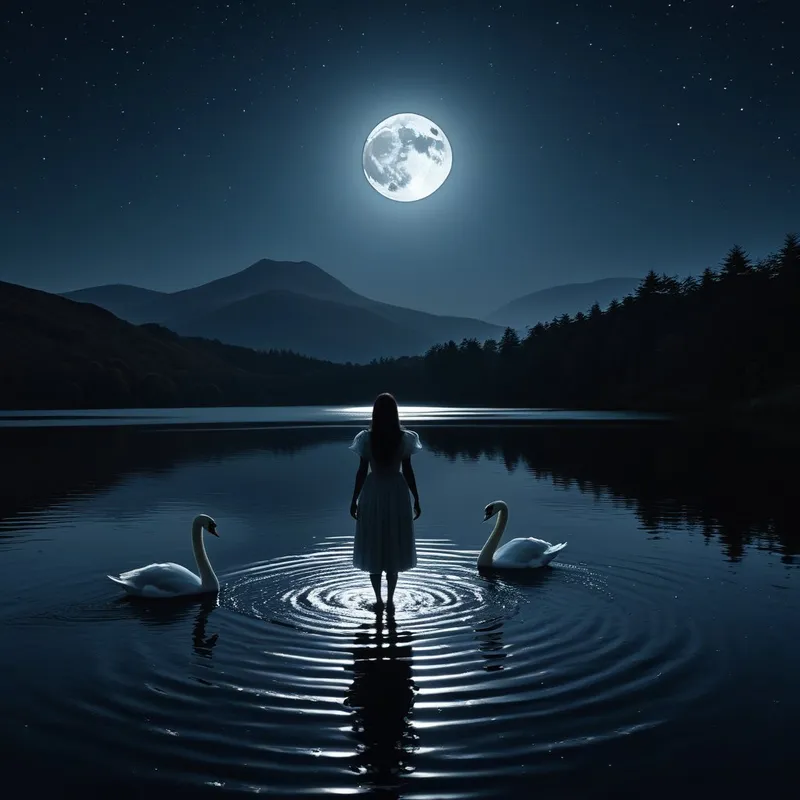
On that fateful night, when the boundary between worlds grew thin as mist, Aengus stood on the shore. He saw the magnificent flock, their white feathers luminous in the autumn moonlight. He called out to her, his voice the sound of a plucked harp string. “Come to me, Caer Ibormeith!”
And she came. The swans circled, and as they did, they cast off their silver chains. Two swans—the most majestic of all—swam to Aengus. He recognized his dream in their dark, knowing eyes. There, on the threshold of the worlds, Aengus too transformed. His human shape melted away, and he became a great, white swan. Together, he and Caer sang a song so piercingly beautiful that all who heard it fell into a deep, enchanted sleep for three days and three nights. Then, as swans, they flew away to his home at Brugh na Bóinne, where they live still, their song the sound of love that has found its true form.
Cultural Origins & Context
This myth is preserved primarily in the medieval Irish text Aisling Óenguso (“The Dream of Aengus”), part of the Mythological Cycle. It is a story from the Tuatha Dé Danann, the tribe of the goddess Danu, who later retreated into the sídhe mounds to become the fairy folk of later folklore.
The tale was likely recited by fili, the poet-seers, who were custodians of history, law, and sacred story. Its function was multifaceted: it explained the nature of divine love as an irresistible, transformative force; it mapped the sacred landscape (tying deities to specific places like the Brugh and Loch Bél Dracon); and it provided a mythological framework for the handfasting traditions of the Celts. Most importantly, it served as a profound allegory for the pursuit of the aisling (vision, dream), the highest form of poetic and spiritual inspiration, which requires the seeker to undergo a fundamental change of state to attain it.
Symbolic Architecture
At its core, the myth of Aengus Óg is a masterclass in the psychology of longing and the nature of true fulfillment. Aengus is not lacking in power, beauty, or station. His is a divine malaise, a soul-sickness born of having seen his own completion in a form he cannot grasp. The dream woman is not a random object of desire, but his own anima, the lost feminine counterpart to his masculine divinity, externalized.
The most profound longing is not for another, but for the part of oneself that exists only in the realm of potential.
The structure of the quest is symbolic: the year-and-a-day of sickness mirrors the gestation period, a necessary dissolution of the old self. The pivotal role of Samhain underscores that this union can only occur in a liminal space—between summer and winter, between the human world and the Otherworld, between waking and dreaming. Caer’s dual nature, woman and swan, represents the beloved as both a personal being and a transcendent, archetypal force. The swan is a near-universal symbol of soul, grace, and transformation. To win her, Aengus must not capture her, but join her in her own element. The silver chains signify the bonds of fate or perhaps the collective nature of the unconscious (the 150 swans), from which the individual soul (Caer) must be distinguished and called forth.
The Dreamer's Resonance
When this mythic pattern stirs in the modern unconscious, it manifests in dreams of profound, elusive beauty. One may dream repeatedly of a mysterious lover whose face is never quite seen, or of a guiding figure who disappears upon approach. There may be dreams of flying as a bird, particularly over water, or of being at a lakeshore at twilight. The somatic sensation is often one of sweet, aching melancholy—a “divine homesickness.”
Psychologically, this signals that the dreamer’s psyche is activating a deep process of individuation. The dream image (the Caer-figure) is a symbol of the Self, the total, integrated personality. The longing is the ego’s pull toward this wholeness. The dream is not instructing the dreamer to find a literal person, but to recognize and pursue the inner vision, the creative spark, or the un-lived life that feels just out of reach. The frustration of the chase is necessary; it wears down the ego’s insistence on control, preparing it for the radical acceptance required for transformation.
Alchemical Translation
The alchemical process mirrored here is the solutio, the dissolving of fixed form into a fluid state, followed by the coniunctio, the sacred marriage. Aengus begins in a state of fixed perfection—the eternal youth. His dream is the nigredo, the blackening, the initial despair that shatters this static perfection. His search is the albedo, the whitening, the purification of intent.
The climax at the lake is the full solutio. He does not fight the beloved’s nature; he surrenders to it. He does not demand she become human for him; he becomes a swan for her.
Individuation is not about becoming who you think you should be, but having the courage to become what you truly are, even if it means shedding the skin of your old identity.
Their flight to the Brugh represents the coniunctio and the resulting rubedo, the reddening, the attainment of the philosopher’s stone—which in psychological terms is the realized Self. The love song that puts the land to sleep symbolizes the mesmerizing, all-encompassing harmony of a psyche that has united its conscious and unconscious elements. For the modern individual, the myth teaches that the pursuit of one’s deepest longing—be it creative, relational, or spiritual—is not a linear conquest. It is a cyclical journey of recognition, patient seeking, and, ultimately, a willing dissolution of the isolated self so that a new, more complete form of being may take flight. The goal is not to possess the dream, but to be transformed by it, to sing its song as your own.
Associated Symbols
Explore related symbols from the CaleaDream lexicon: