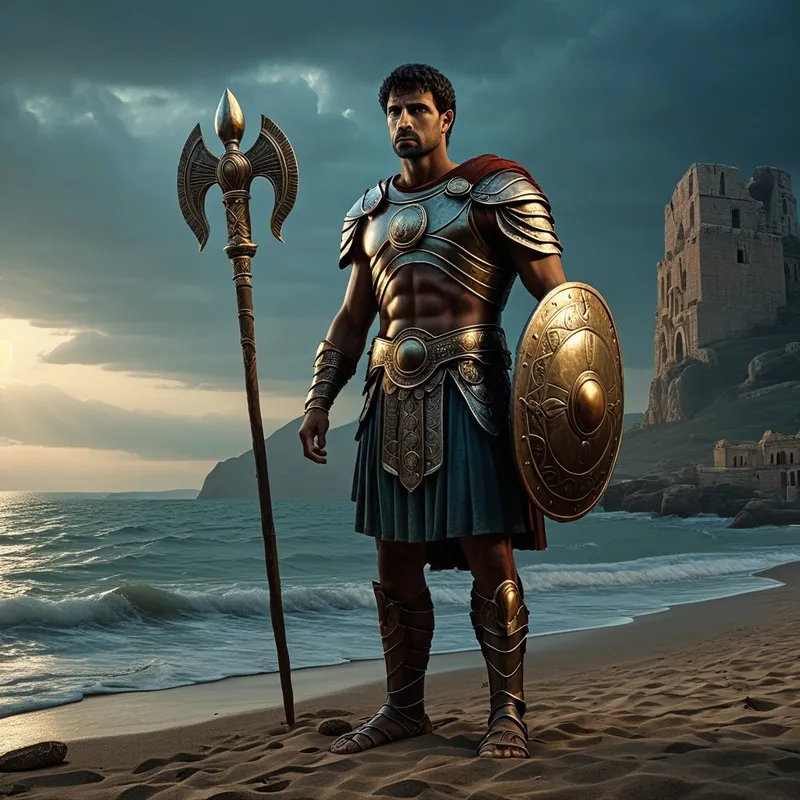
Aeneas Myth Meaning & Symbolism
A Trojan prince, guided by fate and burdened by duty, endures exile, loss, and war to plant the seed from which the Roman Empire would grow.
The Tale of Aeneas
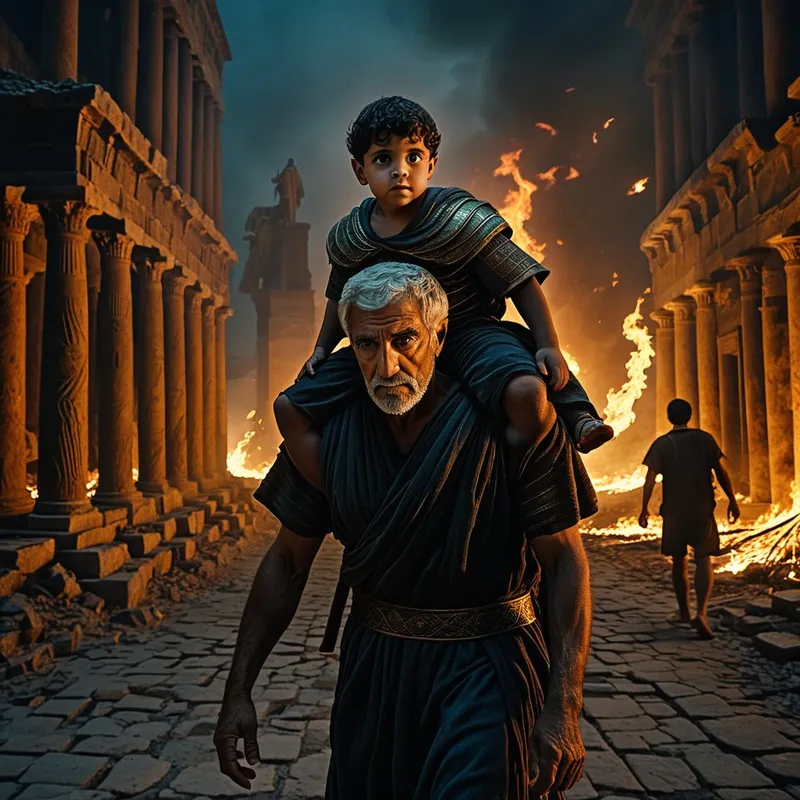
The smoke of Ilium still stings the eyes of the gods. From the ash and the screaming, one figure staggers forth, bearing the weight of two generations on his shoulders. This is Aeneas. His city is a funeral pyre, his king dead, his world undone. The Fates have not cut his thread; they have woven it into a heavier tapestry. With his father, Anchises, clinging to his back and his son, Ascanius, clutching his hand, he passes through the gates of fire, the household gods—the Penates—his only treasure.
The sea is not a refuge but a new arena of torment. For seven years, the wrath of Juno harries him. Storms shred his sails and scatter his fleet. In Carthage, a queen’s heart becomes his temporary harbor. Dido offers him a kingdom, a throne, a love that feels like destiny. But in the dead of night, the messenger god Mercury appears, cold and imperative: “Remember your fate.” Duty is a colder master than love. He sails away, and behind him, a pyre of passion burns against the dawn—Dido’s curse echoing across the waves.
Driven by visions of a promised land, he seeks the Cumaean Sibyl. To know his future, he must first descend into the past. He finds the Golden Bough, his passport to the realm of shadows. In the misty, echoing halls of the underworld, he sees the unquiet dead, the fields of punishment, and finally, the blessed groves. There, the shade of Anchises shows him the pageant of souls waiting to be born—the glorious future of Rome, a procession of heroes stretching into eternity. The vision brands his soul: he is not a man, but a vessel for a people yet unborn.
Landfall in Latium is not peace, but the beginning of a new war. King Latinus sees in him the fulfillment of prophecy, but Juno stirs the warrior Turnus to fury. Alliances fracture, blood soaks the Italian soil. In the final, terrible clash, Aeneas faces Turnus. The Rutulian lies defeated, pleading for mercy. For a moment, humanity flickers in Aeneas’s eyes. Then he sees the belt of his fallen friend, young Pallas, stripped as a trophy on Turnus’s shoulder. Fury, pietas for his comrade, overwhelms pity. The sword falls. With that act, the age of wandering ends. The age of building begins.
Cultural Origins & Context
The myth of Aeneas is Rome’s foundational fiction, a conscious act of poetic and political engineering. While drawing on older Greek fragments about the Trojan hero, it was the Roman poet Virgil, under the patronage of Emperor Augustus, who forged these elements into a unified national epic, the Aeneid, in the 1st century BCE. This was not mere folklore; it was statecraft. The myth served to connect Rome’s burgeoning empire to the venerable antiquity of the Trojan War, granting it a heroic pedigree that rivaled Greece’s. It legitimized the Julio-Claudian line (who claimed descent from Aeneas’s son Iulus) and articulated the core Roman virtue of pietas—duty to gods, family, and state. Recited in forums and taught in schools, it functioned as a civic scripture, defining what it meant to be Roman: to sacrifice personal desire for the destiny of the collective.
Symbolic Architecture
At its heart, the myth of Aeneas is the archetypal journey of the individuating self, where the ego (Aeneas) is tasked by a higher, often painful order (Fate/the Gods) to leave the known world (Troy/the personal past) and endure a liminal sea of trials to found a new consciousness (Rome/the integrated Self).
The hero is not the one who wins, but the one who bears the weight of becoming. Aeneas carries his father—the ancestral past—and leads his son—the potential future. He himself is the living, suffering bridge between them.
Troy represents the complex we must outgrow, a glorious but doomed identity. The burning city is the necessary conflagration of the old self. Dido symbolizes the profound temptation of the anima, the soul’s desire for connection, rest, and creative partnership. To leave her is the myth’s great cruelty and its central necessity—the sacrifice of personal happiness on the altar of a calling that transcends the individual. The descent to the underworld is the non-negotiable journey into the unconscious, where one must confront ghosts and receive the vision that makes the suffering meaningful. The war in Italy represents the final, often brutal, integration of shadow contents (Turnus) that block the establishment of a new psychic order.
The Dreamer's Resonance
When the pattern of Aeneas stirs in modern dreams, it speaks to a psyche in the grip of a foundational transition. The dreamer may find themselves fleeing a “burning city”—a job, relationship, or identity that is collapsing. They feel the burden of responsibility (carrying an elder, guiding a child) amid chaos. The somatic sense is one of profound weariness, a “weight on the shoulders,” coupled with the relentless forward motion of a journey with no clear map.
Dreams of being harried by storms or blocked from a shoreline reflect external resistance and internal doubt. An encounter with a magnetic, all-consuming lover-figure (a Dido) may manifest, offering a seductive escape from the arduous path. The critical psychological process here is the consolidation of pietas—not blind obedience, but a deep, often sorrowful, allegiance to one’s own inner fate or calling, even when it demands heartbreaking choices. The dream-ego is learning to listen to its own Mercury, the inner voice that says, “This is not your home. Keep moving.”

Alchemical Translation
The alchemical work modeled by Aeneas is the opus of creating the Philosopher’s Stone—here, the enduring, golden foundation of the Self. The process begins with nigredo: the blackening, the burning of Troy, the dissolution of all that was familiar and dear. The years at sea are the albedo, the whitening, a purgatorial washing in the salt tears of loss and exile, where all color of the old life is bleached away.
The Golden Bough is the symbol of the citrinitas, the yellowing: the hard-won key of insight that grants passage through the darkest material of the psyche. It is earned, not given.
The descent to the underworld and the vision of future glory is the crucial rubedo, the reddening. Here, the blood of sacrifice gains meaning, and the fragmented soul sees its place in a grand, timeless pattern. The final war is the coagulatio, the coagulation or fixing of the stone. The new consciousness (Rome) is not built peacefully; it must be defended against the last, violent eruptions of the unintegrated shadow (Turnus). The killing of Turnus is a terrible but necessary act of psychic differentiation, where the new Self solidifies by fully confronting and assimilating its own capacity for ruthless decisiveness. The myth concludes not with a celebration, but with a solemn, heavy realization: the foundation is laid, but the building—the lifelong work of living from this new center—has only just begun. The hero’s journey ends where the citizen’s duty begins.
Associated Symbols
Explore related symbols from the CaleaDream lexicon: