Aegis Myth Meaning & Symbolism
The Aegis is the storm-shield of Zeus, a divine artifact of terrifying power, later wielded by Athena as a symbol of strategic, awe-inspiring authority.
The Tale of Aegis
Hear now the tale of the Aegis, not as a thing, but as a force born in the primal scream of the cosmos. Before the age of heroes, in the time when the world was raw and gods wrestled with Titans for the throne of reality, the sky itself was a weapon. Zeus, the Thunderer, did not merely command the storm; he was its furious heart. And from that heart, from the hide of the primordial she-goat Amaltheia who suckled him in secret, or from the flayed skin of the vanquished monster Pallas—the stories whisper over each other like wind through mountain pines—he fashioned his dread sign.
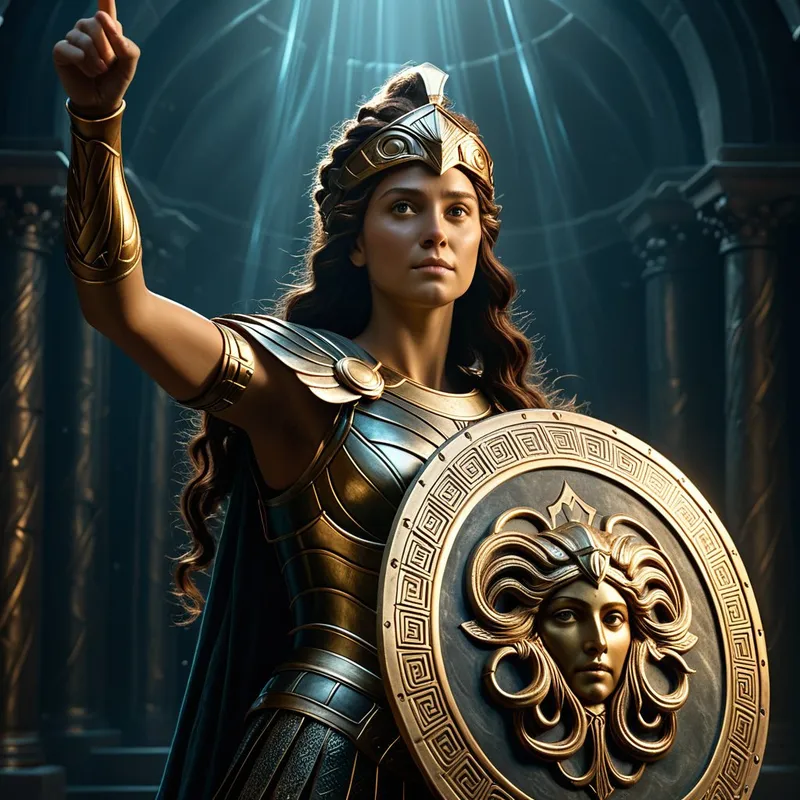
It was no simple shield. To gaze upon it was to witness the birth of awe and terror intertwined. Fashioned by the forger-god Hephaestus, its surface was the color of a gathering tempest at dusk, of polished bronze holding the last light before the deluge. At its center, fixed for all eternity, was the visage of the Gorgon Medusa, her serpent-hair forever frozen in a silent hiss, her eyes wide voids that promised paralysis, the ultimate cessation. When Zeus brandished the Aegis, the very fabric of the world shuddered. He did not raise it to block a blow, but to unleash one. The sound of its shaking was the thunderclap that splits the sky; the light that flashed from the Gorgon’s brow was the lightning bolt that cleaves the oak. It was the banner of his sovereignty, a declaration that here was the power that both orders and obliterates.
But the Aegis found another hand, one that tempered raw fury with glacial intellect. To his daughter Athena, born from his own brow, Zeus lent the terrible device. In her grasp, its nature shifted. She wore it as a goatskin cloak or held it as a buckler, and its terror became strategic, precise. It was her palladium in the chaos of battle, a psychic weapon that sowed panic in enemy ranks—a wave of primal fear preceding the logical strike of her spear. It shielded the heroes she favored, not with a wall, but with an aura of inviolable, divine sanction. Through her, the Aegis became more than an instrument of Zeus’s wrath; it became the emblem of defended civilization, of wisdom so formidable it wears the face of the abyss at its breast.
Cultural Origins & Context
The myth of the Aegis is woven into the earliest strands of Greek epic poetry, its very name—aigis—evoking the goat (aix), tying it to ancient, possibly pre-Olympian, pastoral and storm deities. Its primary narrators were the epic bards, most profoundly Homer. In the Iliad, the Aegis is not a static artifact but an active, terrifying participant. Zeus sends Iris and Phobos to wield it, driving men to mindless flight. Apollo shakes it to rout the Achaeans. Its function in these stories is societal and theological: it visually and viscerally demonstrates the hierarchy of the cosmos. The panic (panikon) it induces is a divine force, a recognition of a power so far beyond human scale that the only sane response is terror and submission.
Its presence in ritual was equally potent. Statues of Athena, most famously the colossal chryselephantine statue by Phidias in the Parthenon, depicted her wearing the Aegis. In this context, it transformed from a battle-horror to a civic protector. For the Athenians, it symbolized the city under the direct, fearsome guardianship of its patron goddess. The message was clear: Athens’s wisdom and strategic power were backed by a divine authority capable of petrifying its foes. The myth thus served to legitimize political and military authority, grounding it in a cosmic order where protection and terror were two sides of the same divine coin.
Symbolic Architecture
Psychologically, the Aegis represents the complex archetype of authority that protects through the managed invocation of terror. It is not a passive barrier but an active field of influence.
The truest shield does not merely deflect the blow; it changes the mind of the one who would strike it.
At its core, the Aegis symbolizes the legitimized power of the Father/King principle (Zeus). This is the raw, structuring force of consciousness that establishes order, sets boundaries, and metes out consequences. Its stormy nature speaks to the potent, often frightening, energy required to maintain psychic integrity against chaos. The Gorgoneion, the face of Medusa at its heart, is the masterstroke of its symbolism. Medusa represents the ultimate face of the untamed, petrifying Shadow—the unintegrated trauma, rage, or primal fear that can freeze the psyche in paralysis. By fixing this image upon his shield, Zeus does not destroy the Shadow; he captures and weaponizes it. The unconscious terror is subjugated, harnessed, and directed outward as a tool of sovereignty.
When Athena assumes the Aegis, the symbol undergoes an alchemical shift. It now represents the conjunction of wisdom and ferocity. Here, the terrifying power of the father is integrated by the discerning, strategic mind of the daughter. The Aegis becomes the armor of conscious realization—the understanding that true wisdom is not naive. It knows the darkness, carries its image, and uses that knowledge not for blind aggression, but for intelligent defense and the sheltering of what is valued.
The Dreamer's Resonance
When the motif of the Aegis arises in modern dreams, it seldom appears as a literal mythological shield. Instead, one may dream of a personal item of immense protective power—a piece of jewelry that glows, a door that cannot be forced, a familiar coat that feels impenetrable. The dreamer often feels a profound, somatic sense of rightful authority or inviolability while in contact with this object.
Conversely, to dream of facing the Aegis—of being confronted by a shimmering, terrifying barrier or a gaze that induces paralysis—signals a profound encounter with legitimate external authority or an internal psychic structure that feels overwhelmingly powerful and forbidding. The somatic experience is key: a freezing in the chest, a weight, a breath held. This is the psyche grappling with a necessary but frightening force of limitation or judgment. The dream asks: What formidable power, either within yourself (a stern inner critic, a long-avoided truth) or in your world (a boss, a parent, a societal rule), are you facing that feels both awe-inspiring and petrifying? The dream of the Aegis marks the process of encountering the non-negotiable, and the psychological work of deciding whether to flee in panic, submit, or seek to understand and integrate its source of power.

Alchemical Translation
The journey of the Aegis, from Zeus to Athena, provides a potent model for individuation—the process of psychic transmutation where one moves from being subject to unconscious forces to becoming the conscious steward of one’s own totality.
The alchemical goal is not to destroy your Medusa, but to mount her visage upon your shield, transforming paralyzing fear into awe-inspiring authority.
The initial state is identification with the unconscious power of the Zeus archetype. This is the individual ruled by raw, reactive impulses—storms of anger, flashes of dominance, or a need for control that feels divinely ordained but is ultimately destabilizing. The "Aegis" here is a weapon of projection, used to threaten the external world into compliance.
The alchemical work begins with the slaying and capturing of the Medusa—the confrontation with the personal Shadow. This is the difficult, heroic task (often undertaken with aid, as Perseus had help from the gods) of facing what petrifies us: our deepest shame, vulnerability, or rage. One does not "beat" this Shadow; one beholds it, severs its autonomous, life-draining power, and takes its essence.
The final, integrated stage is the Athena possession of the Aegis. This is the conscious ego, informed by wisdom (sophia) and craft (techne), taking ownership of that potent, fearful energy. The individual no longer is the storm or is paralyzed by the Gorgon. Instead, they carry the storm's authority and the Gorgon’s warning as integrated aspects of their being. The protective shield is now an emanation of a centered self. One can set boundaries that are firm and awe-inspiring (the shake of the Aegis), not from brittle aggression, but from a deep, unshakeable knowledge of one’s own worth and capability. The terror is not gone; it is mastered, its energy converted into the radiant, formidable presence of a self that is both protected and truly protective.
Associated Symbols
Explore related symbols from the CaleaDream lexicon: