Aegir's Feast Myth Meaning & Symbolism
The gods demand a feast from the sea-giant Aegir, who lacks a cauldron large enough to brew mead for all, forcing Thor on a perilous quest to acquire one.
The Tale of Aegir's Feast
Listen, and hear of the time the gods grew thirsty.
The halls of Aesir were silent, their usual boasting and strife stilled by a singular, shared craving. They had tasted the mead of poetry, they had drunk the ale of victory, but now they desired the deep, unfathomable brew of the sea itself. And so, with the weight of their divine expectation, they descended from Asgard to the threshold of the ocean, to the hall of Aegir.
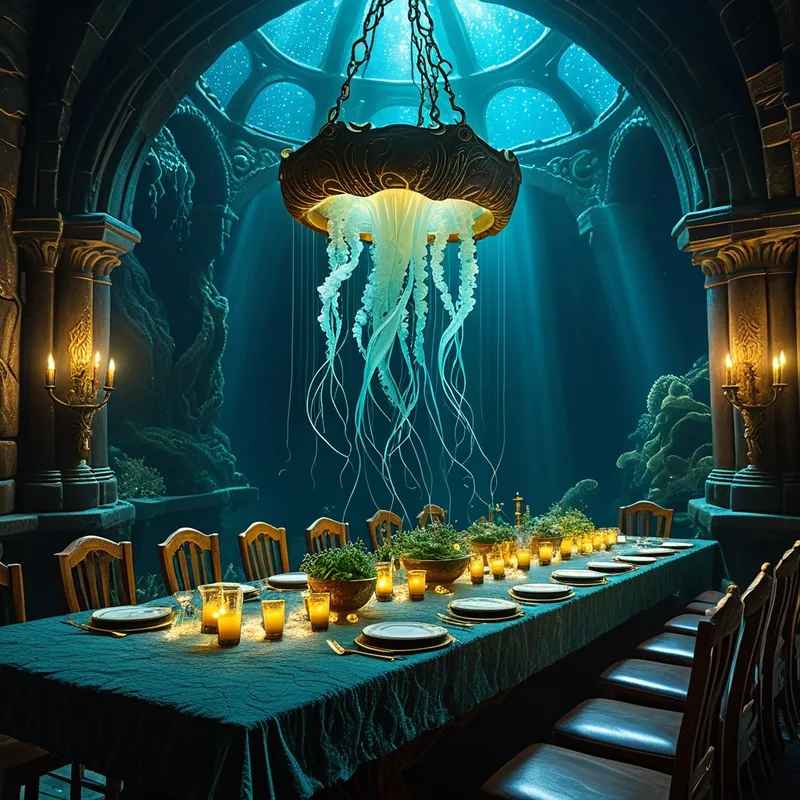
Aegir, whose beard was the grey foam of the ninth wave, whose hall was lit not by fire but by the cold, gold of plundered treasure and the ghost-light of captive sea creatures, received them. He was a giant, yet one who had long kept peace with the gods, his waves carrying their ships, his depths hiding their gold. The gods, led by the one-eyed wanderer and the thunder-bearer, demanded a feast.
But Aegir shook his head, a motion like a settling tide. "Lords of Asgard," his voice rumbled like stones in the deep, "I would brew a mead so mighty it would still the fiercest thirst of the mightiest god. But I have no cauldron vast enough to hold the ocean's bounty for you all. Without such a vessel, the feast is but a dream."
A silence fell, heavier than the ocean's pressure. The gods, who could shatter mountains and outrun light, were thwarted by the lack of a pot. Then Tyr, the one-handed god of courage, spoke. "I know of a cauldron," he said, his voice tight. "A league deep, forged in the dawn of time. It rests in the hall of the giant Hymir, east of Élivágar, under the sky that is frozen. He is my... kin."
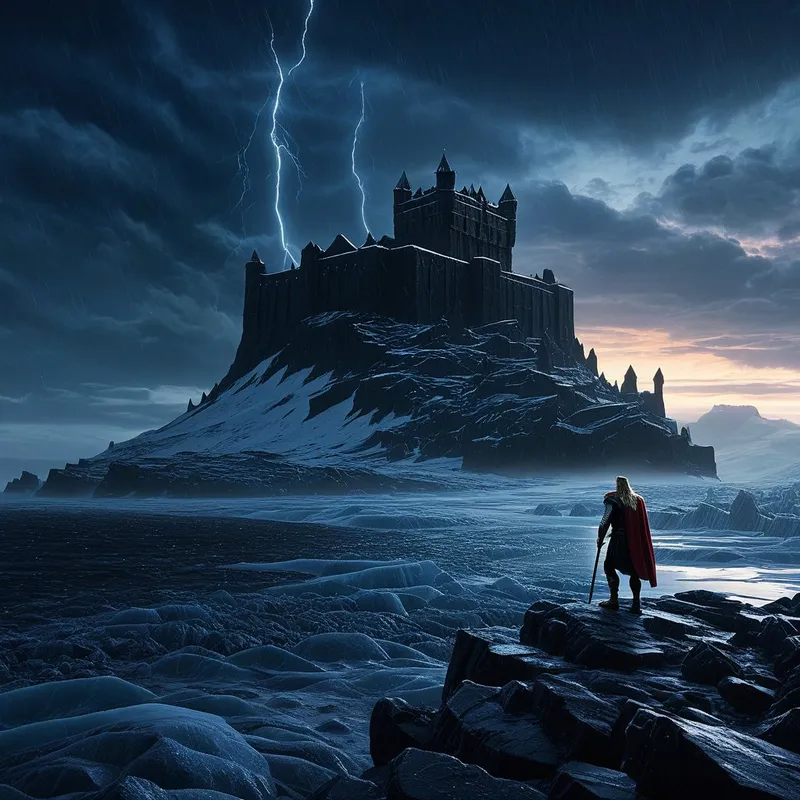
And so the quest was set. Thor, whose rage could boil the sea, harnessed his goats, and with Tyr beside him, they rode into the rim-lands where the world grows cold and giants remember their old grudges. They came to Hymir's hall, a fortress of ice and despair, where the giant returned from hunting with glaciers in his eyes.
The feast in that grim hall was a tense pantomime. Thor, to Hymir's shock and dismay, ate two of the giant's own prized oxen. To prove his worth for the cauldron, Thor was tasked with baiting Hymir's fishing line. What did the god of thunder use? The head of Hymir's largest black ox. What did he catch? Not a fish, but the Midgard Serpent itself, Jörmungandr. The sea boiled, the line sang, the very ocean floor heaved as Thor hauled the cosmic horror to the surface, his feet breaking through the boat's hull to brace against the seabed. In that moment, the struggle was not for a cauldron, but for the fate of the world-sea. Hymir, in terror, cut the line, and the serpent sank back into the abyss, leaving Thor glaring at the giant with promises of violence in his eyes.
Returning to shore, Hymir, perhaps hoping to be rid of them, said Thor could take the cauldron if he could carry it. The gods shattered stone pillars trying to lift it, but the cauldron remained, a mountain of metal. Then Thor, the essence of divine force, simply gripped the rim, stamped his feet through the floor, and hoisted it. He carried it away, the cauldron ringing like a bell of doom against his back as they fled Hymir's wrath.
Back in Aegir's hall, the cauldron was set. The sea-giant, his condition met, brewed his mead. And so the gods finally feasted. They drank the distilled chaos of the deep, the mead that held the taste of storm and serenity, of monstrous depths and shining surfaces. In that hall under the waves, with the cauldron of Hymir at its heart, order and chaos, god and giant, shared a precarious cup, while outside, the serpent they had disturbed coiled in the dark, waiting.
Cultural Origins & Context
The myth of Aegir's Feast is preserved primarily in the poem Hymiskviða (The Lay of Hymir) found in the Poetic Edda, and is referenced in the later Prose Edda. Unlike the grand, world-shaking narratives of Ragnarok, this tale belongs to a different stratum of lore—the mythic anecdote, the story told not of cosmic ends, but of divine social dynamics and the procurement of crucial cultural artifacts.
It functioned as an etiological myth, explaining the origin of the immense brewing cauldrons essential to the Norse culture of feasting, which was the bedrock of social, political, and religious life. The feast (veizla) was where bonds were forged, oaths sworn, and status displayed. A host's worth was measured by his hospitality and the scale of his provisions. The myth elevates this fundamental cultural practice to the divine realm, portraying even the gods as subject to its laws. They cannot simply command a feast; they must fulfill the host's requirement, embarking on a dangerous, almost comically exaggerated quest to secure the proper tool.
The storyteller here is not just recounting a god's adventure but is reinforcing a core societal value: that community and order (the feast) require the confrontation and harnessing of chaotic, external forces (the giant, the serpent). The tale would have resonated in the mead-halls of Viking Age Scandinavia, a reminder that the warmth and safety of the communal fire depended on ventures into the cold, uncertain world beyond.
Symbolic Architecture
At its heart, this myth is a profound allegory of containment. The cauldron is the central symbol—a vessel meant to hold, to brew, to transform raw, boundless potential into something that can be shared and consumed within a defined structure.
The feast is the ordered world; the ocean is the formless chaos that surrounds it. The cauldron is the ritual, the culture, the container that makes one from the other.
Aegir represents the ambivalent, fertile depth of the unconscious itself—capable of providing nourishing insight (the mead) but also of overwhelming the conscious mind if approached without proper respect and preparation (the lacking cauldron). He is not a hostile force, but a neutral one governed by his own laws. The gods, the ruling principles of the conscious psyche (order, law, courage, force), find themselves impotent before his condition. They must descend, must journey "east of Élivágar"—into the psychic hinterlands of the unconscious—to acquire the capacity to hold what he offers.
Thor's confrontation with the Midgard Serpent is the myth's explosive core. It is the moment the ego's heroic force (Thor) directly engages the ultimate symbol of the encircling, devouring unconscious (Jörmungandr). This is not the final battle of Ragnarok, but a preliminary encounter, a testing. The ego glimpses the sheer scale of the psychic totality it is part of, and is both empowered and terrified by it. Hymir's cutting of the line represents the fragile ego's necessary retreat; full integration at this stage would be annihilation. The quest's primary goal is not to slay the serpent, but to secure the cauldron—the means to process the unconscious, not merely fight it.
The Dreamer's Resonance
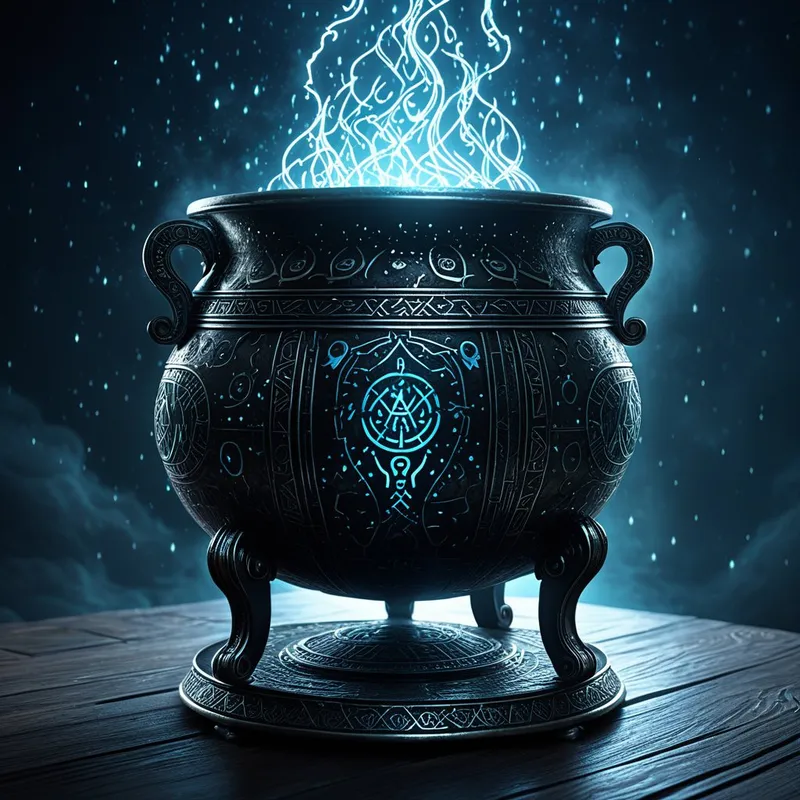
When this myth stirs in the modern dreamer, it often manifests as a profound somatic pressure—the feeling of being in over one's head, of a vast emotional or creative potential that threatens to flood and drown because there is no internal "container" to hold it. One may dream of endless, overwhelming social obligations (the demanded feast), of searching frantically for a specific object to complete a vital task, or of fishing in dark waters only to hook something monstrous and world-breaking.
The figure of Hymir is key. He is the "kin" in the cold place, representing those resistant, archaic structures within the psyche—deep-seated complexes, frozen defenses, or ancestral patterns—that hold the needed resource (the cauldron of capacity) but are hostile to the conscious ego's demands. The dreamer is in a negotiation with their own inner "giant," a part of the self that feels alien, stingy, and formidable. The struggle to lift the cauldron mirrors the dreamer's felt inability to integrate a new strength or capability, until a moment of sheer psychological necessity (Thor's mighty heave) allows a breakthrough.
Alchemical Translation
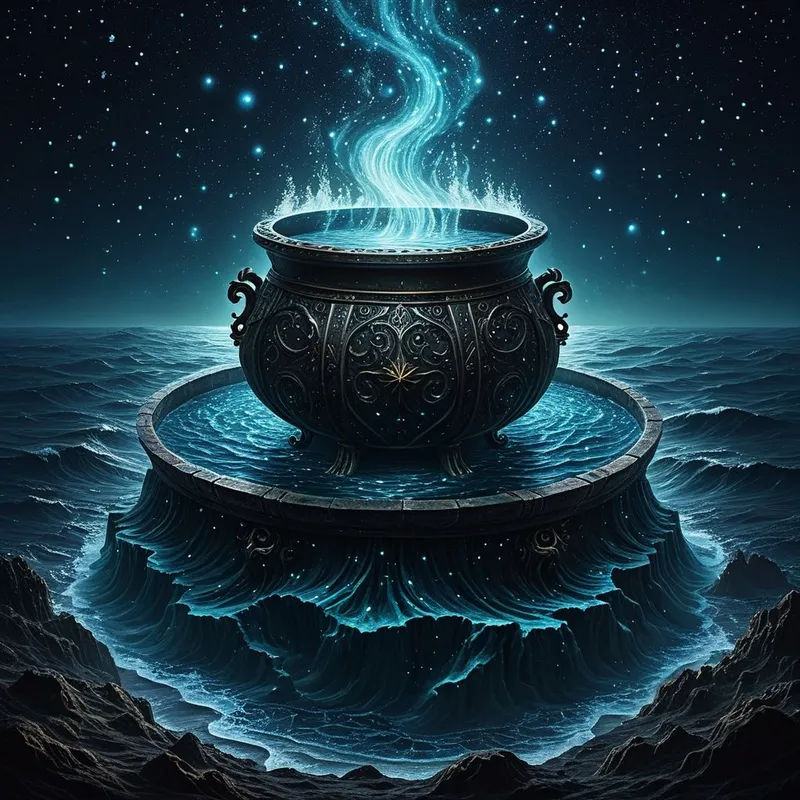
The alchemical journey modeled here is the opus contra naturam—the work against one's own resistant nature to create a vessel for transformation. The individuation process requires that we, like the Aesir, move from a state of lack (spiritual thirst, creative barrenness) to actively seeking the tool that will allow for deep nourishment.
The quest is not for the elixir itself, but for the crucible in which the base materials of experience can be safely dissolved and reconstituted.
First, one must acknowledge the "Aegir" within—the deep, often peaceful but law-bound unconscious that holds the raw material of the Self. Then, one must consent to the "journey to Hymir's hall," confronting the cold, resistant aspects of the personal shadow that hoard our latent capacities. The terrifying encounter with the serpent is non-negotiable; to seek true depth is to risk confronting the sheer magnitude of one's own psychic reality, the "world-encircling" nature of the personal and collective unconscious.
The triumph is not in the battle, but in the retrieval. Integrating the "cauldron" means developing a psychological structure—through ritual, creative practice, therapy, or disciplined introspection—that is robust enough to hold the volatile brew of one's own depths. It is the creation of an inner temenos, a sacred space where chaos can ferment into wisdom, where the monstrous can be glimpsed without being unleashed, and where the final "feast" is the hard-won ability to host all parts of oneself, in a fragile, glorious, and deeply earned communion.
Associated Symbols
Explore related symbols from the CaleaDream lexicon: