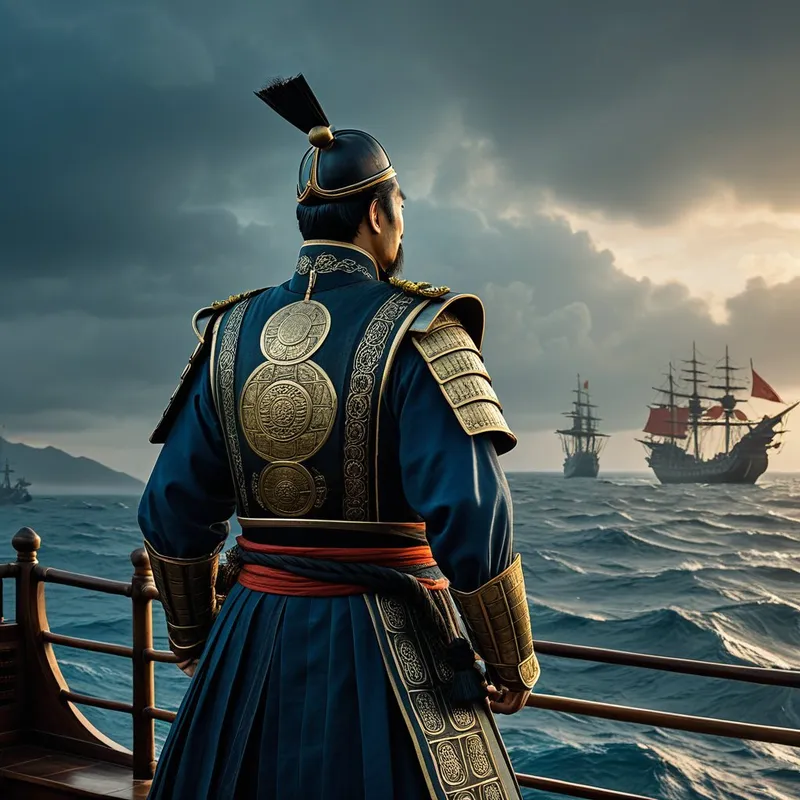
Admiral Yi Sun-sin Myth Meaning & Symbolism
The story of a naval commander who, against impossible odds and political betrayal, defended a nation with genius, integrity, and unyielding spirit.
The Tale of Admiral Yi Sun-sin
Listen. The sea was not always salt and wave; sometimes, it is the breath of a nation, and sometimes, it is its grave. In the age when the Joseon moon hung low and anxious in the sky, a shadow grew from across the water. It was the shadow of a dragon with a thousand ships for scales, an ambition that sought to swallow the land whole. The court was a nest of whispers, of silken robes hiding trembling hands. The defenses were rotten wood. Hope was a guttering candle.
And then, there was the Admiral.
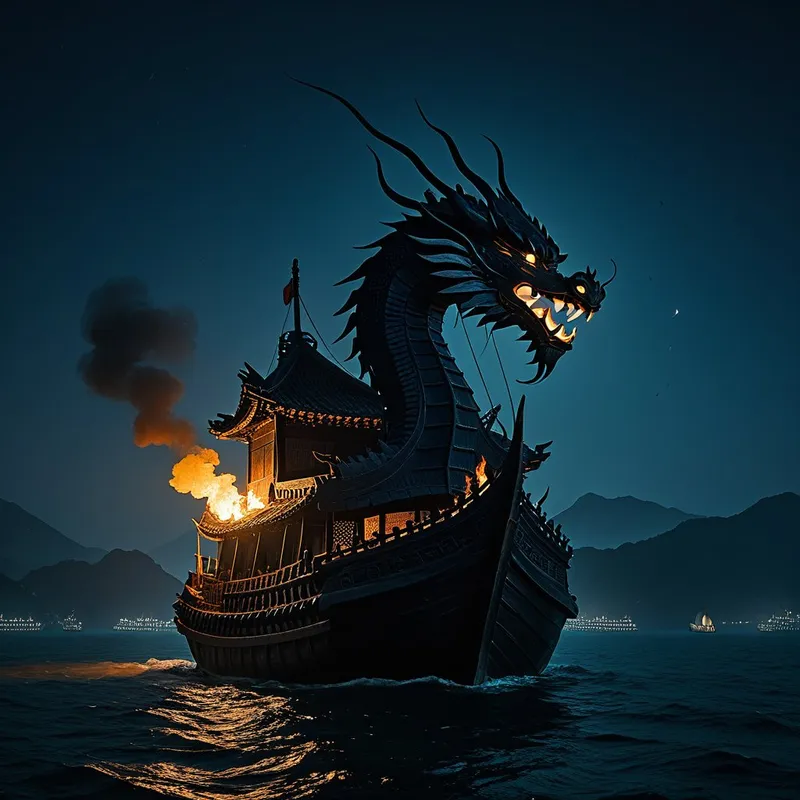
He was not born of a storm, but he became one. Yi Sun-sin walked with a spine of iron and a mind that charted currents deeper than any sailor could see. When they gave him a fleet, it was a fleet of ghosts and splinters. So he dreamed a ship that the world had never seen: the Geobukseon, a fortress that swam, armored like a beast, spitting fire and iron. He built not just vessels, but a wall of will upon the water.
Yet, the greatest enemy often wears your own colors. The envious and the fearful at court, their tongues sharper than any Japanese blade, wove lies around him. They stripped him of his rank, his title, his command. They made him a common soldier, walking in the dust of his own disgrace. The sea, his true kingdom, was forbidden to him. This was his crucifixion—not on wood, but on the rack of betrayal.
But the shadow-dragon fleet came, and the seas ran red with the blood of unprepared men. In desperation, they returned to the disgraced Admiral. They gave him back not a fleet, but a tragedy: a handful of ships against an ocean of enemies. He stood on the deck, the taste of betrayal still bitter in his mouth, and looked at his dozen ships. He did not see weakness. He saw a narrow strait. He saw the turn of the tide. He saw a puzzle, and he was its only solution.
At Myeongnyang, the sea itself held its breath. Thirteen ships against one hundred and thirty. The current was a coiled serpent, and the Admiral knew its mind. He anchored in the channel, a line of defiance so thin it was almost a prayer. As the enemy swarm descended, he unleashed the fury of the strait—the tidal flow that became his ally, funneling the vast fleet into a maelstrom of its own making. Cannons roared like the voice of the land itself. Ships of the invaders, packed tight, shattered and burned. It was not a battle of numbers, but of geometry and spirit. He turned the very landscape into a weapon.
He fought this way for years, an unbreakable dam against the flood. He saved a nation, knowing he was despised by the very court he preserved. His end came not in failure, but in the final moment of a final victory. A single stray shot. He told his son and his nephew to hide his body and keep his death a secret, to let his banner still fly as a ghost of command. His last breath was an order. His final act was duty. And when he fell, the sea, for a moment, grew still.
Cultural Origins & Context
This is not a myth from the misty age of gods, but a legend forged in the documented fires of the late 16th century, during the Imjin War. Admiral Yi was a historical figure of almost incomprehensible military genius, undefeated in 23 naval battles. The mythologization began almost immediately with his death, transforming from history into national psyche.
The primary vessel for this myth was his own Nanjung Ilgi (War Diary), a firsthand account that reads as a profound psychological and spiritual document. His writings, filled with anguish over betrayal, devotion to his men, and unwavering faith in his purpose, provided the authentic, human bedrock. The story was then amplified through official court histories, popular folktales, and later, patriotic narratives during periods of national crisis, particularly the 20th century.
Its societal function is multifaceted. It is a foundational story of resilience, a "Han-infused heroism" that acknowledges profound suffering and injustice as the crucible for transcendent action. It served to model Confucian ideals of loyalty and duty pushed to their absolute limit, while also critiquing the corruption and factionalism that plagued the Joseon court. Ultimately, it became the archetypal story of the individual who saves the collective from itself.
Symbolic Architecture
At its core, the myth of Yi Sun-sin is a masterclass in the symbolism of the Self defending the integrity of the psychic nation from annihilation.
The hero is not the one who never falls, but the one who is reforged in the crucible of his own disgrace, his integrity becoming the anvil upon which fate is shaped.
The Sea represents the unconscious, chaotic, and overwhelming forces of life—the invasive complexes, the neuroses, the raw, undifferentiated psychic energy that threatens to swamp consciousness. The Geobukseon is the symbol of a fortified consciousness. It is not a reckless offensive weapon, but a vessel of impeccable defense and contained power. It represents a psyche that has been consciously engineered—through discipline, insight (the Admiral's strategic genius), and moral principle—to withstand the onslaughts of the unconscious.
The Court symbolizes the persona—the adapted, socialized, and often corrupt outer layer of the personality. Its betrayal of the Admiral is the moment the ego, identified with social standing and approval, turns against the deeper, authentic Self. His demotion is the ultimate dark night of the soul, where the guiding principle is stripped of all external validation and must operate from pure, internal authority.
The Battle of Myeongnyang is the supreme symbol of enantiodromia—the turning of an extreme situation into its opposite. The overwhelming force (the shadow, the complex) is defeated not by meeting it with equal force, but by understanding and utilizing the hidden laws of the psychic landscape (the tides, the strait). It is the triumph of consciousness through alignment with a greater pattern, not through brute strength.
The Dreamer's Resonance
When this myth stirs in the modern dreamer, it signals a profound engagement with the archetype of the besieged Self. To dream of holding a narrow pass against impossible odds, of repairing a broken vessel while being sabotaged, or of receiving a sacred duty from a stern, armored figure is to feel the Admiral's pattern activating.
Somatically, this may manifest as a tightening in the shoulders and jaw—the body preparing to bear a burden. Psychologically, it is the process of "holding the line." The dreamer is likely in a life situation where their core values, integrity, or a crucial project is under sustained assault, whether from external pressures or from internal "courtiers"—voices of self-doubt, fear, or the temptation to compromise. The dream is not necessarily about winning a glorious victory, but about the somatic and psychic experience of enduring with purpose. It asks: What is your Geobukseon? What have you built within yourself that can hold fast? And what corrupt "court" within you must you disobey to remain true to your duty?
Alchemical Translation
The alchemical journey modeled here is not of a seeker finding a treasure, but of a guardian transmuting leaden betrayal and despair into the gold of unassailable purpose. It is the opus of the citadel.
Individuation is often pictured as a quest outward, but the myth of Yi Sun-sin reveals it can be a supreme act of defense—the conscious, deliberate fortification of a sacred inner space against the chaos that would dissolve it.
The first stage is Calcination: the burning away of social identity. The Admiral's demotion is this fire. For the individual, it is any experience of unjust humiliation, failure, or betrayal that destroys one's standing in the world. The ego is reduced to ash.
The second is Coagulation: the formation of the essential vessel. This is the building of the Geobukseon—not in a time of crisis, but in preparation. For us, it is the daily, disciplined work of building psychological structure: ethical codes, mindful practices, cultivated skills, and intellectual frameworks. It is creating a container strong enough to hold the coming conflict.
The supreme operation is Conjunction, achieved at Myeongnyang. Here, the Admiral (conscious will) does not fight the sea (the unconscious) nor the enemy (the shadow). He conjoins with the hidden law of the strait (the Self's deeper pattern). The modern translation is the moment of insight where we stop fighting our nature or our circumstances directly, and instead discover the unique, hidden "current" within the problem—the leverage point where our authentic nature and the demands of reality align. Victory comes from this marriage, not from force.
The final, poignant stage is Mortificatio and Sublimatio in one breath: his death-in-victory. The ego-Self axis is so perfectly aligned that the death of the individual personality (the Admiral) does not collapse the operation. The purpose continues. In individuation, this symbolizes the ultimate sacrifice: the relinquishment of the hero identity itself. The integrated individual acts not for glory, but because it is necessary, and is willing for their personal self to be transcended by the work itself. The banner flies, even when the standard-bearer has fallen. The conscious personality becomes a vessel for a transpersonal duty, and in that final act, achieves its immortal form.
Associated Symbols
Explore related symbols from the CaleaDream lexicon: