Adam Kadmon Myth Meaning & Symbolism
The myth of the cosmic blueprint, the Primordial Human whose shattered light initiates the soul's journey back to divine unity.
The Tale of Adam Kadmon
Before time, before space, before the whisper of a name, there was only the Ein Sof. A boundless, unknowable ocean of pure potential, a silence so complete it was a kind of music. From this profound stillness, a desire arose—not a human want, but a divine yearning to be known. To behold Itself. And so, the Infinite contracted, drawing in Its boundless light to make a space, a womb of pure absence called the Tzimtzum.
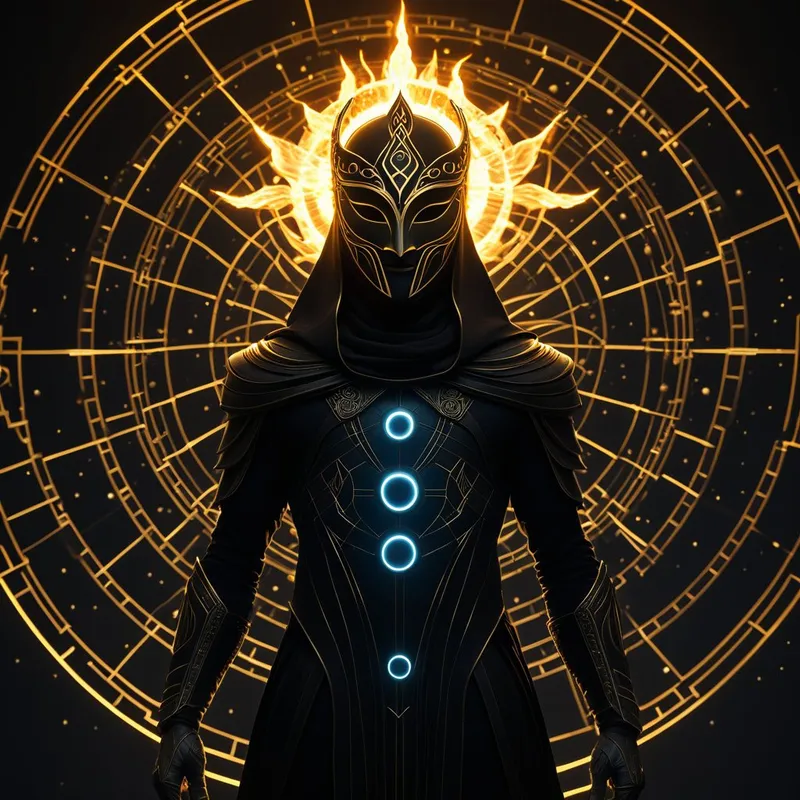
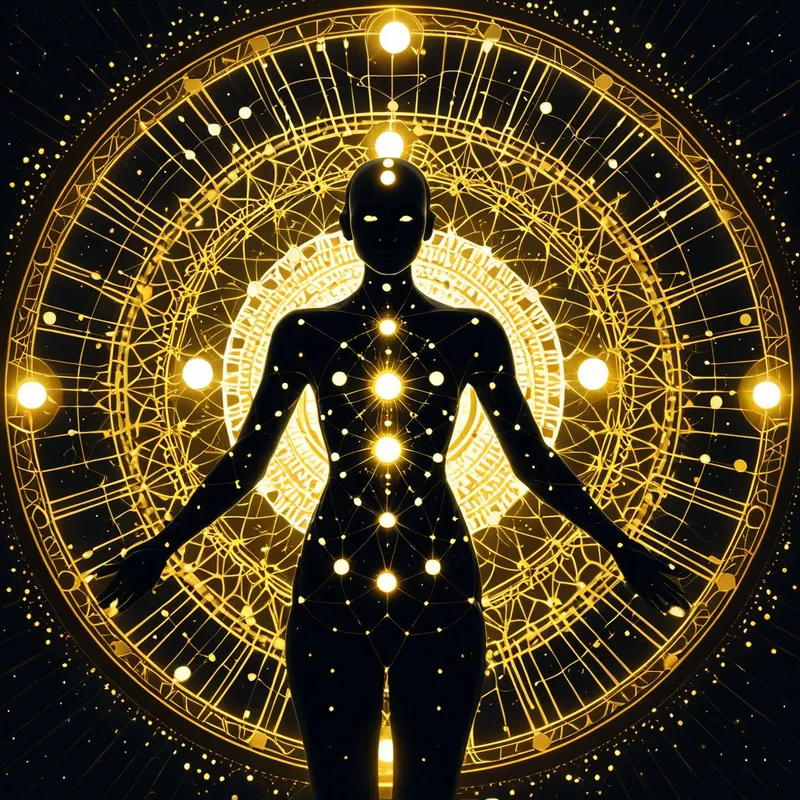
Into this holy vacuum, a single ray of the concealed light descended. But this was no mere beam; it was a form, a pattern, a living idea. It was the Adam Kadmon. Imagine a figure not of flesh, but of structured luminescence, vast as the cosmos yet intimate as a thought. Its body was not a body as we know it, but a constellation of intention. From its brow, its heart, its limbs, emanated ten vessels of pure, crystalline light—the Sefirot. They hung in the void like perfect lanterns, arranged in the pattern of a human form: Keter at the crown, Chokhmah and Binah at the mind, Chesed and Gevurah at the arms, and so on, down to Yesod and Malkhut at the base.
A river of divine radiance, the very essence of the Ein Sof, began to pour from the forehead of Adam Kadmon, flowing down through these vessels to fill them and, in time, create worlds. But the light was too pure, too potent. The vessels of the lower Sefirot, those of structure and form, could not contain the infinite force. With a soundless, catastrophic shattering—the Shevirat HaKeilim—they fractured. Shards of the vessels, still holding captive sparks of the primordial light, fell through the levels of reality, scattering into the abyss of the coming material world.
Adam Kadmon did not die. It remained, the eternal template, now presiding over a cosmos of beautiful, tragic fragmentation. The unbroken light from its higher vessels continued to shine, a guiding memory of unity, while its task—and the task of all that would follow—became one of gathering. The story was no longer just one of emanation, but of desperate, loving redemption. The cosmic human had breathed out its soul, and that soul was now lost in the world, waiting to be found.

Cultural Origins & Context
The myth of Adam Kadmon is not a folktale but a profound metaphysical map, emerging from the heart of Jewish mystical thought, particularly the Kabbalah of the Middle Ages. It finds its most elaborate expression in the Zohar and was systematized in the 16th century by the great sage Isaac Luria in Safed. This was not a story for public squares, but for initiated circles who studied by candlelight, seeing in its structure the secret anatomy of God, the cosmos, and the human soul.
Its societal function was dual. For a people often in exile and persecution, it provided a cosmic validation of their experience: the world is broken, but that brokenness is part of a divine, purposeful drama in which they played the essential role of "gatherers of the sparks." It transformed suffering into sacred mission. Secondly, it served as an intricate psychological and theological model, offering a language to describe the paradox of a transcendent God involved in a finite creation, and the corresponding journey of the soul from fragmentation back to its source.
Symbolic Architecture
Adam Kadmon is the ultimate archetype of the blueprint. It represents the perfect idea that precedes and informs all flawed manifestation. It is the soul before the trauma of incarnation, the unified field before the Big Bang, the complete psychological Self before the ego’s birth and the subsequent splintering into complexes.
The myth teaches that creation is not an act of building from the ground up, but of remembering from the inside out. The world is a scattered text of a single, holy word.
The ten Sefirot are not just divine attributes but the fundamental structures of consciousness itself: will, wisdom, understanding, love, judgment, beauty, endurance, splendor, foundation, and realization. The Shevirah symbolizes the inevitable trauma of existence—the moment pure potential meets the limitations of form, whether cosmic, historical, or personal. The "sparks in the shells" (Klippot) represent divine energy trapped in negativity, addiction, trauma, and unconsciousness, as well as the hidden holiness within the mundane.
The Dreamer's Resonance
When this myth stirs in the modern unconscious, it rarely appears as a bearded giant of light. Instead, it manifests as dreams of profound fragmentation or nascent wholeness. One might dream of a beautiful, intricate machine or crystal shattering. One might find themselves in a vast, dark library trying to reassemble a book from scattered pages that glow faintly. There could be dreams of a shadowy, majestic figure standing just behind you, felt but not seen—the latent template of the complete Self.
Somatically, this can correlate with a feeling of being "scattered," of having one's energy or attention pulled in ten directions. Psychologically, it signals a process of dis-identification. The ego (a small, temporary vessel) is feeling the pressure of a larger, more authentic consciousness trying to emerge. The dream is mapping the fault lines in one's current psychic structure, showing where one's capacity for love, judgment, or wisdom has become brittle and needs to shatter to allow for a stronger vessel to form. It is the psyche's diagnosis of its own "cosmic catastrophe" and the first hint of the repair to come.
Alchemical Translation
The Lurianic myth is, in essence, a grand alchemical formula for individuation. The process of Tikkun Olam (repairing the world) is identical to the process of individuation. The first stage, Tzimtzum, is the necessary withdrawal of projection and inflation. We must create a space within, a holy void, by quieting the ego's noise to allow something new to emerge.
The emanation of Adam Kadmon is the dawning of the Self-archetype, the vision of one's own potential wholeness. The shattering is the painful but necessary deconstruction of old, rigid identities, neurotic patterns, and outgrown worldviews that cannot contain the new consciousness.
The alchemical work is not to avoid the break, but to kneel in the ruins with discernment, gathering not the shards of the old vessel, but the liberated light that was trapped within it.
The final stage is the conscious reconstruction. We do not return to a naive, pre-fractured unity. We build a new, more resilient vessel—the integrated personality—capable of holding both light and shadow, unity and diversity. The repaired Sefirot become a functioning, balanced psyche where wisdom tempers love, and discipline channels grace. The modern individual living this myth moves from feeling like a passive shard blown by fate to becoming an active, microcosmic Adam Kadmon: a localized point where the universe remembers itself, gathers its lost light, and becomes whole again.
Associated Symbols
Explore related symbols from the CaleaDream lexicon: