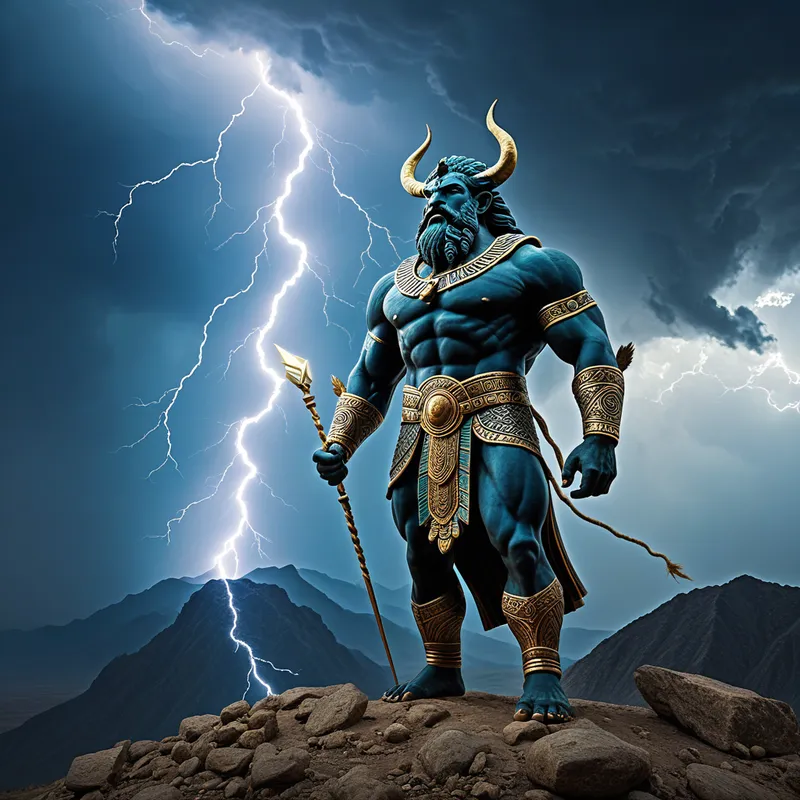
Adad the Storm God Myth Meaning & Symbolism
The myth of Adad, wielder of thunder and rain, embodies the terrifying and life-giving duality of the storm, a divine force of both destruction and renewal.
The Tale of Adad the Storm God
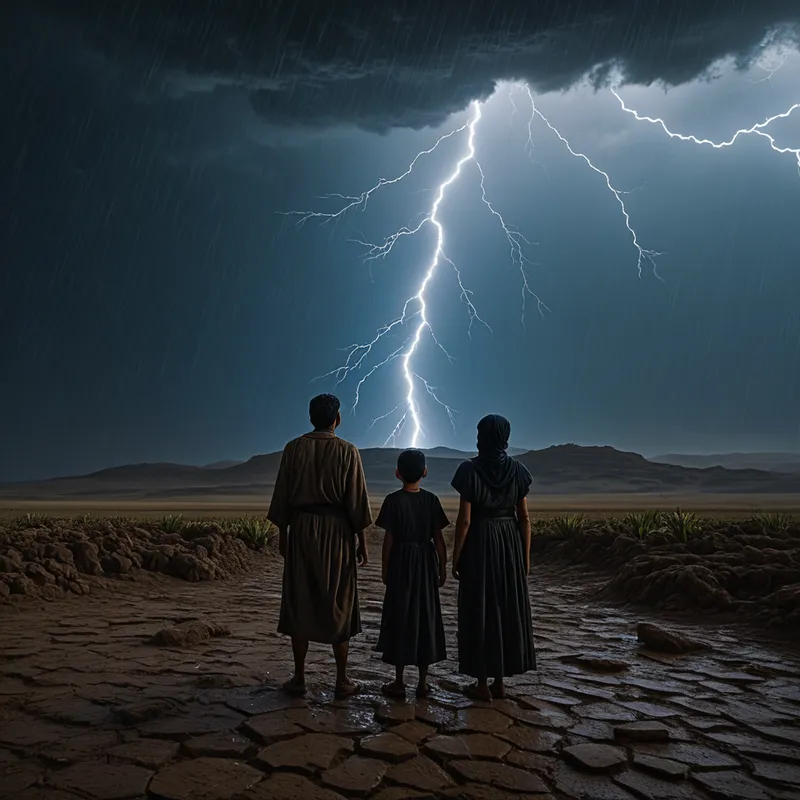
Hear now the voice that rides the wind, the crack that splits the firmament. In the time when the world was young and the will of the gods was written in the sky, there was a silence upon the land of Sumer and Akkad. A great stillness, a heat that pressed upon the brow of every farmer and baked the sacred silt of the two rivers into cracked, barren tiles. The canals lay empty, throats of dust. The barley withered in the field, a whispered plea dying on the stalk.
This was the absence of Adad. The Bull of Heaven was distant, his fury withheld, his bounty forgotten.
Then, a murmur began at the edge of the world. A breath, cool and foreign, stirred the dust in the high passes of the Zagros. The sky, a bowl of relentless brass, began to tarnish at its rim. Clouds gathered—not the gentle fleece of Anu, but great, bruise-purple mountains that climbed upon each other’s shoulders, swallowing the sun. The air grew thick, charged with a presence. Animals grew restless; birds fell silent.
He arrived not with a footstep, but with a shudder. The first peal of thunder was the sound of the sky’s spine breaking. It rolled across the plain, a divine proclamation that shook the very gates of Esagila. Then came his light—the flash of the haddad, the lightning mace. It forked from the cloud-heights, a blazing tree of instantaneous creation and destruction, etching the terror of the god onto the retina of the world.
This was Adad, the Rider of the Storm. His chariot was the whirlwind, his voice the thunderclap, his weapon the bolt that could split a cedar or strike a king dead in his hall. The wind rose to a scream, a sand-laden sharru from the west, stripping leaves, threatening mud-brick homes. The people huddled, not in simple fear, but in the profound, trembling awe of the mysterium tremendum et fascinans—the dreadful and fascinating mystery. They knew this violence was also a promise.
For following the terror came the tears of the god. The rain. It began as heavy, solitary drops, pounding the dust into tiny craters. Then it fell in sheets, a roaring, drenching benediction. The dry wadis became sudden, churning rivers; the cracked earth drank deeply, sighing with relief. The storm was not merely an attack; it was a violent, necessary coupling of sky and earth. In the roaring dark, the destructive power of the lightning and the generative gift of the rain were revealed as one inseparable act.
As suddenly as it began, the fury passed. The clouds unraveled, retreating to the mountains. In the washed-clean air, under a sun now gentle, the world stood transformed. The canals brimmed with life-giving water. The fields, once pale, glistened with fertile potential. The storm was over. The god had spoken. And in his passing, he left not just mud and broken branches, but the solemn, drenched silence of renewal, and the profound understanding that from the sacred chaos of his rage, all order and life must spring.
Cultural Origins & Context
The figure of Adad, also known as Hadad and earlier as Ishkur, is one of deep antiquity in Mesopotamia, his origins tracing back to the earliest Sumerian city-states. His myth was not a single, codified narrative like those of Greece, but a living, breathing presence woven into the very fabric of survival. The stories of Adad were passed down through temple hymns, royal inscriptions, and the oral traditions of farmers who lived and died by his caprice.
His primary societal function was as the regulator of the most fundamental cosmic forces: water and weather. In a land utterly dependent on the Tigris and Euphrates, yet vulnerable to their floods and to devastating droughts, Adad was the personification of that precarious balance. Kings invoked him in inscriptions, claiming his favor to legitimize their rule—a ruler who could secure the storm god’s blessing for timely rains and avert his destructive floods was a true shepherd of his people. He was both a national deity, worshipped in major cult centers like Aleppo and Babylon, and a profoundly intimate one, prayed to by every individual whose livelihood hung in the balance of the coming season’s storms.
Symbolic Architecture
Adad is the archetypal embodiment of the sovereign power that contains and mediates between opposites. He is the divine ruler whose domain is the uncontrollable.
The storm god does not choose between destruction and creation; he understands them as the inhale and exhale of the same cosmic breath.
His bull symbolizes raw, generative potency, while his lightning bolt represents the flash of insight, the disruptive truth, the moment of catastrophic change that precedes new growth. Psychologically, Adad represents the necessary, often terrifying, forces of the psyche that break down stagnant structures (droughts of the spirit, rigid ego-complexes) so that new life can emerge. He is the anger that clears the air, the crisis that forces transformation, the emotional thunderstorm that, while frightening, brings the nourishing rain of clarity and release.
The Dreamer's Resonance
When the pattern of Adad storms into modern dreams, it signals a profound somatic and psychological process: the buildup and inevitable discharge of powerful, potentially transformative energies that the conscious ego has been suppressing or ignoring.
A dreamer may find themselves in a landscape under a gathering storm, feeling the atmospheric pressure change in their very bones. They may witness chaotic, destructive winds or feel the terror of being exposed to lightning—this is often the psyche’s representation of unexpressed rage, surging creative energy, or a looming life change that feels both dangerous and exhilarating. The somatic experience in the dream—the charge in the air, the roar of the wind—mirrors the body’s own pre-conscious registering of this inner turbulence. The dream is the psyche’s attempt to weather the storm, to safely experience and ultimately integrate these powerful, archetypal forces rather than be shattered by them.

Alchemical Translation
The myth of Adad models the alchemical stage of solutio and coagulatio, applied to the psyche. The journey of individuation often requires a sacred, internal storm.
First comes the gathering storm: a period of increasing tension, dissatisfaction, or emotional pressure that the old, ordered conscious attitude can no longer contain. Then, the lightning strike: a disruptive event, a painful insight, a burst of long-contained emotion that shatters a cherished self-image or life structure. This is the destructive aspect of Adad’s bolt, the necessary death of what is outworn.
The lightning of insight must first destroy the tower of illusion before the rains of understanding can water the new seed of the Self.
Following this rupture comes the rain—the flood of feeling, the release of tears, the nourishing descent of unconscious content into conscious awareness. This is the coagulating, fertile aspect. The ego, having been humbled and cleansed by the storm, does not rebuild the same structure. Instead, it learns to build with the new, water-rich silt deposited by the flood. The individual moves from a state of psychic drought (rigidity, sterility) to one of fertile potential, having integrated a measure of the storm god’s raw, life-giving power. They become, in a sense, a steward of their own inner weather, respecting the necessity of both the clearing gale and the gentle rain.
Associated Symbols
Explore related symbols from the CaleaDream lexicon:
- Storm — The primary manifestation of Adad, representing the totality of chaotic, transformative power that encompasses both destructive fury and life-giving nourishment.
- Thunder — The voice of Adad, symbolizing the awe-inspiring, unavoidable proclamation of divine or unconscious truth that shakes the foundations of one's world.
- Lightning — Adad's sacred weapon, representing sudden, illuminating insight, catastrophic change, and the electrifying connection between the heavens (spirit) and the earth (matter).
- Rain — The generative gift of the storm, symbolizing emotional release, spiritual nourishment, fertility, and the blessing that follows a period of drought or crisis.
- Sky — Adad's domain, representing the vast, uncontrollable realm of spirit, potential, and the forces that govern human fate from above.
- Earth — The recipient of the storm's violence and bounty, symbolizing the grounded self, the physical body, and the material world that is transformed by higher forces.
- Bull — Adad's sacred animal, embodying untamed masculine potency, fertilizing power, brute strength, and the instinctual drives that underpin creative and destructive acts.
- River — The consequence of the storm's rain, representing the flow of life, emotional current, and the fertility that arises from the union of chaotic sky and receptive earth.
- Mountain — The throne and birthplace of the storm, symbolizing stability meeting volatility, the meeting point between the human world and the realm of the gods.
- Chaos — The essential state from which Adad operates, representing the primal, unstructured potential that must periodically erupt to dissolve stagnant order.
- Order — The societal and cosmic balance that Adad's storms both threaten and ultimately restore, representing the stable state that is periodically cleansed and renewed by chaos.
- Gathering Storm — The potent, tense period of buildup before the release, symbolizing the accumulation of unconscious pressure, impending change, and the somatic anticipation of transformation.