Achilles' Spear Myth Meaning & Symbolism
The spear that wounded Telephus could also heal him, embodying the paradox that the source of our deepest pain holds the key to our wholeness.
The Tale of Achilles' Spear
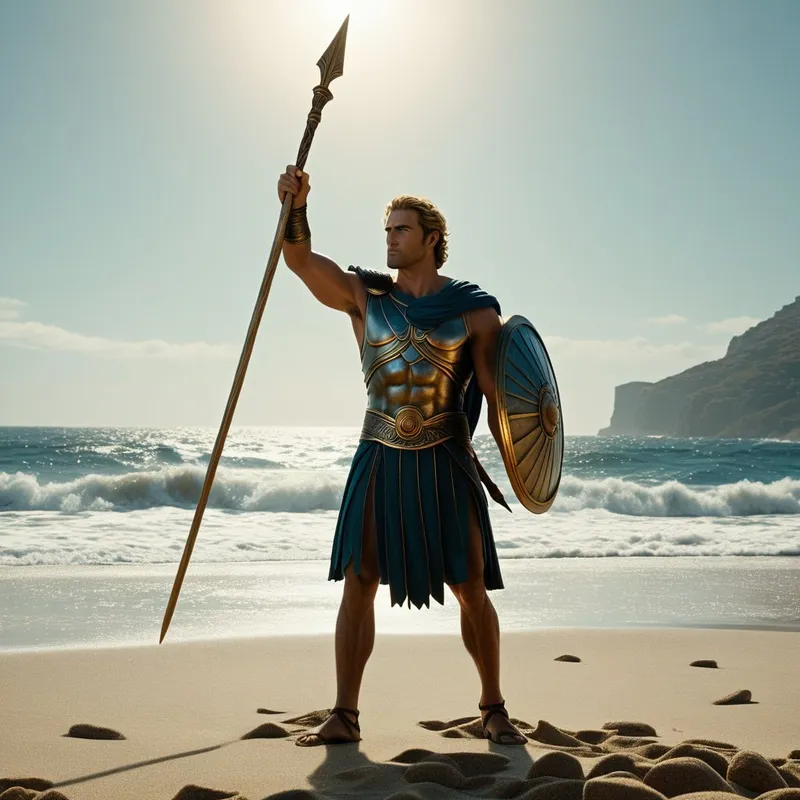
Hear now of the spear that knew two truths: one of bronze, one of blood. It was not forged in a mortal fire, but hewn from the heart of a mountain. The centaur Chiron himself, in the deep, resin-scented woods of Pelion, took an ash tree that had been struck by Zeus's own lightning. He shaped it for Peleus, a gift for a king, a weapon for a dynasty. Its point was bronze, hungry and bright, but its soul was of the storm and the sacred grove.
This spear passed to Peleus's son, Achilles, and drank deep of the war-god's fury at Troy. Yet its most profound story was written not on the plains of Ilium, but on a mistaken shore. The Greek fleet, blind with rage for Paris's theft, landed in Mysia, thinking it Troy. There stood Telephus, a son of Heracles, defending his home. Battle erupted, chaos on the sand. In the fray, Achilles lunged. His Pelian ash spear, driven by divine strength, found Telephus's thigh. It was not a clean kill, but a bitter, burrowing wound. The bronze pierced, the wood splintered, and the king fell, his lifeblood soaking the foreign earth.
The Greeks sailed away, their error realized. But for Telephus, the wound festered. No poultice, no prayer, no physician's skill could soothe it. The flesh turned green and wept a poison that mirrored the poison in his soul—the injustice, the confusion, the relentless, gnawing pain. An oracle, a voice from the smoky dark, spoke a riddle: "He that wounded shall also heal."
Desperate, in agony, Telephus journeyed to Argos, where the Greeks had gathered anew. He limped into their midst, a living accusation. He clasped the knees of Agamemnon, but the High King could only shrug. Then, his eyes fell on Achilles. The memory of the ash shaft, the searing bronze, flashed between them. The oracle's words hung in the air. In a moment of terrible clarity, Telephus understood. He did not ask for a new medicine, but for the old violence. He begged Achilles to scrape the rust—the very sperma or seed—from the spear's point into his wound.
Achilles, guided perhaps by Apollo or the sheer, stark logic of the myth itself, complied. He took the spear that had caused the affliction. From its sacred, blood-stained bronze, he scraped fine particles, the metallic memory of the injury. These he applied to the weeping gash in Telephus's thigh. And as the source of the poison entered the wound a second time, a miracle of inversion occurred. The wound closed. The flesh knit. The poison became its own antidote. The spear that had taken life, gave it back.
Cultural Origins & Context
This myth is preserved primarily in the fragments of the Epic Cycle, particularly the Cypria, and later in the works of tragedians and mythographers like Apollodorus. It was not a tale of the main Trojan saga but a "prequel," a narrative knot that had to be untied for the great story to proceed: the Greeks needed Telephus to show them the way to Troy. Its transmission was likely in the repertoire of rhapsodes, who would perform such episodes as self-contained dramas of fate and paradox.
Societally, it functioned as a narrative embodiment of a profound Greek concept: pharmakon. This word means both "poison" and "cure." The myth dramatizes this duality in the most visceral way possible. It taught that the world is not divided cleanly into harmful and helpful forces, but that these qualities are often inherent in the same object, the same action, the same person, depending on context and application. The spear is the ultimate pharmakon. It also reinforced the authority of oracles—their messages are not instructions, but cryptic keys that require deep, often painful, engagement to understand.
Symbolic Architecture
The spear is not merely a weapon; it is a axis of transformation. Its shaft, of ash from Mount Pelion, connects it to the world of nature, wisdom (via Chiron), and the chthonic realm. Its bronze point connects it to human craft, war, and piercing consciousness. Together, they form a bridge between the instinctual and the intentional.
The wound and the cure are not two things, but two faces of the same encounter with the sacred.
Telephus’s festering wound symbolizes a state of psychic stagnation. It is an injury that will not heal because its meaning has not been integrated. It is a "complex" in the Jungian sense—a knot of energy, memory, and emotion that drains the psyche. The oracle’s riddle forces a confrontation with the source. One cannot simply find a new solution (a new herb, a new god); one must return to the origin of the pain.
Achilles, in this myth, acts not as the raging hero, but as an agent of this paradoxical healing. He becomes the wielder of the pharmakon. His action—scraping the rust—is alchemical. He transforms the inert, oxidized residue of violence (the "sperma") into a healing agent. This signifies that the healing principle is often hidden within the traumatic memory itself, in its specific, gritty, undeniable details.

The Dreamer's Resonance
When this myth pattern stirs in the modern unconscious, it often manifests in dreams of recurring injuries, of being pursued by a figure from one's past who is also a healer, or of finding a strange, dual-purpose object. The somatic sensation is crucial: a deep, old ache that flares up, demanding attention not with numbness, but with a sharp, specific pain.
Psychologically, the dreamer is in the state of Telephus. They carry a wound—perhaps from childhood, a failed relationship, a professional humiliation—that has become chronic. It defines a part of their life narrative. They have tried many "cures": avoidance, rationalization, new relationships, new jobs. But the wound festers because they have not dared to return to the spear-point—to re-engage with the original event, person, or pattern that caused the injury, not to be victimized again, but to extract the "rust," the essential learning trapped within it.
The dream is the oracle, presenting the riddle. The healing begins when the dreamer, in their waking life, finds the courage to consciously and carefully approach the source of their pain to gather the transformative "spear-rust."

Alchemical Translation
The process modeled here is the core of Jungian individuation, specifically the integration of the shadow. The spear represents a shadow content—a violent impulse, a searing criticism, a devastating failure—that has wounded the ego. The ego's initial response is to flee the pain (the Greeks sail away). But the wound, now part of the shadow, follows and poisons the system.
The oracle's command—"He that wounded shall also heal"—is the call of the Self, the central archetype of wholeness. It instructs the ego (Telephus) to seek out the very shadow aspect (Achilles with the spear) it has been avoiding. The alchemical operation is the scraping of the rust. This is the conscious, deliberate act of shadow-work: revisiting the memory, feeling the repressed emotion, examining the shame or rage without identification or judgment, to extract its latent meaning and energy.
Individuation is the process by which the poison of the unexamined past is transmuted, through conscious engagement, into the medicine for the future self.
The rust, once the agent of decay, becomes the seed of new growth. The wound, fully integrated, ceases to be a source of weakness and becomes a site of initiation, a testament to resilience. The psyche learns its most profound lesson: that its greatest power for healing is often concealed within its most authentic, and sometimes most painful, experiences. The spear is not discarded; it is understood. And in that understanding, the hero gains not just a weapon, but a staff of wisdom.
Associated Symbols
Explore related symbols from the CaleaDream lexicon: