Achilles' Armor Myth Meaning & Symbolism
The divine armor forged for Achilles becomes a cursed prize, igniting a fatal rivalry that questions the very nature of glory and identity.
The Tale of Achilles’ Armor
Hear now the tale not of a man, but of his shell. The air over Troy was thick with the ash of grief. [Achilles](/myths/achilles “Myth from Greek culture.”/) lay dead, felled not by a hero’s spear in glorious combat, but by a god-guided arrow to his one mortal spot. His body was rescued from the fray, but his spirit, that furious fire, had fled to the misty halls of [Hades](/myths/hades “Myth from Greek culture.”/). What remained on the black-sailed ships of the Greeks was a void—a yawning chasm where their invincible spear-point had been.
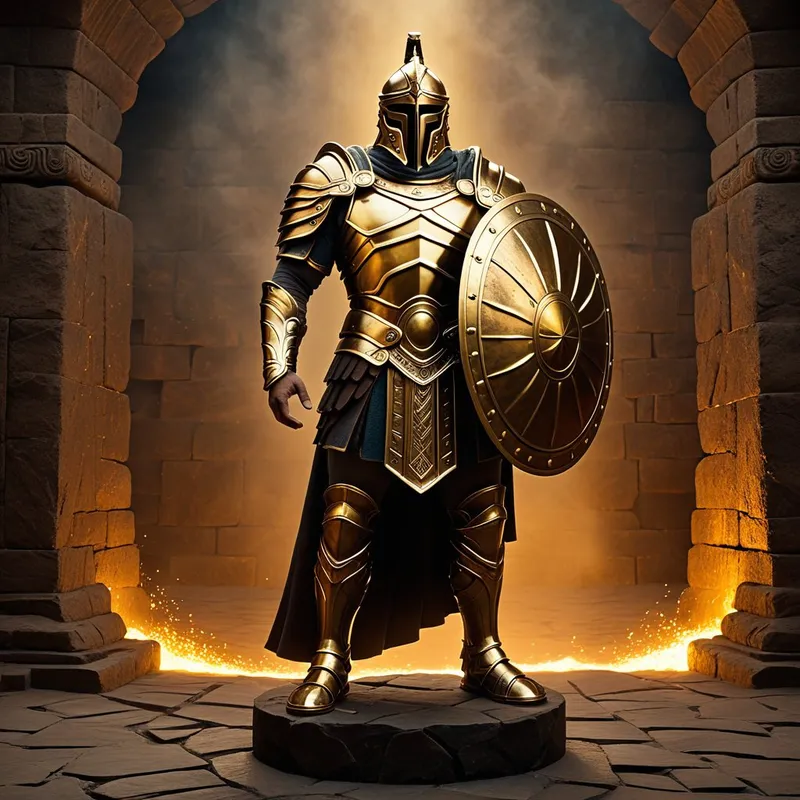
And in that void rested his armor. Not mere bronze and leather, but a second skin forged in the heart of a volcano. For his mother, [the sea](/myths/the-sea “Myth from Greek culture.”/)-goddess [Thetis](/myths/thetis “Myth from Greek culture.”/), in her divine grief, had descended to the smoky realm of [Hephaestus](/myths/hephaestus “Myth from Global/Universal culture.”/). She found the lame god at his anvil, the air singing with the ring of hammer on divine metal. She asked not for a son returned—that even the gods could not grant—but for a monument to his memory. [Hephaestus](/myths/hephaestus “Myth from Global/Universal culture.”/), moved by her tears, worked a miracle. He did not craft a tombstone, but a cosmos. Upon the great shield, he hammered the sun and [the moon](/myths/the-moon “Myth from Tarot culture.”/), [the earth](/myths/the-earth “Myth from Hindu culture.”/) and [the sea](/myths/the-sea “Myth from Greek culture.”/), two beautiful cities—one at peace, one at war—and a vineyard, a herd of cattle, and a dancing floor. The armor was a world unto itself, a perfect, immortal order to encase the most mortal of rages.
This divine shell now sat in the Greek camp, gleaming with a cold, untouchable light. It called to the greatest of the remaining warriors. Two men stepped forward: [Odysseus](/myths/odysseus “Myth from Greek culture.”/), the man of many turns, and Ajax, the towering wall of a man, the bulwark of the army. To don this armor was to be named successor, to step into [the shadow](/myths/the-shadow “Myth from Jungian culture.”/) of the demigod and become the new point of the Greek spear.
The army was assembled. Words flew like javelins. Odysseus spoke with silvered tongue, weaving arguments of cunning and guile, virtues that had saved the army time and again. Ajax, a man whose language was action, could only roar of his brute strength, his unwavering position in the front line, his shield that had never broken. The hearts of the men were divided, but when the votes were cast, it was the silver tongue that won. The armor was awarded to Odysseus.
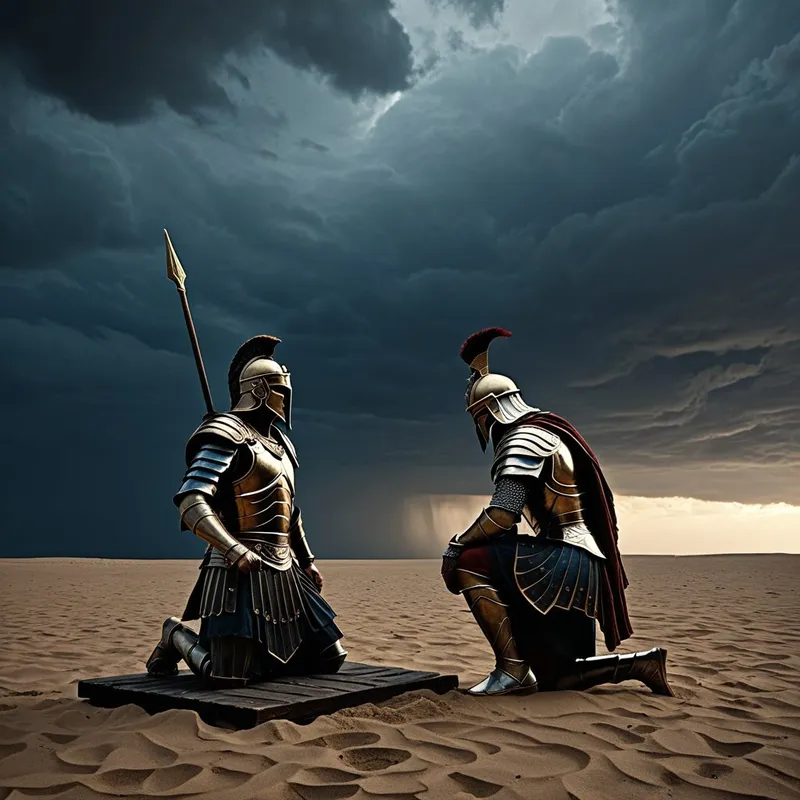
A silence fell upon Ajax, deeper than any he had known in battle. [The world](/myths/the-world “Myth from Tarot culture.”/), so solid under his feet, turned to mist. The honor he lived by, the code of the warrior, had been rendered meaningless by words. The divine armor, meant to protect, had become a poison. That night, the Fury</ab title=“A spirit of madness or frenzy sent by the gods”> sent by [Athena](/myths/athena “Myth from Global/Universal culture.”/), clouded his mind. In the murky twilight of his tent, he saw the flocks of the army as his enemies, the sheep and cattle as the mocking Greeks. He fell upon them in a grotesque slaughter, believing he was exacting his revenge. As dawn broke, the red light revealed not the bodies of his rivals, but butchered beasts. Clarity returned, and with it, a shame so total it left no room for life. Taking his own sword, the sword that had never failed him in honest combat, he fell upon it. The mightiest of the Greeks after Achilles died by his own hand, a final, tragic turn authored by the very armor meant to confer immortal glory.
Cultural Origins & Context
This story forms a crucial, haunting coda within the larger epic cycle of [the Trojan War](/myths/the-trojan-war “Myth from Greek culture.”/). It is most famously recounted in the Aethiopis, a lost epic of the Epic Cycle, and finds its most poignant surviving rendition in Sophocles’ tragedy, Ajax. For the ancient Greeks, this was not a sidebar but a core lesson in the tragic architecture of heroism. The [bards](/myths/bards “Myth from Celtic culture.”/) who sang this tale around fires and in royal halls were doing more than recounting events; they were probing the limits of the heroic code itself.
In a culture that prized kleos (glory) above almost all else, the armor of Achilles represented the ultimate prize—the tangible symbol of being the “best of the Achaeans.” Its award was a societal act, a decision made by the group about who best embodied their collective strength and identity. The myth served as a cautionary tale about the fragility of that social contract and the dangerous, isolating weight of the honor it bestowed. It asked the audience: what happens when the system of recognition fails the most recognizably loyal? It was a story told to inspire awe at divine craftsmanship, but also to stir unease about the very values the society held sacred, revealing how the pursuit of glory could unravel the individual and the community from within.
Symbolic Architecture
The [armor](/symbols/armor “Symbol: Armor represents psychological protection, emotional defense, and the persona presented to the world. It symbolizes both safety and the barriers that separate us from vulnerability.”/) is the central, luminous [symbol](/symbols/symbol “Symbol: A symbol can represent an idea, concept, or belief, serving as a powerful tool for communication and understanding.”/), and it is profoundly paradoxical. Forged by a god, it is a work of immortal art, a [microcosm](/symbols/microcosm “Symbol: A small, self-contained system that mirrors or represents a larger, more complex whole, often reflecting the universe within an individual.”/) of the ordered world. Yet, when placed in the [human](/symbols/human “Symbol: The symbol of a human represents individuality, complexity of emotions, and social relationships.”/) [realm](/symbols/realm “Symbol: The symbol of ‘Realm’ often signifies the boundaries of one’s consciousness, experiences, or emotional states, suggesting aspects of reality that are either explored or ignored.”/), it becomes a cursed object, a catalyst for madness and [death](/symbols/death “Symbol: Symbolizes transformation, endings, and new beginnings; often associated with fear of the unknown.”/).
The divine artifact does not elevate the mortal who wears it; it reveals the fatal gap between the perfection of the form and the frailty of the content.
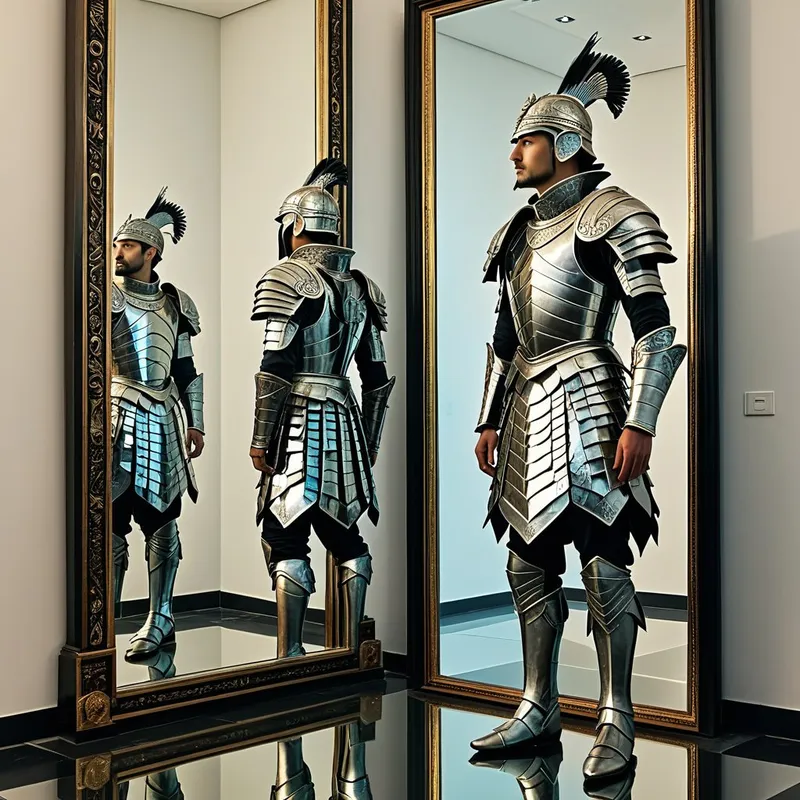
For Achilles, the armor was a perfect fit—an external manifestation of his internal, near-divine rage and capability. It was an extension of his arete (excellence). Once his [spirit](/symbols/spirit “Symbol: Spirit symbolizes the essence of life, vitality, and the spiritual journey of the individual.”/) vacates it, the armor becomes an empty ideal, a [shell](/symbols/shell “Symbol: Shells are often seen as symbols of protection, transition, and the journey of personal growth.”/) of a greatness that has departed. Ajax and Odysseus are not contending for a tool, but for an [identity](/symbols/identity “Symbol: Identity represents the sense of self, encompassing personal beliefs, cultural background, and social roles.”/). To win it is to be annointed as the new “Achilles,” a psychological burden as heavy as the physical [metal](/symbols/metal “Symbol: Metal in dreams often signifies strength, transformation, and the qualities of resilience or coldness.”/).
Ajax represents [the ego](/myths/the-ego “Myth from Jungian culture.”/) built entirely on a single, solid principle: brute force, unwavering loyalty, and front-line honor. His shattering is the shattering of a monolithic identity that cannot bend. He is the [hero](/symbols/hero “Symbol: A hero embodies strength, courage, and the ability to overcome significant challenges.”/) who cannot navigate a world where words hold more power than deeds. His suicide is the ultimate, tragic [integration](/symbols/integration “Symbol: The process of unifying disparate parts of the self or experience into a cohesive whole, often representing psychological wholeness or resolution of internal conflict.”/)—the only way his unwavering self can remain “true” is through self-annihilation.
Odysseus, the winner, represents the adaptable [psyche](/myths/psyche “Myth from Greek culture.”/), the cunning intelligence that can wear many masks. He can “fit into” the armor because his identity is not rigid. Yet, the myth hints that this victory is also a burden. To wear another man’s glory, especially a glory so singular, is to forever live in a borrowed [skin](/symbols/skin “Symbol: Skin symbolizes the boundary between the self and the world, representing identity, protection, and vulnerability.”/), a [theme](/symbols/theme “Symbol: Themes in dreams often represent the overarching ideas or emotions the dreamer is grappling with.”/) Odysseus’s long, identity-concealing [journey](/symbols/journey “Symbol: A journey in dreams typically signifies adventure, growth, or a significant life transition.”/) home will painfully explore.

The Dreamer’s Resonance
When this myth stirs in the modern unconscious, it often manifests in dreams of inheritance and impossible expectation. To dream of being awarded a magnificent, ill-fitting suit of armor, or of coveting a colleague’s prestigious job title or social role, is to touch the Ajax complex. The dreamer may feel an immense pressure to step into a predefined role—the perfect successor, the ideal partner, the consummate professional—a role forged by familial, social, or professional expectations (the “divine forge”).
The somatic experience is one of constriction and crushing weight. The dreamer feels the glory of the position but also its suffocating rigidity. The subsequent dream narrative—losing the prize, breaking it, or being wounded by it—signals a psyche in crisis, recognizing that the proffered identity is a shell that does not contain their true self. This is the moment of Ajax’s madness: the ego’s realization that the world it built its worth upon has fundamentally changed its rules, leading to a psychological breakdown that, in analysis, must be navigated not toward self-destruction, but toward a painful rebirth of identity.
Alchemical Translation
The alchemical process modeled here is the mortificatio and sublimatio of the heroic ego. The initial state is the [prima materia](/myths/prima-materia “Myth from Alchemical culture.”/) of raw, identified strength (Ajax) and cunning (Odysseus) contesting over a prized, fixed form (the Armor).
The first [death](/myths/death “Myth from Tarot culture.”/) is Achilles’ demise, which sets the process in motion by vacating the perfected form. The contest and its outcome represent the [separatio](/myths/separatio “Myth from Alchemical culture.”/) and mortificatio. Ajax’s monolithic ego is dissolved in the acid of humiliation and shame—a necessary, brutal [death](/myths/death “Myth from Tarot culture.”/) of the old, rigid self. His suicide is the ultimate image of this; in the individuation process, this is the symbolic death of an outmoded complex, a way of being that must be sacrificed.
The prize is not the armor, but the liberation from needing to wear it.
Odysseus’s victory represents the beginning of sublimatio. He takes the symbolic form, but the rest of his myth—the long voyage, the loss of all his men, the disguises—shows that he does not simply become “the new Achilles.” He must be broken down further, stripped of all the armor of his former identity (king, warrior, victor) until he returns home naked and unknown. Only then can he be rebuilt.
For the modern individual, the alchemy lies in recognizing the “divine armor” offered by society—the prestigious job, the perfect [persona](/myths/persona “Myth from Greek culture.”/), the inherited trauma or expectation—and undertaking the much harder task: not of winning it, but of descending into one’s own forge. It is the work of melting down the inherited, glittering forms and, like Hephaestus, hammering out a shield that depicts your own world, your own conflicts, your own dance. The goal is not to wear another’s glory, but to bear the unique and vulnerable masterpiece of your own authentic life.
Associated Symbols
Explore related symbols from the CaleaDream lexicon: