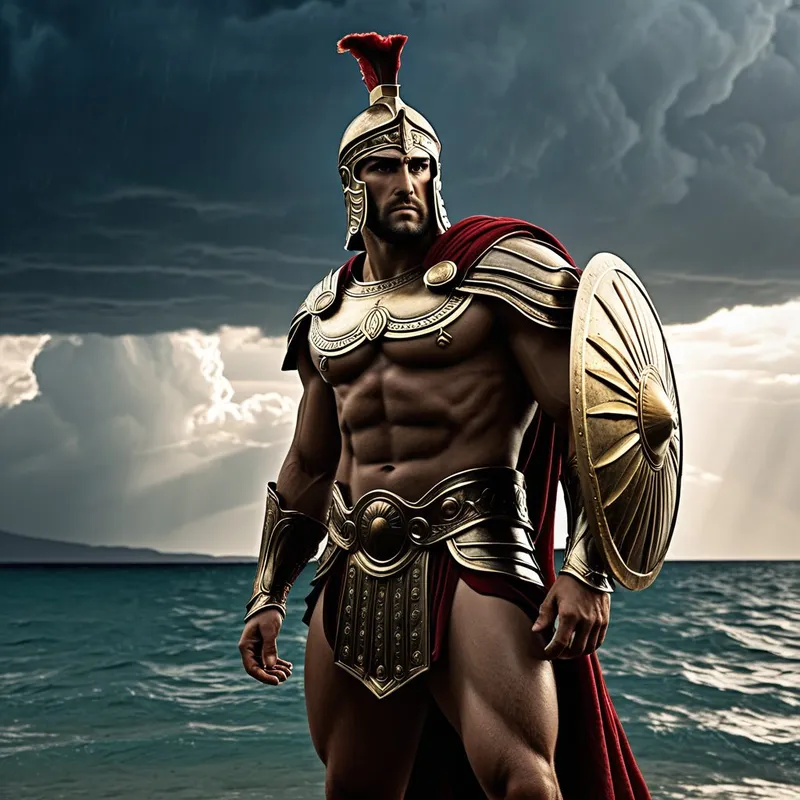
Achilles Myth Meaning & Symbolism
A hero forged by divinity and mortality, whose legendary power was undone by a single point of hidden, human weakness.
The Tale of Achilles
Hear now the song of the swift-footed one, the man who was a spear-point cast by the gods into the heart of mortal fate. It begins not with glory, but with a mother’s dread. Thetis, silver-limbed daughter of the Old Man of the Sea, knew a prophecy that chilled her immortal blood: her son would be a man greater than his father, but his life would be brilliant and brief, a flash of lightning against the dark.
To cheat this doom, she took the infant to the banks of the Styx, the black river of oaths. In the twilight silence, she submerged him, her hands the only anchor between the divine waters and the mortal child. The waters, which make the gods deathless, washed over him. Where they touched, his skin became like adamant, a living armor. But where her fingers gripped his left heel, the water did not kiss. There, a small patch of pink, vulnerable flesh remained—the secret seed of his mortality.
He grew under the tutelage of the wise centaur Chiron, fed on the marrow of lions and the wisdom of the wild. He became a youth of terrifying beauty and speed, his very presence humming with contained violence. When the call to Troy came, Thetis, desperate, hid him among the women on the island of Skyros. But the cunning Odysseus came with gifts of finery and, among them, a spear and shield. At the blast of a war-horn, Achilles’ hand shot out for the weapon, his disguise shattered by the fire in his blood. He chose the short, glorious life.
At Troy, he was the storm. The Myrmidons moved as one with his will. He raged along the shore, and men fell like wheat before the scythe. But pride is the hero’s shadow. When Agamemnon stole his war-prize, the maiden Briseis, a cold, silent fury took Achilles. He withdrew his gleaming might from the battle. He sat in his tent by the gray sea, listening to the distant din of war, nursing his wrath like a black flame. Without him, the Greeks faltered and fell.
Then came the turning of the tide, brought by a different grief. His beloved companion, Patroclus, wearing Achilles’ own famed armor, went out to rally the Greeks and was struck down by the Trojan prince Hector. The news broke upon Achilles like a physical wave. His cry of loss was so profound it reached his mother in the sea-depths. Grief transmuted his pride into a rage that was no longer hot, but absolute, a force of nature. Thetis brought him armor forged anew by the smith-god Hephaestus, a shield depicting the whole world.
Clad in this divine metal, Achilles returned to the field, and the earth itself seemed to tremble. He chased Hector around the walls of Troy, a predator of relentless, terrible purpose. He slew him, and in his madness, dishonored the body. But even in his triumph, he knew. He spoke to the dead Priam, who came to beg for his son’s body, and in that moment of shared sorrow, the god-like rage passed, leaving only the weary man who saw his own fate reflected in the old king’s tears. The prophecy coiled tight. Paris, guided by Apollo, let fly an arrow. It found the only place it could: the small, unremembered heel. The invincible hero fell, and the greatest of the Achaeans was gone, his glory and his grief echoing forever in the wine-dark sea.

Cultural Origins & Context
The myth of Achilles is the cornerstone of the Iliad, but its roots dig deep into a pre-Homeric, oral tradition of bardic song. For centuries before Homer composed his version in the 8th century BCE, the tale was sung by aoidoi in the halls of chieftains. It was not mere entertainment; it was a cultural engine. The story of Achilles served as a foundational narrative for the Greek aristocratic ideal—the aristos, the "best." It explored the terrifying price of that excellence (arete) and the fragile contract between human action and divine will (moira).
In a society where kleos (glorious fame) was the only immortality offered to mortals, Achilles presented the ultimate paradox: he chooses certain death to secure eternal renown. His story functioned as a communal meditation on the limits of human power, the capriciousness of the gods, and the inescapable nature of fate. It asked its audience, what is a life well-lived? A long, quiet one, or a short, brilliant flame that lights up history? The myth provided no easy answer, only the haunting, beautiful tragedy of the choice itself.
Symbolic Architecture
At its core, the myth of Achilles is an anatomy of the heroic psyche, a map where supreme power and fatal vulnerability share the same territory. His invulnerability symbolizes the persona—the perfected, seemingly impermeable self we present to the world, forged by parental influence (Thetis) and cultural training (Chiron). It is the armor of talent, status, or identity we believe makes us untouchable.
The flaw is not an accident of the myth; it is the myth's central truth. The point of vulnerability is the secret gateway where destiny enters the fortress of the self.
The heel is the symbolic locus of the shadow—the repressed, forgotten, or denied aspect of the self. It is that which was not submerged in the transformative waters of consciousness. For Achilles, it is his mortality, his raw humanity, which his divine mother could not bear to fully surrender. Psychologically, it represents whatever we deem too weak, too tender, or too shameful to integrate: dependency, grief, softness, fear. We hide it, but it remains the conduit through which the "arrow" of life—betrayal, loss, failure—inevitably strikes. His rage, first over a slight to his honor and then over the loss of Patroclus, is the eruption of this denied humanity. It is the shadow, in its most destructive form, claiming its due.
The Dreamer's Resonance
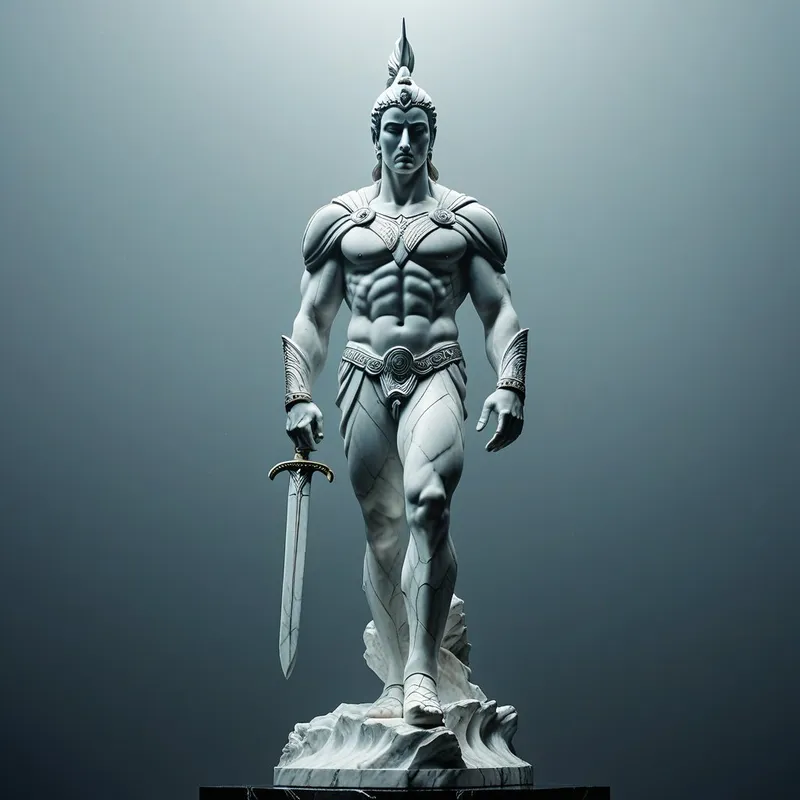
When the pattern of Achilles stirs in the modern dreamer, it often signals a confrontation with a constructed identity that has begun to crack. One may dream of being invincible in a boardroom or on a stage, only to notice a small, inexplicable wound on an ankle. Or perhaps a dream of a magnificent, towering statue of oneself, flawless until the camera angle shifts to reveal a fragile, crumbling foundation at the feet.
Somatically, this can manifest as a literal pain or weakness in the heels, ankles, or calves—the body speaking the psyche's truth about where it feels unsupported or where its "standing" in the world is precarious. Psychologically, the dreamer is likely navigating a situation where a long-relied-upon strength—their intellect, their resilience, their independence—has suddenly failed them. The dream is the unconscious pointing to the hidden heel: the unprocessed grief, the unacknowledged need for connection, or the repressed fear that underpins their "invincible" stance. It is an invitation to turn around and look at what one has been dragging behind, the un-dipped part of the self.
Alchemical Translation
The alchemical journey modeled by Achilles is not one of overcoming the flaw, but of consciously integrating it. The initial stage is the creation of the persona-armor (the dipping in the Styx), a necessary development for navigating the world. The crisis occurs when life inevitably strikes the heel (the withdrawal, the grief). The heroic ego, believing itself self-sufficient, is shattered.
The alchemy happens not in the rage, but in the stillness that follows its exhaustion. It is in the recognition that the wound and the gift are born from the same source.
The true transmutation begins with the meeting with Priam. Here, Achilles, the invincible hero, and Priam, the broken king, meet not as enemies but as fellow sufferers. This is the coniunctio oppositorum—the conjunction of opposites. Achilles sees his own mortal fate in the face of his enemy's father. In that moment of shared humanity, his rage—the fire that purified nothing—subsides, and a deeper understanding emerges. The psychic gold to be found is the realization that our greatest power is not in our invulnerability, but in our capacity to feel, to grieve, and to connect from that very place of wounding. The individuated self is not the flawless hero, but the one who has acknowledged the heel, who carries both the strength of the armor and the tenderness of the wound, and who understands that a meaningful destiny is forged in the tension between them. We are not called to be Achilles before the arrow, but Achilles in the moment he truly sees Priam—mortal, connected, and profoundly, heartbreakingly complete.
Associated Symbols
Explore related symbols from the CaleaDream lexicon:
- Ankle
- Soldier
- Combat Boots
- Bloodstone Talisman
- Resilient Thorns
- Pill Bug Roll
- Spiny Lobster
- Shark Tooth
- Warrior's Cap
- Courageous Soldier
- Fiery Spirit of Competition
- Medieval Armor
- Roman Gladiator
- Thistle Blossom
- Spear Throwing
- Spear Throwing Technique
- Hwarang Warriors
- Political Allegiance
- Buff
- Immunity
- Vaccine
- Rage