
Abraham Myth Meaning & Symbolism
A patriarch's radical covenant with the divine demands impossible sacrifice, shattering old worlds to birth a new relationship with the sacred.
The Tale of Abraham
Listen. In the beginning of a new age, when the world was still thick with old gods of stone and field, there was a man. His name was Abraham. He dwelt in the city of his fathers, amidst the familiar idols. Then, a Voice spoke—not from a statue, but from the terrifying silence of the unknown. It was a command that was also a promise: "Go from your country and your kindred and your father's house to the land that I will show you. I will make of you a great nation."
So he went. With his wife Sarah, whose laughter was yet unborn, and his household, he turned his back on the known world. He became a stranger, a wanderer under the vast, indifferent sky, following a promise whispered on the wind. The Voice spoke of descendants as countless as the stars, a cruel joke for a man with a barren wife and advancing years. Yet, against all reason, against the mocking silence of Sarah’s womb, he believed.
The promise was tested in fire. Kings rose and fell around him; he bargained for the fate of cities. Finally, in their extreme old age, a miracle of flesh and blood: a son. Isaac. The laughter of disbelief became the laughter of joy. The promise had flesh; the future had a face.
Then, the Voice returned. It did not whisper this time. It cut through the soul like a blade of cold iron. "Take your son, your only son Isaac, whom you love, and go to the land of Moriah, and offer him there as a burnt offering." The world shattered. The promise demanded its own destruction. The star-filled future was to be consumed on a pyre of obedience.
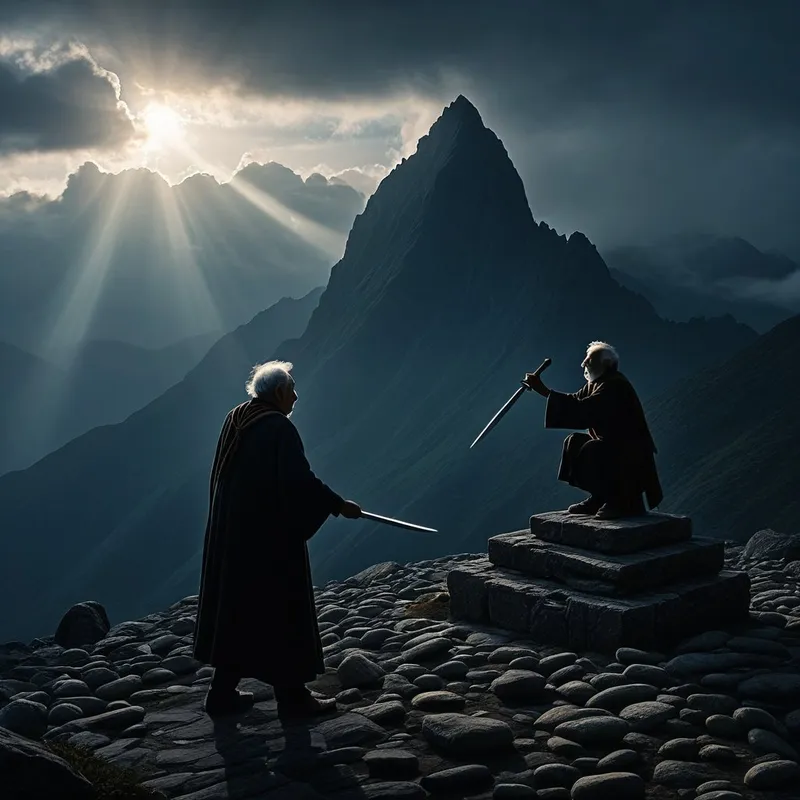
For three days they walked, father and son, into the heart of the horror. The weight of the unspoken lay between them. Isaac carried the wood for his own sacrifice. On the mountain, as Abraham bound his son, as he raised the knife, the cosmos held its breath. In that ultimate, unbearable tension—the absolute surrender of the heart's deepest desire—the Voice cried out a second time. "Do not lay your hand on the boy!" A ram, caught in a thicket, became the substitute. The covenant was sealed not in the death of the son, but in the father’s willingness to traverse the abyss. He had passed through the fire, and was remade.
Cultural Origins & Context
This story is the foundational bedrock of the Abrahamic traditions. It is found in the Book of Genesis, a text composed and redacted over centuries, likely during the formative periods of ancient Israel's monarchy and exile. It was not a story told in grand temples initially, but around campfires and in family tents, a tribal epic of origins.
Its primary societal function was etiological—it explained why this particular people were in a unique, covenantal relationship with a singular, transcendent God, distinct from the pagan deities of the land. It established the paradigm of the covenant (brit): a binding, mutual agreement between the divine and the human, based on faith and obedience. The storytellers, the priests and scribes, used Abraham’s journey to map a spiritual and ethnic identity rooted not in a fixed land or king at first, but in a radical act of faith and a terrifying test that defined the very nature of that faith.
Symbolic Architecture
At its core, this is not a story about child sacrifice, but about the sacrifice of the idol. Every cherished assumption, every human guarantee of the future—even the divinely promised son—must be held in open hands, not clutched as a possession.
The true sacrifice is always the idol you have made of your own understanding, your own security, and your most precious promise.
Abraham represents the nascent ego-consciousness called into a relationship that utterly transcends it. The gods of his fathers were localized, predictable forces. The Voice of the Elohim/Yahweh is unlocalized, unpredictable, and demands a journey into the unknown. The call to leave Ur is the call to individuation: to leave the collective, ancestral psyche (the "father's house") to found a new, conscious relationship with the Self (the divine).
The Akedah is the ultimate symbolic crisis. Isaac is not just a son; he is the embodied future, the concretized promise. To be asked to sacrifice him is to be asked to annihilate one's own hope, the logical outcome of one's faith. Psychologically, this represents the point where the conscious attitude, built on a divine promise, is confronted by a demand from the unconscious that seems to contradict and destroy that very attitude. It is the dark night of the soul, where all conscious understanding fails.
The ram is the symbol of the tertium non datur—the third thing that emerges from the tension of opposites (clinging to the promise vs. absolute surrender). It is the unexpected, redeeming symbol from the unconscious (the thicket) that allows life to continue on a new, transformed level. The covenant is renewed not through blind possession of the promise, but through the terrifying freedom of non-attachment to it.
The Dreamer's Resonance
When this myth stirs in the modern dreamer, it often manifests as a profound existential dilemma. You may dream of being commanded to destroy something you have built with immense care—a career, a relationship, a creative project that is your "child." The dream atmosphere is one of solemn, dreadful necessity, not malice.
Somatically, this can feel like a tightening in the chest, a weight of unspeakable responsibility. Psychologically, you are navigating the nigredo—the darkening. The old "covenant" you had with life—"if I do X, I will receive Y"—is being dismantled. The dream is not advocating literal destruction, but is orchestrating a crisis of attachment. It asks: Can you hold your most precious identity, your promised future, so lightly that you are willing to offer it back to the unknown? The terror and resolution felt in the dream are the psyche's way of rehearsing this ultimate act of psychological surrender, preparing the ground for a new, less ego-bound structure of being to emerge.

Alchemical Translation
The alchemical process mirrored in Abraham’s saga is the entire opus: from separation to conjunction.
First, the Separatio: He is called out of Ur, away from the fused, unconscious mass of collective values and familial gods. This is the initial distillation of the individual spark from the prima materia of the ancestral psyche.
Then, the long journey through the desert represents the Mortificatio and Putrefactio—the burning away of old certainties, the decay of the logical timeline. The barrenness of Sarah’s womb is this stage; all fertile hope seems dead.
The birth of Isaac is the Albedo—the whitening, a moment of joyous crystallization, the tangible proof of the work. It is the conscious achievement, the embodied symbol of the Self's promise.
But the work is not complete. The Akedah is the supreme Rubedo—the reddening, the stage of fiery ordeal. Here, the conscious achievement (Isaac) must be sacrificed back to the very Self that promised it. This is the paradox of individuation: to fully realize the Self, the ego must surrender its claim to own that realization. The ego’s treasured image of its own spiritual success is the final idol that must be placed on the altar.
The ram is the philosopher's stone—not a thing to be possessed, but the transformative moment itself, born from the absolute tension between holding on and letting go.
For the modern individual, the alchemical translation is this: any profound calling or life-purpose (the covenant) will inevitably lead you to a mountain where that very purpose, as you understand and are attached to it, must be symbolically sacrificed. The transformation occurs not in the receiving of the promise, but in the willingness to relinquish your ego’s claim on it. The new land you inherit is not a piece of geography, but a state of being—a consciousness that has passed through the fire of non-attachment and now dwells in a covenantal relationship with the depths, free from the tyranny of both despair and guaranteed outcomes. You become, like Abraham, a stranger and a sojourner in your own life, anchored only in the terrifying, liberating dialogue with the unknown.
Associated Symbols
Explore related symbols from the CaleaDream lexicon: