
Ablution Myth Meaning & Symbolism
A myth of a primordial being dissolving into the cosmic waters to cleanse creation's taint, emerging reborn through a crucible of sacrifice.
The Tale of Ablution
Listen, and hear the tale that the Furnace-Keepers whisper when the great alembics cool. In the time before the First Conjunction, when the Prima Materia was yet heavy with potential, there walked a being known as Mercurialis. Not a god of thunder or love, but a deity of essence itself—a figure of flowing quicksilver and quiet observation, whose form shimmered between solidity and smoke.
The world then was a newborn thing, brilliant but flawed. From the violent marriage of Sulfur and Salt in the womb of the cosmos, a residue had been left behind. A taint. It was not evil, but a fundamental heaviness, a spiritual slag that clung to every newborn star and budding soul. It manifested as a creeping shadow in the corners of reality, a dullness in the light, a leaden weight in the heart of all things.
Mercurialis, who flowed through the veins of the world, felt this taint as a personal sickness. The celestial rivers ran sluggish. The songs of the Sylphs were flat. The great work of creation was stifled before it could truly begin. The other primordial forces debated, devised, and distilled, seeking a solution in complexity. But Mercurialis knew a simpler, more terrible truth. The taint was not out there to be fixed; it was in here, part of the substance of all that was. To cleanse the alloy, one must first dissolve the metal.
And so, without fanfare or declaration, Mercurialis walked to the source of the Aqua Vitae, the great font from which all waters of spirit and matter sprang. The air smelled of ozone and damp stone. Looking into its depths, they did not see their own reflection, but the shadowed lattice of the world's malaise, like a black net cast over a silver fish.
They stepped in.
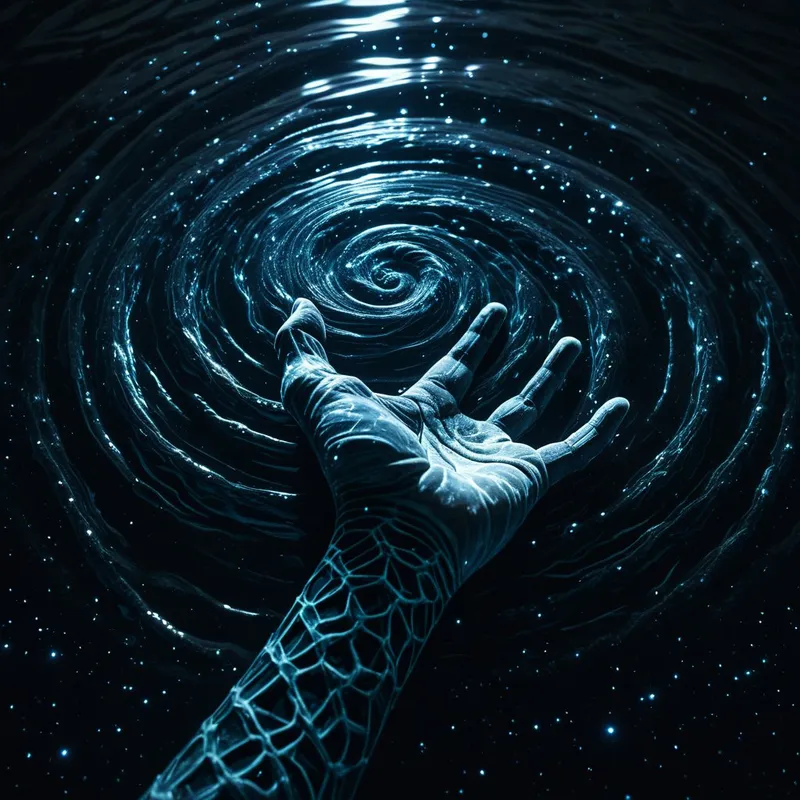
The moment the Aqua Vitae touched their mercurial feet, a scream—silent to the ears but deafening to the soul—rippled through creation. This was no gentle bath. It was an unmaking. The waters, activated by the sacrifice of a sovereign essence, became a solvent of unimaginable power. Mercurialis did not wash. They dissolved. Their form, that beautiful, mutable body, began to liquefy, to stream away into the font. Fingers became rivulets of silver. Their face, a mask of serene acceptance, blurred and ran like hot wax. The taint within them, the leaden shadow they had absorbed from the world, crystallized upon contact with the sacred waters, falling away like flakes of black salt, sinking into the abyss below.
For an acon, there was only the churning, luminous soup of the font—a chaotic, pained, and pregnant mixture of purified essence and extracted corruption. The universe held its breath. Then, from the very center of the turmoil, a heat began to grow. Not the fire of Sulfur, but the gentle, persistent heat of fermentation, of gestation. The dissolved essence of Mercurialis, now inseparably mixed with the purifying power of the waters, began to coalesce.
It did not re-form as it was. From the font emerged a new being, or perhaps the same being utterly transformed. Where there was quicksilver, now there was a body of clear, living water held in a humanoid shape by a subtle internal light. Where there was opacity, now there was transparency. This was Aqua Permanens—the Permanent Water. The first rain that fell from this being was not water, but a shower of clarity. Where it fell, the spiritual slag receded, not annihilated, but transmuted into fertile soil from which new, unburdened potentials could grow. The work of the cosmos could continue, inaugurated not by a act of domination, but by an act of radical, self-annihilating cleansing.
Cultural Origins & Context
The myth of Ablution finds its roots not in the popular temples or royal courts of the Alchemical culture, but in the workshops, laboratories, and scriptoria of its Adepts. It was an esoteric narrative, passed down orally from master to apprentice alongside the secret names of reagents and the precise angles of distillation coils. Its primary function was initiatory.
To hear the full myth was a privilege earned only after demonstrating not just skill, but a certain temperament—a willingness to question the solidity of the self. It was recited during the ritual preparation of the Magnum Opus, specifically before the stage of Nigredo. The story served as both a warning and a map. It warned that true transformation is not an additive process of gaining knowledge or power, but a profoundly subtractive one of losing one's current form. It mapped the terrifying, essential step of dissolution that must precede any coagulation into a higher state.
The tellers were often the Furnace-Keepers, those who maintained the perpetual, low fires of the great athanors. Their voices, smoky and measured, mirrored the slow, inevitable process the myth described. In a society obsessed with the transformation of base metals into gold, the myth of Ablution was the crucial spiritual corollary: to achieve the gold of the spirit, one must first dissolve the lead of the conditioned self.
Symbolic Architecture
At its heart, the myth of Ablution is a master symbol of the solve in the alchemical dictum solve et coagula. It is the archetypal representation of deconstruction, the necessary death of a current state of being.
Mercurialis represents the psychic Mercurius within us—our adaptable ego, our conscious identity, and our connective intelligence. It is who we believe ourselves to be. The "taint" or spiritual slag is not sin, but the accumulated psychic material of a lifetime: rigid identities, compulsive behaviors, unresolved traumas, and cultural conditioning—the psychic lead that weighs down the soul.
The purification of the world begins not with scrubbing its surface, but with the willing dissolution of the one who perceives it as dirty.
The Aqua Vitae is the transformative power of the unconscious itself, the solvent of the deep psyche. To step into it is an act of supreme courage—it is to voluntarily submit one's familiar self (the ego) to the disintegrating, re-organizing forces of the Self (the total psyche). The agonizing dissolution is the experience of ego-death, where all one's certainties, defenses, and self-narratives melt away. The crystallization and sinking away of the black salt is the visible separation and acknowledgment of one's shadow material, now seen for what it is and removed from the living process.
The rebirth as Aqua Permanens symbolizes the emergence of a new psychic center. This is not a bigger, better ego, but something qualitatively different: a self-aware vessel guided by a deeper, more universal principle. It is transparency instead of opacity, fluid adaptability rooted in an immutable core.
The Dreamer's Resonance
When this myth activates in the modern psyche, it often manifests in dreams of profound, unsettling cleansing. These are not dreams of a refreshing shower, but of overwhelming, sometimes frightening, purification.
The dreamer may find themselves caught in a rain that washes away their clothes, then their skin, revealing muscle and bone. They may dream of a flood in their own home, rising to dissolve the very walls and furniture, leaving them floating in a featureless sea. They may be in a bath where the water turns to a powerful acid or a blinding light, stripping them layer by layer. The somatic experience upon waking is often one of deep fatigue, vulnerability, or a strange, hollow lightness—as if something solid inside has been washed away.
Psychologically, these dreams signal that a process of necessary psychic dissolution is underway. The conscious mind is being confronted with the fact that its current structure is inadequate for the life it is trying to live. An old identity—be it "the responsible one," "the victim," "the achiever"—is breaking down. The ego is, often reluctantly, capitulating to a deeper process of reorganization initiated by the Self. It is the dream equivalent of the Nigredo stage: dark, chaotic, and full of the sensation of loss, but fundamentally purposeful. The dreamer is experiencing their own personal Aqua Vitae, and the terror is the ego's rightful fear of its own temporary annihilation.

Alchemical Translation
For the modern individual seeking wholeness, the myth of Ablution models the most counter-intuitive and essential phase of individuation: the surrender of control. Our culture prizes accumulation—of wealth, knowledge, experiences, even spiritual "attainments." The path of Ablution demands the opposite: a radical letting go.
The first translation is recognizing the "taint" not as a moral failing, but as psychic inertia. It is everything in us that says "I am this" and "I cannot be that." It is our most cherished defenses. The alchemical work begins when, like Mercurialis, we feel the weight of this inertia as a sickness stifling our life force.
The second is the voluntary descent into the solvent. This is the practice of allowing—allowing repressed emotions to surface, allowing long-held beliefs to be questioned, allowing a relationship or career to end even when the ego screams for its preservation. It is therapy, meditation, creative expression, or any practice that softens the ego's boundaries and lets the waters of the unconscious flow in.
The goal is not to survive the waters unchanged, but to be changed by the waters into something capable of surviving what comes next.
The "black salt" that crystallizes and falls away is the concrete insight gained in this process. "Ah, this rage is not who I am, it is a pattern I learned." "This need for constant approval is a heavy chain." Seeing it, naming it, and letting it sink away is the purification.
Finally, the coagulation as Aqua Permanens is the integration. The individual does not return to "normal." They become more fluid, more transparent to their own motives and the world's reality. They act not from a rigid identity, but from a center that has been cleansed of its heaviest fixations. They have undergone the ablution, and their very presence has a clarifying effect on their surroundings, turning psychic lead into fertile ground for new growth. The myth teaches that before we can become who we are meant to be, we must courageously cease to be who we have been.
Associated Symbols
Explore related symbols from the CaleaDream lexicon: