Abhyanga Myth Meaning & Symbolism
A myth where the divine touch of sacred oil is a ritual of restoration, weaving the body and soul back into harmony with the cosmos.
The Tale of Abhyanga
Listen, and let the story seep into your bones.
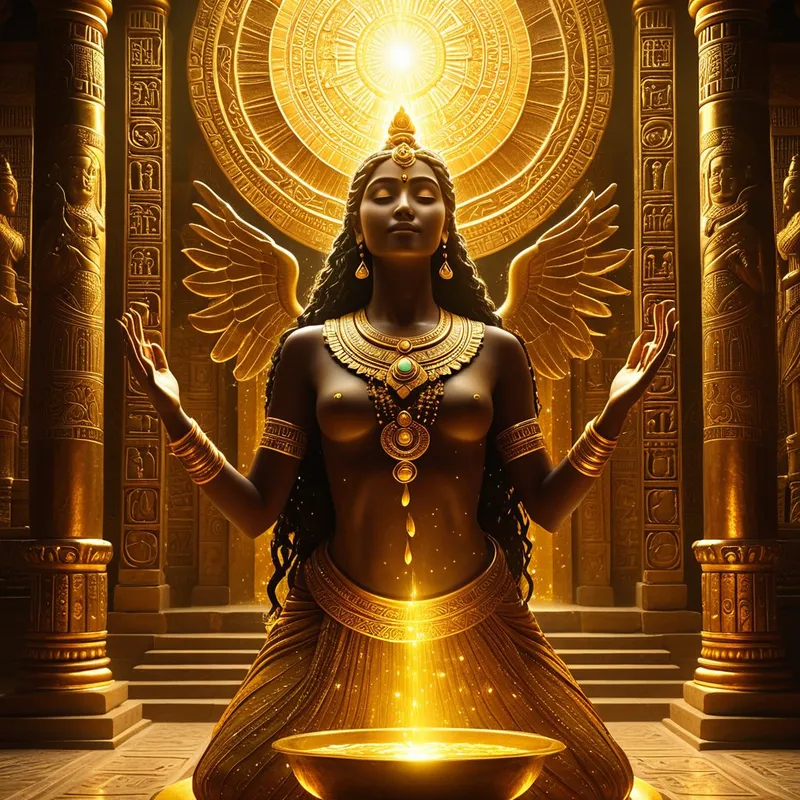
Before time was measured in heartbeats, when the cosmos was still humming the primordial note of its birth, the gods and demons churned the great ocean of milk. From that turbulent, frothing chaos, they sought the nectar of immortality. But the first being to rise from the depths was not a pot of ambrosia. It was he, Dhanvantari, the divine physician. In his four hands, he held the tools of his sovereignty: the pot of nectar, the leech, the surgical knife, and the conch shell. But it was the oil that flowed from the conch that held another, quieter secret.
The churning was a violence of creation. It strained the very fabric of the celestial beings. Their divine Koshas—the sheaths of light, mind, and bliss—were frayed. Their immortal forms ached with a fatigue deeper than marrow. They had wrestled the cosmic serpent Vasuki and stirred the foundations of reality. Victory left them hollow, their radiance dimmed.
Dhanvantari saw not just bodies, but landscapes of distress. He saw Vayu trapped and turbulent in their joints, the sacred fire of Agni guttering low in their bellies, the waters of Apas stagnant and cold. They were dis-integrated, pulled apart by the effort of their own world-making.
He called them to his sanctuary, a place where the air was thick with the scent of earth-rooted herbs: ashwagandha for strength, brahmi for clarity, sesame seed, the very essence of sustenance, warmed over a gentle flame. He did not speak of battle or glory. He spoke of surrender. "Lay down your weapons," his silence said. "Lay down your divinity. For this moment, be only a body that remembers it is also earth."
And so, the mighty ones lay upon couches of fragrant wood. Dhanvantari took the warmed, golden oil. The first touch was not a technique, but a covenant. His hands, charged with the intelligence of creation itself, met skin that was a map of cosmic strife. He began to work, not on muscle and bone, but on the pathways where light travels—the Nadis. His strokes were long, deliberate, following the riverbeds of life force from the crown to the soles.
As the oil sank in, a miracle of quietude unfolded. The frantic Vata was soothed, settling like dust in a still room. The smoldering heat of Pitta was cooled and directed. The heavy stagnation of Kapha was gently mobilized. It was a re-membering. The god who had forgotten his connection to the earth felt roots grow from his feet. The goddess whose mind was a storm of strategy felt her thoughts become clear, still pools. The oil was the medium, the hands were the ritual, and the body was the temple being reconsecrated. They arose not merely rested, but re-knitted. Whole. The ritual of Abhyanga was born not from a prescription, but from a primal act of compassionate, tactile poetry.
Cultural Origins & Context
This mythic essence is woven into the daily fabric of life through the classical medical text, the Charaka Samhita. Here, Abhyanga is elevated from folk practice to a sacred science of longevity (Ayur). It was not merely hygiene; it was a foundational pillar of Ayurveda, as vital as diet or herbs. Traditionally, knowledge of its precise methods—the types of oils for different constitutions (Doshas), the direction of strokes, the timing linked to the seasons and times of day—was passed down from teacher (Acharya) to student within the Gurukula system.
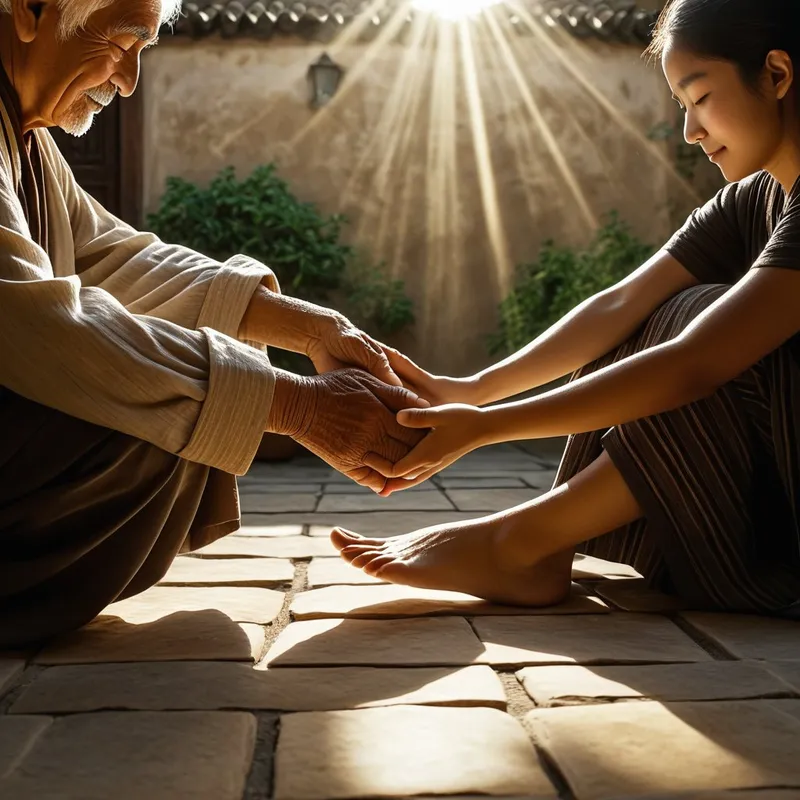
Its societal function was profound. It was a daily ritual of self-care that affirmed a core philosophical principle: the body is not a prison for the soul, but its sacred instrument and first home. To nourish it with such deliberate, loving attention was to honor the divine within the material. It was performed on infants to ensure healthy growth, on the elderly to preserve dignity and function, and on everyone as a preventative measure against the wear and tear of life (Jara). It was, and is, a democratized sacrament, a way for every individual to enact their own miniature, daily version of Dhanvantari’s divine restoration.
Symbolic Architecture
At its core, the myth of Abhyanga is a map of integration. The fractured, weary deities represent the human condition after any great exertion—physical, emotional, or spiritual. We, too, churn the oceans of our experience and are left dis-integrated.
The oil symbolizes the unbroken, nourishing flow of consciousness and life force that seeks to reconnect what has been separated.
It is the mediating substance between spirit and matter. The warm, golden quality points to liquid sunlight—the captured radiance of Surya—made tangible, meant to be absorbed. Dhanvantari’s hands represent applied wisdom and compassionate, conscious touch. They do not force; they guide. They follow the innate intelligence of the body’s channels (Nadis), respecting its own sacred architecture.
The ritual’s direction—from head to foot—is a symbolic grounding. It brings awareness from the crown chakra (Sahasrara), the realm of pure spirit, down through the body to root in the earth at the feet. It is an alchemical circuit, completing the connection between heaven and earth within the individual vessel. The act of surrendering to the touch is perhaps the most potent symbol: the ego, the warrior identity, must temporarily relinquish control to allow a deeper, systemic healing to occur.
The Dreamer's Resonance
When this myth stirs in the modern unconscious, it often manifests in dreams of profound tactile repair. One might dream of being anointed with warm, golden light that seeps into cracks in the skin. Or of lying passively while benevolent, unseen hands mend a shattered porcelain version of the self. There may be imagery of frozen rivers beginning to flow, or of dead, brittle branches becoming supple and green again.
Somatically, the dreamer is likely experiencing a state of depletion or fragmentation. They have been "churning their own ocean"—pushing through a project, a crisis, or a period of intense emotional labor. The psyche is signaling a critical need for receptive, nourishing care. The dream is not advocating for more action (the hero’s battle), but for deep surrender (the caregiver’s ritual). It points to a process where the conscious, striving mind must step aside to allow the autonomic, healing intelligence of the body-psyche to do its work. The dream is an invitation to become both Dhanvantari and the deity—to apply the oil of self-compassion and to receive it fully.

Alchemical Translation
The alchemical journey modeled by Abhyanga is one of solve et coagula: to dissolve and to re-coagulate. First, one must acknowledge the state of solve—the feeling of being dissolved, frayed, and weary from life’s churnings. The conscious ego must consent to this dissolution, to lay down its arms.
The application of the oil represents the conscious introduction of the medicina—the healing agent. In psychological terms, this is the loving attention of the observing Self.
This attention, like the oil, must be warm (compassionate), fluid (adaptable), and penetrating. It must flow into the stuck, neglected, and wounded parts of our being—the turbulent emotions (Vata), the burning resentments (Pitta), the heavy depressions (Kapha).
The rhythmic, grounding strokes are the discipline of mindful practice—whether therapy, meditation, journaling, or simply conscious breathing. This practice follows the innate patterns of the psyche, gently moving energy from the abstract worries of the mind down into the grounded reality of the body, releasing what is toxic and integrating what is vital.
The final stage, coagula, is the rebirth into wholeness. It is not about becoming someone new, but about re-membering who you fundamentally are when the fragments are lovingly pieced back together. The individuated Self that emerges is not a triumphant warrior, but a sovereign being in repose—integrated, grounded, resilient, and radiantly at home in its own skin. The myth teaches that our greatest power often lies not in further striving, but in the sacred, daily ritual of receiving and giving profound care to the vessel of our existence.
Associated Symbols
Explore related symbols from the CaleaDream lexicon: