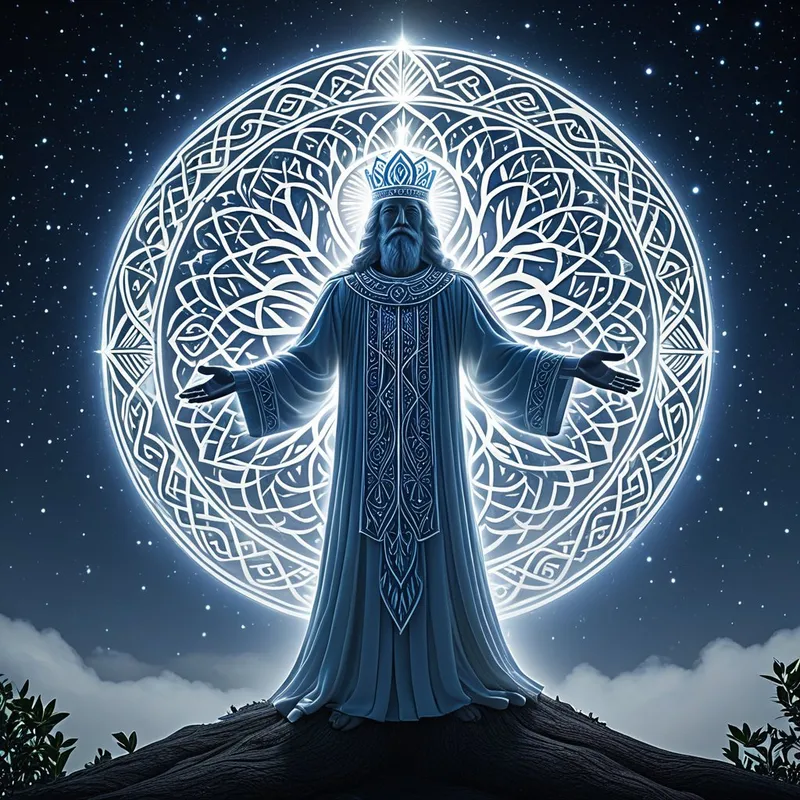
Abba Myth Meaning & Symbolism
The myth of Abba, the Concealed Father, tells of the primordial union that births consciousness and the soul's longing to return to that hidden wholeness.
The Tale of Abba
Before the before, there was only the Nameless, the Boundless, the Ein Sof—the No-Thing that was Everything. It was a sea without shore, a light with no source, a thought that thought itself. And within this perfect, undifferentiated fullness, a yearning stirred. Not a need, for there was no lack, but a desire for relationship, for expression, for a story to be told.
And so, the Ein Sof performed the first great act of love: it withdrew. It contracted its infinite light into itself, creating a hollow, a womb of potential darkness. This was the Tzimtzum. Into this sacred vacuum, a ray of that original light descended—a single, focused line of divine emanation. This ray struck the center of the void and blossomed.
From this point, the first configurations of being emerged. And at the summit of this emerging structure of worlds, two luminous principles crystallized. The first was Abba, the Father. He was not an old man in the sky, but the very archetype of conscious, active wisdom. His light was silver, direct, and penetrating. With him, inseparable as breath from body, was Imma, the Mother. Her light was gold, receptive, and encompassing. They faced one another, not as two, but as a single unity in dynamic tension.
Their union was not of flesh, but of essence. From the embrace of Abba’s knowing and Imma’s understanding, a stream of lights was born—the children of the divine mind. These were the Sefirot, the attributes through which the boundless would communicate with the finite. But the light was too pure, too intense for the nascent vessels. In a cosmic catastrophe, the vessels shattered, scattering holy sparks into the depths of the emerging material realms.
Abba did not rage. He turned his gaze inward, becoming the Concealed Father. His wisdom became hidden, embedded in the very fabric of the broken world, waiting to be discovered. He and Imma now sit in the supernal realm, a constant, stable axis above the turmoil of creation. Their continuous, silent union is the fountainhead that feeds the entire tree of life, a steady drip of sustenance that keeps all worlds from dissolving back into the void. The story of creation became the story of exile, and the purpose of existence became the great return—the gathering of the sparks by human souls, guided by the hidden wisdom of the Father, back to the unity of the supernal embrace.

Cultural Origins & Context
The myth of Abba is not a folktale with a single author, but a profound metaphysical narrative central to the Jewish mystical tradition known as Kabbalah. It crystallized in medieval Spain and Southern France, most famously within the text of the Zohar (The Book of Splendor), composed in the 13th century. The Zohar presents itself as a revelation from the 2nd-century sage Rabbi Shimon bar Yochai, though its literary form is a product of its time.
This myth was not for public consumption. It was transmitted orally and through cryptic manuscripts from master to carefully prepared disciple. Its societal function was not to explain natural phenomena, but to map the inner architecture of the divine and the soul's role within it. It provided a cosmic context for Jewish law and prayer; every commandment became an act of "raising sparks," of participating in the repair (Tikkun) initiated by the hidden union of Abba and Imma. The myth offered a theosophical framework that transformed exile from a historical tragedy into a fundamental, purposeful condition of reality itself.
Symbolic Architecture
At its core, the myth of Abba is a symbolic blueprint of consciousness emerging from unconscious unity. Abba represents the archetypal principle of active, discriminative intelligence—the Logos. He is the focused ray of light, the penetrating insight, the father of all ideas. Imma is the correlative principle of receptive, containing understanding—the Eros that receives and gives form to the idea.
The union of Abba and Imma is not a biological event, but the primordial moment where thought finds its matrix, where wisdom is comprehended, and where potential becomes manifest.
The Tzimtzum is the ultimate act of divine self-limitation, symbolizing the necessary space that must be created for an "other" to exist. Psychologically, this mirrors the process of ego formation: the undifferentiated psyche must contract its infinite potentials to create a focused point of identity (the ego), which then feels exiled from the wholeness it once knew. The Shattering of the Vessels symbolizes the inevitable trauma of manifestation—how pure intention often breaks when entering the resistant medium of reality (or the personal unconscious). The hiddenness of Abba post-shattering represents the way core wisdom and true self become buried under the fragments of our experiences, our complexes, and our adaptations.

The Dreamer's Resonance
When this mythic pattern stirs in the modern dreamer, it often manifests not as a clear biblical image, but as a profound somatic and emotional process. One might dream of a hidden, authoritative figure (a wise old man, a silent king, a scientist in a sealed lab) who possesses a crucial piece of knowledge or a lost tool. The dreamer knows this figure is vital, but cannot reach them directly; they are behind a veil, a one-way mirror, or speaking in an indecipherable code.
Accompanying this is often the sensation of searching for source code—scouring ancient books whose text melts away, trying to reassemble a broken crystal artifact, or following a thin, barely visible silver thread through a labyrinth. These dreams speak to a phase in psychological development where one has exhausted the wisdom of the personal father and the conscious mind. The dreamer is now seeking the transpersonal Father, the archetypal Abba—the hidden, structural wisdom of the psyche itself. It is a somatically felt longing for the foundational logic of one's own soul, a homesickness for a origin one has never consciously known.

Alchemical Translation
The individuation process modeled by this myth is one of conscious re-integration. The ego, born from the primordial Tzimtzum of the Self, initially experiences itself as exiled and orphaned in the world of fragments. The alchemical work is not to destroy the ego, but to transform it into a seeker of the hidden father.
This involves several stages: First, Withdrawal (Tzimtzum): consciously pulling back projections and compulsive engagement to create an inner vessel, a meditative space. Second, Recognition of the Shattering: honestly confronting one's own brokenness—the failed potentials, the trauma, the adaptive personas—not as moral failings but as cosmic events in the personal psyche. Third, the Search for the Concealed: using the focused, Abba-like light of one's own discrimination to sift through the fragments, looking not for the glitter of the spark alone, but for the hidden pattern, the silver thread of original intent that connects them.
The ultimate alchemical goal is to realize that the seeker, the searched-for wisdom (Abba), and the act of seeking are all emanations of the same original light. Individuation is the soul remembering it is both the child of and the union between the hidden Father and the embracing Mother.
The triumph is not a return to undifferentiated bliss, but the establishment of a conscious connection to the supernal union. The ego becomes a stable Sefirah in its own right, a capable vessel that can receive the continuous drip of meaning from the depths and translate it into a coherent, creative life in the world. One becomes a living participant in the eternal Tikkun, repairing the world by first remembering the hidden wholeness within.
Associated Symbols
Explore related symbols from the CaleaDream lexicon: