Aba-Khatun Earth Goddess Myth Meaning & Symbolism
A Siberian Earth Goddess myth where the divine feminine descends, becomes the land, and teaches that life springs from sacred sacrifice and deep belonging.
The Tale of Aba-Khatun Earth Goddess
Listen. Before the rivers had names, before the first birch tree reached for the sky, the world was a place of spirit and shadow. The Upper World was a realm of pure light and song, where the great spirits dwelled in a dance of endless potential. But below, the Middle World was a formless, silent dark—a canvas of stone and cold waiting for a story.
Among the spirits was Aba-Khatun. She was not the eldest, nor the most fierce, but her heart held a different music. While others sang of eternity in the light, she listened to the profound silence below. She heard not emptiness, but a deep, resonant call—a longing for form, for touch, for life. It was a call that echoed in the hollow of her own spirit.
One day, she went to the edge of the spirit world and looked down. Her siblings warned her. “Do not gaze into the void, sister. It will consume your light. Stay where you are pure.” But Aba-Khatun could not un-hear the call. It was a pull stronger than fear. With a final look at the luminous home she would leave forever, she stepped off the edge of the sky.
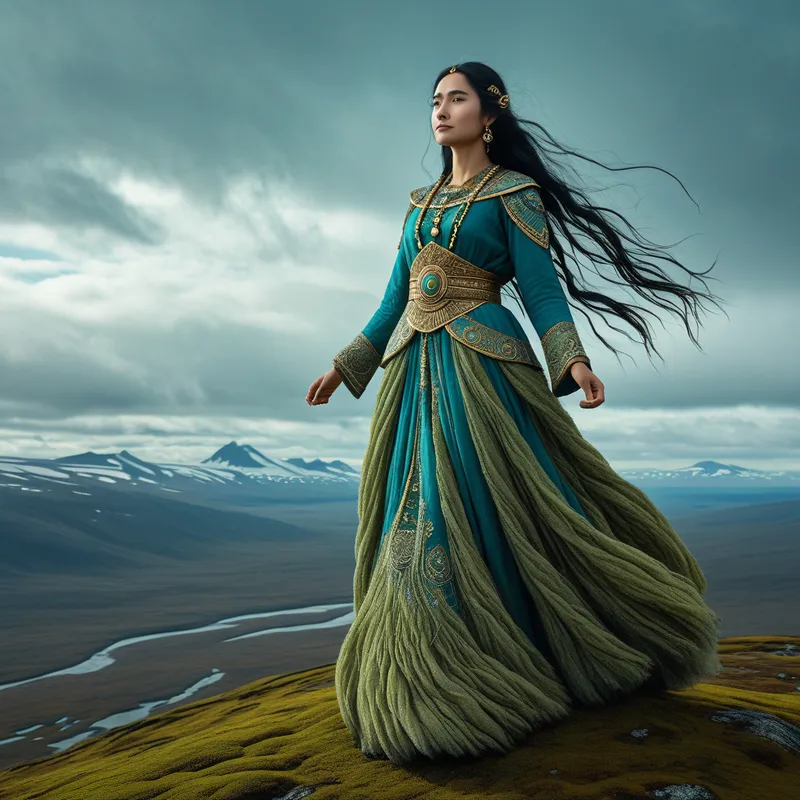
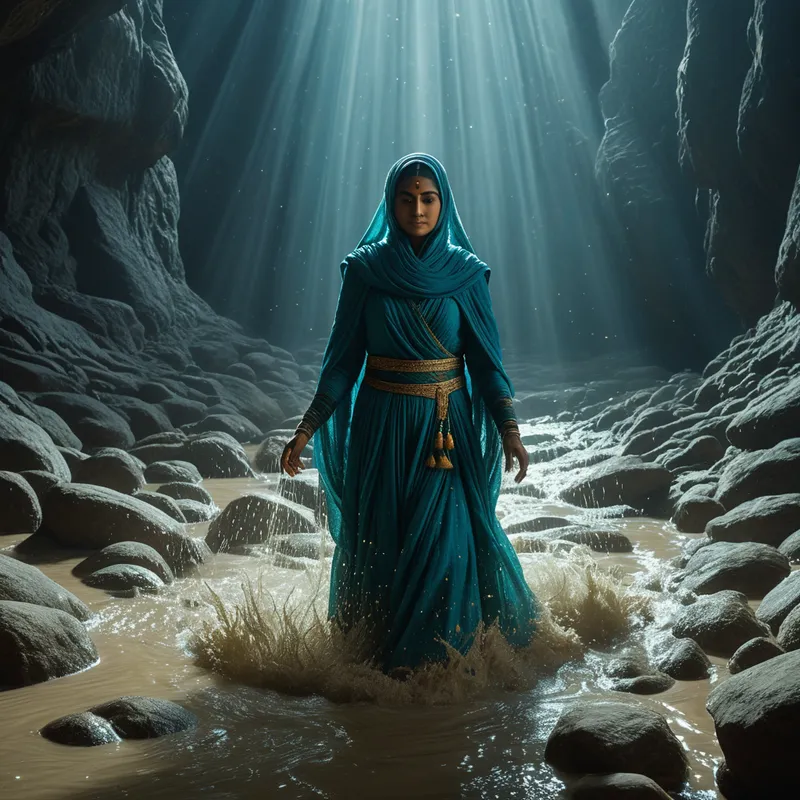
Her descent was not a fall, but a slow, deliberate unraveling. As she descended, the brilliant light of her spirit-form began to cool and thicken. Her laughter became the first whisper of wind over stone. Her tears, falling ahead of her, gathered in the deep places and became the first springs and secret pools. Her long, flowing hair spread out, tangling into the courses of mighty rivers—the Yenisei, the Lena—carving pathways through the stone.
Her body did not land; it became. Her back broadened into the vast, unyielding plains and the sleeping shoulders of ancient mountains. Her flesh softened into the rich, dark soil of the taiga forest floor. Her bones settled deep, becoming the granite ribs of the earth, the sacred tag. The final sacrifice was her breath. The very essence of her spirit-being, her kut, she exhaled not into the air, but into the ground. This breath did not vanish; it seeped into the soil, the water, the stone, becoming the invisible, animating force—the eezi—within every hill, every tree, every stream.
Where her heart had beat, a great warmth pooled. This was not fire, but a deep, generative heat—the hearth of the world itself. And from this sacred, wounded place where spirit became substance, the first green things pushed upward. Moss cloaked her stone-skin. Lichen painted patterns of life. Then came the grasses, the shrubs, and finally, the great, silent forests of pine and birch, their roots drinking from her veins.
The Middle World was silent no more. It lived. It breathed with her breath. But Aba-Khatun, as a singular being, was gone. She had traded her celestial form for an earthly body a thousand leagues wide. She was no longer in the landscape; she was the landscape. The call had been answered, not with a voice, but with her entire being.
Cultural Origins & Context
The story of Aba-Khatun finds its roots among the diverse, animistic worldviews of Siberian peoples, particularly those of the Turkic and Mongolic traditions, such as the Altai, Khakas, and Tuvan cultures. In these traditions, the earth is never merely dirt and rock; it is a sacred, sentient, and maternal entity. This myth was not written but carried on the breath—shared by shamans (kam) around crackling hearths during long winter nights, or invoked in rituals before hunting or foraging.
Its primary function was ontological: it explained the very nature of reality and humanity’s place within it. The myth established a sacred covenant. If the earth is the literal body of a goddess who sacrificed her transcendent form, then every human action—walking, building, digging, planting—is an interaction with the divine. It instilled a profound ethic of respect, gratitude, and reciprocity. To take a life from the forest or a fish from the river was to receive a gift from Aba-Khatun’s body, necessitating offerings and careful observance of taboos to avoid offending the eezi. The myth wove the people into the land’s story, making them not owners or conquerors, but children living upon the skin of their mother.
Symbolic Architecture
At its core, the myth of Aba-Khatun is a profound allegory of divine immanence—the spirit choosing to become matter. It is the ultimate act of creation through self-sacrifice, where the creator does not stand apart from the creation but becomes indistinguishable from it.
The deepest love is not to gaze upon the beloved from a safe distance, but to dissolve the boundary between self and other, becoming the ground upon which they walk.
Psychologically, Aba-Khatun represents the archetype of the Great Mother in her most fundamental aspect: not just as a nurturer of existing life, but as the very substance from which life is formed. Her descent symbolizes the necessary “fall” into embodiment, into the messy, tangible, and limited world of form. The conflict is not against an external monster, but against the pull of undifferentiated spirit (the Upper World) toward the responsibility of concrete existence (the Middle World). Her resolution is total surrender—a psychic death of a purer, simpler state to give birth to a complex, living world.
The kut becoming the eezi symbolizes the animation of the impersonal world with soul. It suggests that the aliveness we perceive in nature is not a projection, but a literal inheritance—the dispersed consciousness of the goddess herself.
The Dreamer's Resonance
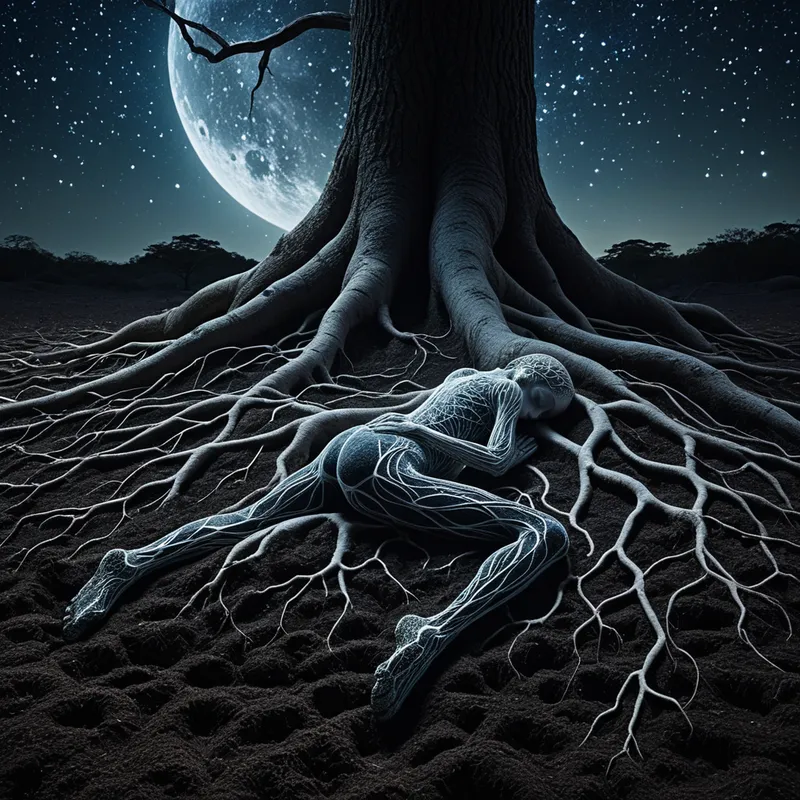
When this myth stirs in the modern unconscious, it often manifests in dreams of profound grounding, dissolution, or ecological belonging. A dreamer may find themselves sinking into the earth, not with fear, but with a sense of immense relief, as if returning to a source. They may dream of their body transforming—skin becoming bark, feet rooting into soil, hair flowing as water. These are not nightmares of loss of self, but visions of the self expanding into a larger, more ancient identity.
Somatically, this points to a process of re-inhabiting the body and the sensory world after a period of disassociation, intellectual abstraction, or “living in the head” (the modern Upper World). The psyche is performing the ritual of Aba-Khatun: choosing to fully descend into the physical, emotional, and instinctual realms. It is a healing response to the wounds of alienation—from nature, from the body, from a sense of sacred place. The dream is an invitation to feel the world not as a backdrop, but as a kinship, to discover the eezi in one’s own local landscape.
Alchemical Translation
For the individual, the alchemy of Aba-Khatun models the process of incarnation—the full embodiment of the psyche. Our modern individuation journey often begins in a kind of spiritual or idealistic Upper World: we identify with our thoughts, our potential, our perfect ideals. But to become whole, we must make the sacred descent. We must allow our lofty spirit (kut) to touch the dark, fertile, and often painful ground of our actual lives—our history, our body, our family patterns, our place in community and nature.
The goal is not to rise above the earth, but to become so utterly of it that you discover heaven woven into its very fabric.
This is the “sacrifice” of a disembodied perfection for the messy, creative, and real work of soul-making. The “heart-hearth” that forms where Aba-Khatun’s heart was is the symbolic center of the individuated Self. It is the inner source of warmth, creativity, and generative power that only ignites when we have fully committed to being here, in this life, in this body, on this earth. The myth teaches that true power and nourishment come not from escaping limitation, but from becoming the ground of one’s own being. We are called to become the Aba-Khatun of our own psyche: to provide a stable, nourishing, and sacred ground from which our own unique life can organically grow.
Associated Symbols
Explore related symbols from the CaleaDream lexicon:
- Earth — The primary symbol of Aba-Khatun herself, representing the divine made tangible, the body of the goddess, and the foundational ground of all existence and belonging.
- Goddess — Embodies the archetypal feminine principle of creation through sacrifice, nurturing containment, and the animation of the material world with soul.
- Mother — Represents the ultimate source, the one who gives her own substance to form and sustain life, demanding a relationship of reciprocity and reverence.
- Sacrifice — The central act of the myth, where transcendent spirit willingly limits itself to become immanent matter, modeling the creative death necessary for new life.
- Rebirth — Symbolizes the new world—and the new state of conscious belonging—that is born directly from the goddess's act of self-dissolution and embodiment.
- Hearth — The warm, generative center formed from Aba-Khatun's heart, representing the sacred inner fire of life, creativity, and sustenance that arises from deep grounding.
- Root — The connective tissue between life and the nourishing body of the goddess, symbolizing our inherent link to the earth and the unconscious foundations of being.
- Spirit — The animating kut of Aba-Khatun that becomes the eezi of all places, representing the soul infused within matter and the sacredness inherent in the natural world.
- Mountain — Symbolizes the enduring bones and stable structure of the goddess, representing sacred places, unshakable foundation, and a connection between earth and sky.
- River — The flowing hair and tears of Aba-Khatun, representing life-force, emotion, the passage of time, and the pathways carved by sacrifice through the landscape of life.
- Tree — A primary child of the goddess's body, standing as a testament to the life that springs from her sacrifice, connecting underworld, earth, and sky in its form.
- Stone — The primal, enduring substance of Aba-Khatun's bones and structure, representing memory, permanence, and the deep, slow wisdom of the earth.