
The Somatic Echo
It begins not as a thought, but as a stillness. A hush in the chest, a suspension of breath you didn’t know you were holding. The body becomes a vessel of pure, unblinking attention. There is a pressure behind the eyes, a cool clarity in the spine, as if your entire nervous system has been tuned to a single frequency: reception. This is the somatic echo of witnessing—a visceral, pre-cognitive state of being seen by and seeing into a moment that holds a terrible, beautiful truth. It is the feeling of the world holding its breath, waiting for you to acknowledge what has always been there, shimmering just beneath the surface of your daily forgetting.
The Dreamer's Log
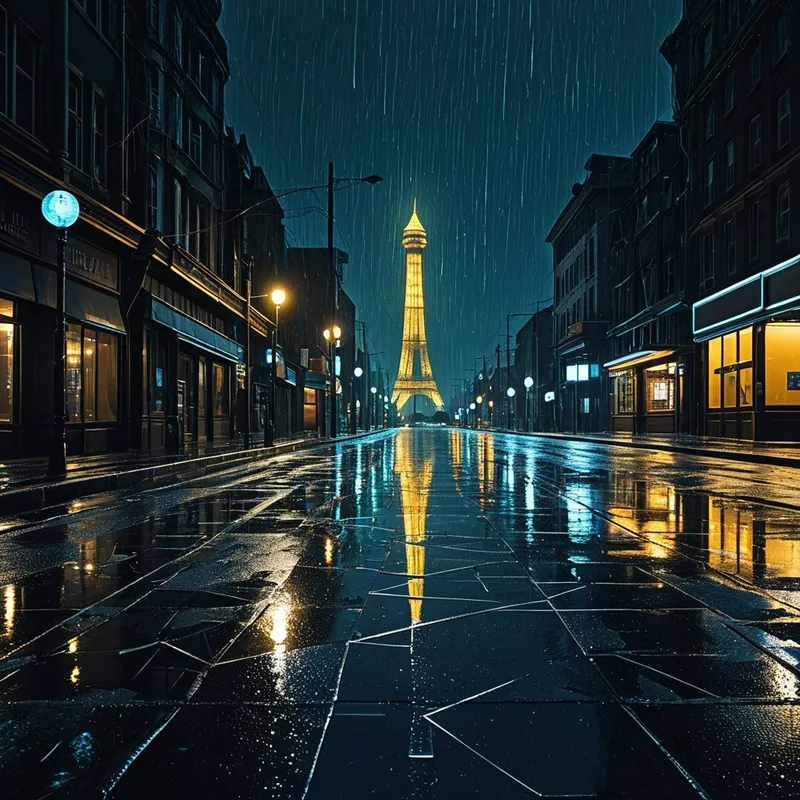
I am standing on a deserted city street at midnight, the asphalt gleaming with recent rain. A shattered phone screen lies at my feet, its glass a spiderweb of fractures. In each shard, a different fragment of a weeping face is reflected—an eye here, a mouth there. I cannot look away. A single, thin filament of golden light extends from the broken device, stretching taut into the dark sky, connecting it to a distant, silent communications tower that hums with a low, pervasive frequency.
Alchemical Interpretation: The dreamer is being called to witness the fractured narrative of their own emotional distress, to see how each broken piece is still connected to a central, transmitting source of consciousness that awaits reintegration.
The False Lead
Witnessing is not voyeurism. It is not the passive, detached consumption of imagery, nor is it the morbid fascination of the bystander. To mistake it for mere observation is to commit the great error of our age: believing that seeing is the same as looking. Voyeurism seeks sensation; witnessing demands participation. It is not about watching something happen to someone else, but about allowing something to happen within you. The terror of the witnessing dream is not the event itself, but the irrevocable responsibility that comes with the act of seeing. It marks the end of plausible deniability, the collapse of the story that you did not know.
Psychological Architecture
To witness in a dream is to be appointed by the psyche as the sole responsible party for a piece of unbearable reality. This is the core of its Shadow work. The psyche, in its infinite wisdom, presents a scene—often of grief, conflict, vulnerability, or surreal beauty—and says: This too belongs to you. You can no longer exile it to the periphery. The figure you see weeping in the plaza, the argument behind the glass door, the forgotten room in your own house pulsing with a strange light—these are not random strangers or set pieces. They are disowned parts of your own internal family system, exiles carrying emotions or memories you could not metabolize alone.
The individuation process here is one of radical reclamation. By holding the gaze, you perform a psychic act of immense courage: you stop the projection. You withdraw the energy you’ve used to keep that scene “out there” and allow it to become “in here.” The pressure you feel is the strain of dissolving an internal boundary. You are not solving the problem you see; you are consenting to be the container for it. This is how the orphaned fragment, once witnessed with conscious presence, begins to lose its charge of terror and starts its journey home. It ceases to be a haunting and becomes, simply, a memory, an emotion, a part of the whole.
Mythic Resonance
Consider the figure of Moriah, the mountain of seeing. In the ancient narrative, a father is asked to take his beloved son to its heights, not for a sacrifice of death, but for a sacrifice of attachment. The pivotal moment is not the raised knife, but the divine intervention: "Now I know that you fear God, since you have not withheld your son." The father is not rewarded for blind obedience, but for his demonstrated capacity to witness the full, horrifying implication of his faith without turning away. He sees the potential of his own loss completely, and in that unflinching gaze, the situation transmutes. The ram appears. The story shifts.
This is the mythic firmware of witnessing: a journey to the bleak height where you must see the thing you most dread, not to be destroyed by it, but to prove to your own soul that you can hold the sight. The “ram” — the unexpected resolution, the creative alternative, the divine mercy — only appears after the gaze has been held. It cannot manifest in the space of averted eyes.
Symbolic Nodes
- Windows, Mirrors, Screens: Any interface that both separates and connects, offering a view you cannot physically enter.
- Silent Observers: Statues, portraits, dolls, or distant figures on balconies who simply watch.
- Recorded Media: Old film projectors, paused videos, corrupted data files, answering machine messages—evidence that persists.
- Transparent Barriers: Glass walls, water surfaces, veils, or force fields that create a clear but impassable divide.
- Isolated Light Sources: A single lit room in a dark building, a flashlight beam in a forest, a candle in a vast hall.
Archetypal Resonance
The energy of the Witness is the pure, distilled essence of The Sage Archetype. Not the Sage as a lecturer dispensing knowledge, but the Sage as the silent, all-seeing presence in the mountain temple. This archetype’s core drive is the pursuit of truth, not for power or comfort, but for the liberation that comes with understanding. The somatic echo of cool clarity and suspended breath is the Sage’s perceptual mode: detachment from the personal drama in service of perceiving the underlying pattern.
The alchemical potential here is vast. The Shadow Sage manifests as the dogmatic judge, the one who sees only to condemn or categorize. The integrated Sage, however, witnesses to comprehend, to hold the paradox, to allow the truth to be what it is without immediately forcing it into a familiar box. In the dream of witnessing, you are being initiated into this higher function of consciousness. You are learning to use your awareness not as a spotlight to highlight only the acceptable, but as a spacious, compassionate field in which even the most shattered fragments of experience can be seen, and thus, begin to heal.
The Alchemical Process
The alchemy of witnessing is the transformation of passive trauma into active testimony. The raw lead of the experience is the frozen, unprocessed event-memory—a snapshot of pain that haunts the periphery. The heat and pressure required are generated by a single, agonizing act: sustained attention without interpretation.
You must hold the dream image in your mind’s eye without rushing to explain it, justify it, or make it mean something palatable. This is the nigredo, the blackening. It feels like drowning in the significance of what you see. The grief, the shame, the awe—it must be fully felt. The transmutation occurs in the moment the identification shifts from “I am seeing a terrible thing” to “I am the space in which this terrible and beautiful thing is being seen.” The “I” expands from the ego, which wants to flee, to the consciousness, which can contain.
The gold that is produced is sovereign perception. You are no longer at the mercy of what enters your field of vision; you have reclaimed your authority as the one who grants it a field in which to appear. The event loses its power to define you because you have defined your relationship to it. You have become the witness, not the victim, of your own reality.
The Integration Protocol
Question 1: In the witnessing dream, what was the one detail I most wanted to look away from? What quality (sadness, rage, vulnerability, beauty) did that detail hold?
Question 2: If the scene I witnessed is a message from an exiled part of myself, what is the first sentence that part would speak if it finally had a voice?
Question 3: How does holding this gaze consciously change the old story I’ve told about who I am and what I can bear?
Action 1 (Somatic Anchoring): Upon waking, before the mind scrambles to analyze, return to the somatic echo. Sit upright, place a hand over your heart and one on your belly. Breathe into the stillness you felt in the dream. For two minutes, simply re-inhabit that state of pure, non-judgmental reception. You are not recalling a dream; you are re-establishing the witness position in your waking body.
Action 2 (Unstructured Transcription): Take a blank page. Set a timer for 10 minutes. Write from the perspective of the setting of the dream—the street, the room, the forest. Describe what it felt like to have that scene unfold within you. Let the prose be messy, poetic, or stark. The goal is not to document the event, but to give voice to the container that held it.
Action 3 (Ritual of Acknowledgment): Find a small stone or natural object. Hold it while you consciously recall the witnessed dream scene. Then, go to a threshold—a doorway, a garden edge, a window. Acknowledge aloud: "I have seen what was shown. I hold the sight." Place or leave the object at that threshold, symbolizing that the witnessed content now resides in the liminal space of your awareness, neither buried inside nor projected outside, but honorably held at the boundary where transformation occurs.
Final Validation
It is a sacred and terrifying thing to be chosen as the witness. To feel the weight of that seeing is to touch the raw edges of your humanity. Do not diminish the courage it took to not look away in your sleep; that was the psyche’s trial by fire. The grief or awe you felt is the measure of your capacity for depth. Now, in the light of day, you are not being asked to relive the trauma, but to claim the authority that the dream bestowed upon you: the authority of the one who sees. In that claim lies a profound and unshakable sovereignty. You are no longer just the character in the story. You have become, at last, the conscious space in which the entire story is allowed to unfold.