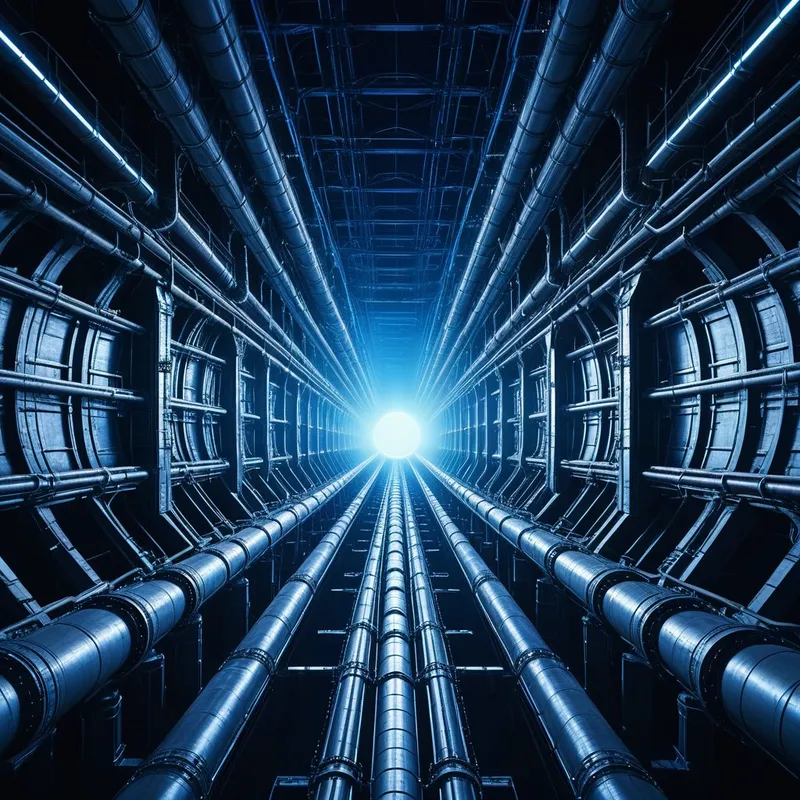
The Dream of Ventilation: An Alchemy of Release
The Somatic Echo
Before the image forms, the body knows. It is a pressure that has no single source—a silent, mounting hum in the bones, a density in the chest that feels less like emotion and more like a physical law. You are a vessel sealed too well. The air inside grows stale, recirculated through the same tired circuits of thought and feeling until it is thick with the carbon dioxide of old narratives. This is the somatic echo of a psyche that has become its own containment unit. It is not panic, but a profound, weary compression. The dream of ventilation begins here, in this visceral, wordless plea from the organism itself: I cannot breathe what I am exhaling.
The Dreamer's Log
I am standing in a sterile, windowless server room. The only sound is the low, anxious drone of a thousand fans. I approach a central rack, its metal grilles glowing a dull, ominous amber with trapped heat. My task is clear and desperate: I must find the release valve. My fingers scramble over smooth, hot metal, seeking a latch, a lever, anything. The drone rises to a scream.
This is the dream of a system overheating under the burden of its own uninterrupted processing. The alchemical interpretation: The sealed intellect, burning through its own fuel, seeks the grace of an exhaust port to transmute heat into light.

The False Lead
Do not mistake this for a simple dream of escape or a wish for a vacation. Ventilation is not about fleeing the source of heat, but about transforming the very nature of the container. It is a structural dream. The false lead is to believe the pressure is caused by external circumstance—a bad job, a difficult relationship—and that changing those will solve it. The dream points inward, to the architecture of the self. It is not about removing the server, but about redesigning the room so the server can function without threatening to melt down. This is the difference between mere problem-solving and profound psychic re-engineering.
Psychological Architecture
To understand ventilation is to engage in the shadow work of circulation. We build internal chambers—for grief we deem too messy, for anger we consider unseemly, for a creativity we fear is wasteful. We seal them with the mortar of routine, rationality, and "keeping it together." But energy cannot be destroyed, only transformed or displaced. The sealed emotion does not vanish; it pressurizes. It becomes the background hum of anxiety, the low-grade fever of resentment, the creative paralysis that feels like inertia.
The individuation process here is one of permitted leakage. It is the courageous, counter-intuitive act of intentionally weakening your own seals. It is allowing the steam to whistle, the valve to hiss. This is not a catastrophic rupture, but a controlled, conscious release. The shadow fears this, screaming that to release any pressure is to lose all control, to become undefined and chaotic. The work is to differentiate between a collapse and a ventilation—between destruction and necessary exchange.
Mythic Resonance
We see this in the myth of the Labyrinth. It is not the Minotaur at its center that is the ultimate horror, but the silence, the endless, echoing passages with no inlet for new air. The hero’s thread, often seen as a mere tool for return, is fundamentally an act of ventilation. It creates a conduit, a psychic airway, connecting the suffocating depths of the unconscious with the world above. Without that thread, even a victorious hero would perish, suffocated by the very secrets they conquered.
Similarly, the tale of Pandora’s Box is not merely about the release of evils, but about the structural necessity of an open container. Once opened, the pithos could not be fully resealed. Hope remained, not as a consolation prize, but as the essential atmosphere that now, because of the opening, could circulate within a world now honest in its complexity. The sealed vessel was an illusion of peace; the ventilated one, though fraught, could sustain life.
Symbolic Nodes
- Fans, Vents, Grilles: The mechanisms of exchange, often blocked, broken, or straining.
- Stale or Thick Air: The palpable quality of unprocessed emotional and mental matter.
- Windows That Won’t Open: The conscious desire for fresh perspective, thwarted by an unseen lock.
- Overheating Machines: The intellectual or systemic parts of the self pushed beyond sustainable limits.
- Whistling Kettles, Hissing Valves: The audible signal that pressure has reached a critical point of necessary release.
- Vast, Empty Ductwork: The often-unused potential for internal circulation and flow.
Archetypal Resonance
The energy of ventilation resonates most deeply with The Rebel Archetype. Not its shadow aspect of wanton destruction, but its core, revolutionary function: to dismantle oppressive structures so that life may flow. The Rebel’s somatic echo is the claustrophobic rage against artificial constraint, the intuitive knowing that a system is suffocating its inhabitants. Its alchemical potential lies in its targeted precision—it does not seek to annihilate the building, but to blow out a wall where a window should have been. The Rebel archetype activates here not to create anarchy, but to restore the fundamental right of the psyche to breathe, to exchange its inner atmosphere with the outer world, transforming stagnant control into dynamic sovereignty.
The Alchemical Process
The alchemy of ventilation is the Solve et Coagula—the dissolving and re-coagulating—applied to psychic atmosphere. The prima materia is the compressed, internalized air of your history. The heat and pressure are supplied by life itself, by the inevitable friction of existence within a sealed system.
First comes the Solve: the dissolution of the belief that containment equals safety. This is the painful heat. It is the recognition that your "strength" in holding it all in is actually a slow self-immolation. You must allow the seals to soften. This might feel like a loss of integrity, a terrifying vulnerability.
Then, the Coagula: the re-forming. As the stale air is vented, a vacuum is created—not an emptiness, but a potential space. Into this space rushes new air, new perspective, a different quality of thought. The psyche re-coagulates around this new principle of exchange rather than storage. The self is no longer a locked archive, but a living system in respiration with the world. The terror of release is transmuted into the profound sovereignty of knowing you have an internal climate control—you are neither sealed in nor blown open, but in conscious, rhythmic dialogue with what is within and without.

The Integration Protocol
Question 1: Where in my life does my composure feel most like a sealed unit? What specific emotion or thought am I most diligently preventing from "escaping" into my awareness or expression?
Question 2: If my current inner atmosphere had a texture, a temperature, and a smell, what would they be? What would the atmosphere be if it were life-sustaining?
Question 3: What one belief about myself—often a "noble" one like "I must be strong" or "I shouldn't burden others"—acts as the primary valve, keeping my system closed?
Action 1 (The Somatic Vent): For five minutes, sit still and focus only on the physical sensation of pressure in your body. Don't analyze it. Then, make a sound—a sigh, a hum, a whispered word—with the sole intention of directing that sensation out with your breath. Imagine you are venting steam, not solving a problem.
Action 2 (The Unsealed Journal): Engage in a session of completely unstructured, non-linear writing. Use a large piece of paper. Write sentences, single words, draw lines connecting them, scribble over others. The goal is not a coherent narrative, but to mimic on the page the process of internal release and chaotic, re-organizing flow. Let it be messy and unedited.
Action 3 (The Ritual of Exchange): Take a small, sealed container (a jar, a box) outside. Write on a slip of paper the "quality of air" you wish to release (e.g., "the thick air of old resentment"). Place it inside, seal it, then hold it. Open the container, gently remove the paper, and let the wind take it or burn it safely. Close the now-empty container and bring it inside, symbolically making space for a new, unplanned quality to enter.
Final Validation
It is profoundly difficult to choose to ventilate. Everything in a survival-based psyche argues for tighter seals, for more control, for the grim comfort of known stagnation over the terrifying freshness of the unknown. To feel that pressure and choose the valve is an act of immense courage. It means trusting that you are more than your containment; you are the living, breathing intelligence that can design the system itself. The dream of ventilation is not a sign of weakness, but a blueprint from your deepest self for sustainable power. It shows you where you are already whole, already sovereign, waiting only to be allowed to breathe.