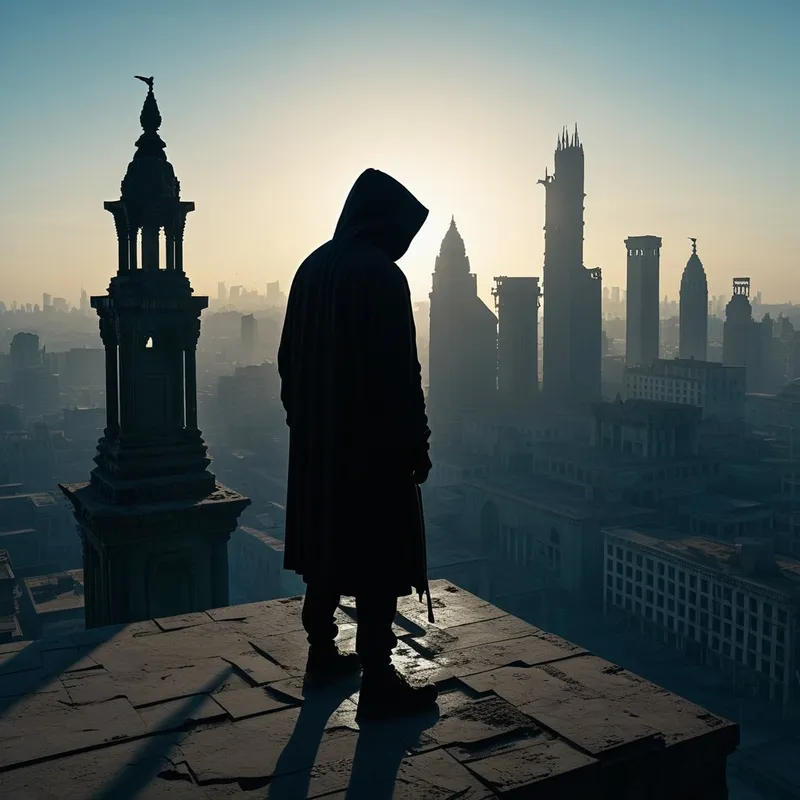
The Urban Labyrinth: A Map of the Constructed Self
The Somatic Echo
Before the mind can name the streets, the body knows the city. It is a pressure in the sternum, a low-grade hum in the jaw—the somatic echo of a thousand unseen systems operating in concert. It’s the tautness of shoulders bracing against a crowd that isn’t there, the quickening pulse at a crossing light that never changes. This is the felt sense of the constructed: a labyrinth not of stone, but of habit, expectation, and the silent agreements that hold a life in its current shape. The urban dream arrives not as a postcard, but as a vibration—the deep, sub-audible frequency of the psyche’s own infrastructure. You feel the grid before you see it; you sense the weight of verticality, of layers stacked upon layers, both in the world and within.
The Dreamer's Log (Case Vignette)
The dreamer stands at the mouth of a familiar subway station, but the stairs descend into black, still water. A single, luminous token rests on the wet concrete. The city above is a silent scream of light, but down here, only the lapping of the flood and the ghost-flicker of neon ads on cracked tiles. They know they must enter the water to reach the other side.
Alchemical Interpretation: The conscious persona (the known station) has been inundated by the unconscious (the black water), and the only currency for passage is a forgotten, inner value (the token), requiring a descent into the flooded underworld of the psyche.

The False Lead
The urban dream is not merely a replay of daily stress or a simple fear of crowds. To interpret it as such is to mistake the cathedral for the scaffolding. This theme is not about the annoyance of traffic, but about the terror of becoming part of an anonymous, unstoppable flow with no exit. It is not about missing a train, but about the profound grief of watching a vessel of meaning—a connection, a direction—depart without you, leaving you stranded on a platform of your own making. The anxiety here is structural, not incidental. It points to the very architecture of your adapted self.
Psychological Architecture
The urban landscape in dreams is the psyche’s own blueprint made manifest. The towering office blocks are the achievements and identities we’ve built, their glass facades reflecting not sky, but other facades—a hall of mirrors for the persona. The labyrinthine alleyways are the repressed memories, the shadow material we’ve walled off from the main thoroughfares of our awareness. The forgotten basement, the locked rooftop, the abandoned factory: these are the internal family systems exiled from the well-lit apartments of our acceptable self.
To walk this dream city is to engage in profound Shadow work. The indigeneity process here is the reclamation of wildness within the grid. It is the discovery of the overgrown lot where weeds crack the pavement—the instinctual life force that refuses total domestication. The work is to stop identifying solely as a tenant in this constructed self and to remember you are also the ground upon which it is built, and the sky that hangs above it. You must become both the city planner and the wandering fox within it.
Mythic Resonance
We see this eternal drama in the myth of Daedalus and the Labyrinth. The master architect builds an impossibly complex prison to contain the monstrous Minotaur—a perfect metaphor for the ingenious ego constructing a maze of defenses, routines, and complexities to wall off the raw, bull-like power of the instinctual shadow. We live in our self-made labyrinths, forgetting we are also the Minotaur at the center, and the Daedalus who designed the walls. The urban dream asks the Theseus question: Do you have the thread—the connection to something real and loving (Ariadne’s clue)—that can guide you through your own inner complexity without being devoured by it?
Symbolic Nodes
- Endless Highways/Freeways: The compulsive, automated patterns of thought and behavior; life on autopilot.
- Abandoned or Condemned Buildings: Aspects of the self deemed unusable, outdated, or too damaged; neglected potential or trauma.
- Rooftops & Basements: The highest aspirations (rooftops) and the deepest foundations or repressed material (basements).
- Subway/Tunnel Systems: The subconscious mind; movement beneath the surface of awareness; hidden connections.
- Construction Sites: The psyche in a state of active deconstruction and rebuilding.
- Flooded Streets: The unconscious emotions breaching the containment of rational control.
- Flickering Streetlights: Failing consciousness or guidance; intermittent awareness.
- The City Limits/Edge of Town: The boundary between the constructed self (persona) and the unknown, wild self.
Archetypal Resonance
The energy most active in the urban dream is that of The Ruler Archetype in both its sovereign and shadow aspects.
The urban landscape is the ultimate expression of the Ruler’s drive: to order chaos, to impose structure, to create a kingdom. In its light, this archetype builds the coherent identity, the career, the life that functions. But in its shadow—as The Shadow Ruler (Tyrant/Control-Freak)—it manifests as the oppressive grid, the relentless internal critic that micromanages every feeling, the tyrannical demand for efficiency that exiles spontaneity. The somatic echo of the clenched jaw and tight shoulders is the body under this shadow rule. The alchemical potential lies in a coup d’état of the soul: not to destroy the city, but to depose the inner tyrant and reclaim sovereignty. It is to move from being a subject of the system to becoming the benevolent monarch of your own inner realm, allowing for parks, wild spaces, and unexpected alleyways within your being.
The Alchemical Process
The transmutation of the urban dream is the conversion of claustrophobia into sovereignty. The required heat is the intense, uncomfortable pressure of seeing your own complicity. You must feel the heat of recognizing that you are both the prisoner and the warden, the citizen and the bureaucrat. The pressure is the weight of the entire constructed world—your adaptations, your masks, your “shoulds”—pressing down until the old, brittle foundations crack.
In this crucible, the leaden grief of being trapped in your own life begins to soften. The terror of the maze becomes the curiosity of the explorer. Through this heat, the soul learns to inhabit the infrastructure rather than just be processed by it. You discover secret passages—your creativity, your forgotten passions—that bypass the main traffic. You learn to read the city not as a sentence, but as a language you can speak. The gold that emerges is not escape, but profound, unshakable agency: the knowledge that you can navigate, alter, and find meaning within any labyrinth, because you contain the original blueprint.

The Integration Protocol
Question 1: Where in your waking life do you feel most like a anonymous unit in a system, and where do you feel like a sovereign being with agency? What is the tangible difference?
Question 2: If your current psyche were a city district, which neighborhood is well-patrolled and gentrified (over-controlled), and which is abandoned, walled-off, or considered “dangerous” (exiled shadow)?
Question 3: What one law, imposed by your inner tyrant, would you repeal tomorrow to allow for more wildness, spontaneity, or beauty in your internal kingdom?
Action 1 (Somatic Cartography): Next time you walk through a city or town, walk without destination. Let your body choose the turns. Notice where it feels drawn (an open square, a narrow alley) and where it recoils (a loud thoroughfare, a blank facade). Map this later not as streets, but as states of being in your inner landscape.
Action 2 (Unstructured Urban Sketch): Without planning, draw your psychic city. Let the pen move. Where do towers cluster? Where is there empty space? Where is there water, or a break in the wall? Do not judge it as art; read it as a diagnostic map of your inner structures.
Action 3 (Ritual of the Token): Find a small, disc-like object—a coin, a stone, a button. This is your subway token to the unconscious. Hold it and state one thing you are willing to “descend” to understand better (a recurring emotion, a pattern). Place it on your windowsill or altar. When you dream, you have paid your fare.
Final Validation
To dream of the urban labyrinth is to feel, acutely, the weight of the world you have helped build. It is a lonely and exhausting vision. Validate that fatigue. The concrete is real to the soul. And yet, within that validation lies your power: the dream itself is proof that you are not the city. You are the one who walks it, observes it, and feels its pressure. You are the consciousness that can, in time, learn to redesign the districts, turn out the lights in the prison blocks, and plant gardens in the cracks. The maze exists, but so does the thread. You are both. And the remembering of that is the first step out of the endless street, and into the sovereignty of your own boundless inner sky.