
The Architecture of Becoming: Dreams of Transitional Spaces
The Somatic Echo
It begins not as a thought, but as a hollow resonance in the solar plexus. A low-grade hum of suspension, a feeling of being neither here nor there. The body knows this state before the mind can name it: a subtle vertigo, a lightness in the feet as if the ground has become provisional. There is a quiet, pervasive alertness, a somatic tuning to a frequency of almost. The breath feels caught between inhalation and exhalation; the muscles hold a readiness for a motion not yet granted form. This is the visceral signature of the psyche entering a liminal zone—the physical echo of standing in the antechamber of your own transformation.
The Dreamer's Log
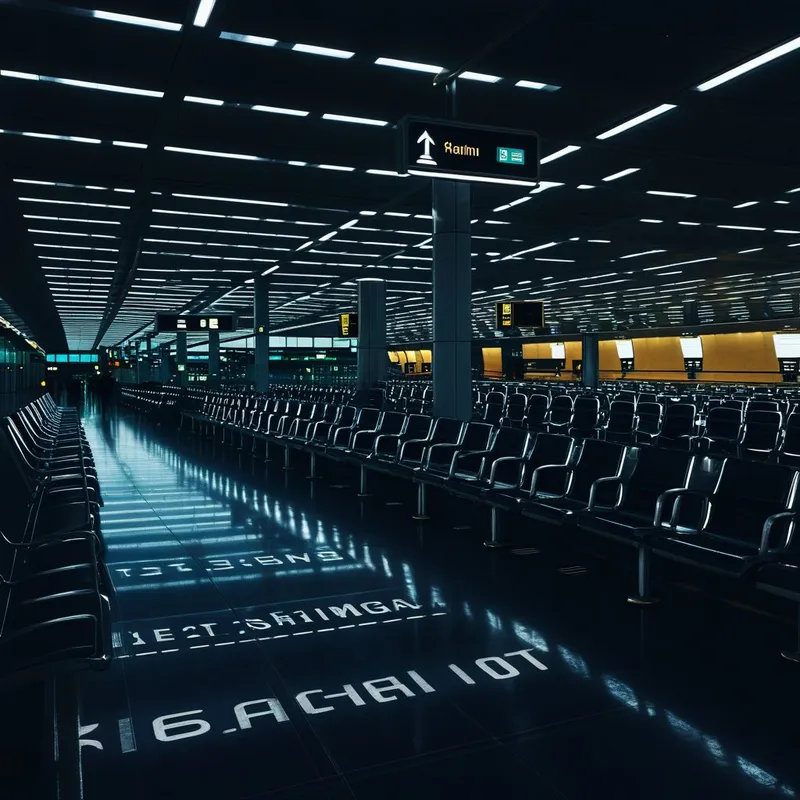
The dreamer finds themselves in a vast, empty airport terminal in the dead of night. The polished floors stretch into darkness, reflecting the cold glow of a single departure board. Its text scrolls endlessly in a language they almost recognize, announcing gates to places with no names. They are holding a ticket, but the destination is a smudged, water-stained blank.
This is the psyche in its drafting phase, constructing the blueprint for a new chapter of being before the conscious self has agreed to the journey. The alchemical interpretation: The old identity has been decommissioned, and the new one is awaiting final clearance from the soul’s central command.
The False Lead
This theme is not about procrastination, indecision, or mere "bad luck" stranding you in a waiting room of life. To mistake the sacred liminal for passive stuckness is a critical error. The transitional space is not a prison of inaction; it is the active, fertile void where the components of your future self are being gathered, sorted, and welded together in silence. The anxiety you feel is not a signal of failure, but the heat of that internal forge. You are not doing nothing; you are becoming something. The work is subterranean, architectural.
Psychological Architecture
To understand the depth at play, we must move past the comforting idea of a simple "life change." This is Shadow work of the most foundational kind. The transitional space emerges when an old internal system—a way of relating, a core belief, a foundational identity—has outlived its usefulness. Its collapse is not a disaster, but a necessary demolition.
In the language of Internal Family Systems, exiled parts that were protected by that old structure now float in the psychic ether, awaiting reassignment. A Manager part that once ran your career with ruthless efficiency now paces the empty terminal, useless without its old function. A Firefighter part that soothed with distraction finds the usual exits barred. The transitional dream is the psyche’s ecosystem in a state of dynamic, often terrifying, re-organization. The corridors and thresholds are the psychic ligaments and tendons stretching to accommodate a new posture of being. You are not between jobs or relationships; you are between selves. The individuation process demands this dissolution of previous forms so that a more authentic, integrated totality can coalesce from the fragments.
Mythic Resonance
This universal firmware is encoded in our oldest stories. Consider Inanna’s descent into the underworld. Her journey is not a single event, but a procession through seven gates. At each, she is stripped of a royal garment—a crown, a robe, a jewel. This is not mere punishment; it is the architecture of transition. The gates are the transitional spaces, and the stripping is the alchemical dissolution of the old self, piece by piece, until she arrives at the core, naked and ready for the true ordeal of transformation. She does not simply walk into the dark; she passes through a series of defining, narrowing chambers. Similarly, the Bardo of Tibetan tradition is the ultimate transitional space—a lucid, hallucinogenic landscape between death and rebirth where the soul’s latent tendencies project the reality it will next inhabit. These myths tell us the truth: the between-place is where the real work of identity-formation happens.
Symbolic Nodes
- Endless Corridors & Hallways: The psychic pathway of integration, often feeling endless because the destination is not a place, but a state of being.
- Airports, Train Stations, Bus Depots: Hubs of potential futures; the self as a vessel of choice awaiting a trajectory.
- Lobbies, Waiting Rooms, Antechambers: The space of pause before an audience with a greater authority (the Self, fate, a decision).
- Bridges, especially half-built or swaying: The act of connection between two known shores, emphasizing the peril and instability of the process.
- Elevators & Escalators: Vertical transition, moving between levels of consciousness or status without your own locomotive power.
- Tunnels with a distant light: The birth canal of the psyche; a pressured, directed movement toward emergence.
Archetypal Resonance
The energy here is most purely that of The Explorer Archetype. Not the Explorer in its triumphant, summit-planting phase, but the Explorer in its essential, defining moment: the leaving of the known shore. This archetype resonates in the hollow hum of potential, in the somatic alertness to unknown horizons. Its core energy is not discovery, but the courage for departure that must precede it. The shadow of this archetype—the Aimless Wanderer—haunts these dreams as the fear that this transition leads nowhere, that the corridor is a loop, the ticket is void. The alchemical potential lies in embracing the Explorer’s fundamental truth: that the seeking itself is the territory, and the transitional space is the only real map.
The Alchemical Process
The transmutation here is one of solutio—the alchemical dissolution. The intense psychological pressure is the sustained tolerance of ambiguity. The heat is applied by life itself, forcing you out of a previous container. The old, crystalline structures of "who you are" and "how things work" must be dissolved back into psychic solution. This feels like grief, terror, and groundlessness. The sovereign self is not the one who avoids this dissolution, but the one who consents to be dissolved, trusting that from the formless solution, a new, more resilient crystalline structure—a truer identity—will precipitate. Sovereignty is earned by enduring the not-knowing, by holding the ticket to the blank destination, and declaring, "Even this is part of my journey."
The Integration Protocol
Question 1: What old "garment" of identity (a role, a title, a story I told myself) is being symbolically removed from me as I stand in this liminal space?
Question 2: If this corridor or waiting room is not a prison, but the construction site of my next self, what raw materials (talents, forgotten dreams, unexpressed truths) do I see scattered around me, waiting to be built with?
Question 3: What authority or inner voice am I truly waiting for permission from in this antechamber, and what would happen if I granted that permission to myself, now?
Action 1 (Somatic Anchoring): When the vertigo of transition arises, stand barefoot. Feel the floor. Breathe deeply and say aloud, "I am here, in the between. This is a real place. I am building my ground as I stand on it." This grounds the ephemeral in the physical.
Action 2 (Cartography of the Liminal): Take a large piece of paper. Without planning, draw your transitional space as it feels—a maze, a tunnel, a vast station. Let your hand move intuitively. Then, with a different colored pen, mark one small "X" on the drawing where you sense a hidden door, a source of light, or a resource you hadn't noticed. This externalizes and interrogates the internal landscape.
Action 3 (Ritual of the Threshold): Physically cleanse the doorway of your home. As you do, state quietly: "I honor the thresholds within and without. I release what must stay behind. I sanctify the passage for what wishes to emerge." This simple, outward ritual mirrors and empowers the profound inner process of crossing over.
Final Validation
It is legitimate to feel unmoored, anxious, and profoundly weary in these spaces. The psyche is undertaking a covert, total renovation of the self, and you are living in the construction dust. This difficulty is the measure of the transformation underway. Do not curse the corridor for its length. Instead, listen to its acoustics. Test its walls. This is not a place you are trapped in; it is a place you are being built through. The sovereignty you seek is not at the end of the hallway. It is forged in the very courage to walk its length, trusting that you are both the architect of the destination and the traveler who will arrive there, whole.