The Liminal Loom: Dreaming in Transitional Space
The Somatic Echo
Before the image forms, the body knows. It is a hollowing out. A specific, resonant emptiness in the solar plexus, as if the scaffolding of your identity has been quietly removed overnight, leaving only the ghost of its structure. Your feet, in the dream, never quite find purchase; the ground is neither solid nor liquid, but something in between—a viscous potential. There is a low hum in the bones, a vibrational suspension. You are not falling, but you are not held. You are in the echo chamber of the self, where every breath sounds like a question and the air tastes of ozone and old paper. This is the somatic signature of the transitional space: the visceral experience of being unmade, poised in the breath between exhale and inhale.
The Dreamer's Log (Case Vignette)
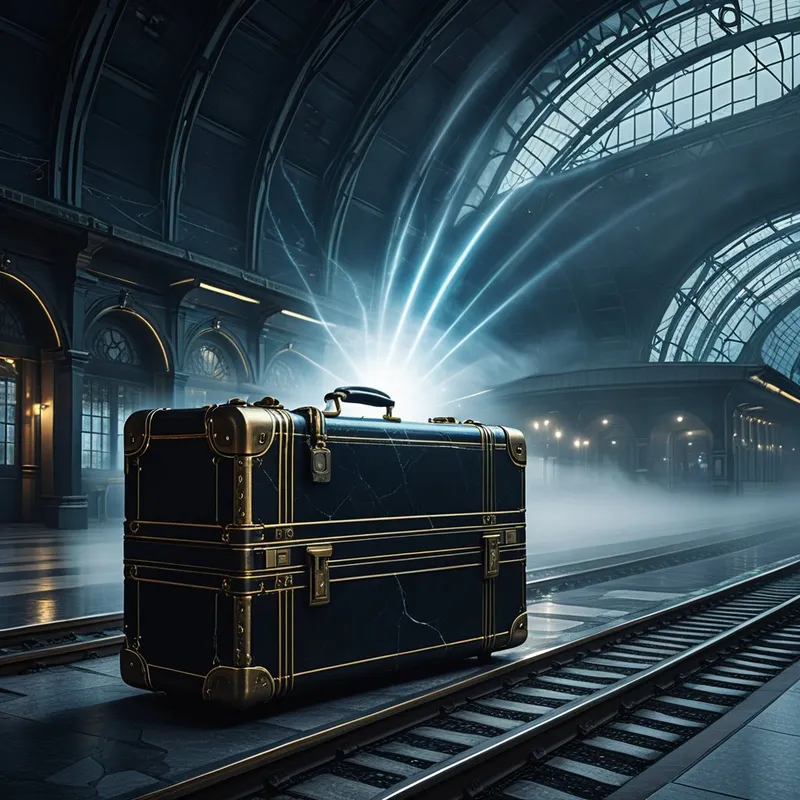
I am in a vast, abandoned train station lit only by the erratic glow of departure boards showing languages I cannot read. I have a suitcase, but I don’t know what’s inside. No trains arrive. No trains leave. The only sound is the hum of the lights and the distant, rhythmic clicking of a single, unseen telegraph.
Here, the psyche has constructed a perfect cathedral of pause. The station is the archetypal between-place; the suitcase, the condensed symbol of an unlived life or an unintegrated past; the unknown contents, the mystery of potential. The untranslatable boards signify a consciousness on the threshold of a new dialect, a new way of knowing. This is not a dream of stasis, but of potent, pregnant waiting.
Alchemical Interpretation: The dream is the solve—the dissolution of the known itinerary—preparing the soul for the coagula, the condensation of a new destination from the vapors of the void.
The False Lead
This is not mere indecision or procrastination, dressed in night-time symbolism. Do not mistake the profound structural silence of the transitional space for the noisy anxiety of everyday "bad luck" or simple fear of change. The latter is a storm on the surface of a known sea. The former is the experience of the sea floor itself shifting, of continental plates of the psyche grinding slowly, irrevocably apart. It is not about choosing between Path A or Path B. It is the terrifying, sacred realization that the old map has dissolved, and the new landscape has not yet risen from the mist. To interpret this as a call for a simple, practical "decision" is to commit a violence against the soul's need for gestation.
Psychological Architecture
To stand in a transitional space is to consent to shadow work of the most demanding kind. It is to hold a vigil at the deathbed of an old self-concept—the reliable professional, the certain partner, the defined rebel—and to midwife a form that is still spectral, unknown. This is the core of Individuation: not the heroic arrival, but the willing dissolution in the service of a more authentic cohesion.
Internally, it feels like a council of your inner parts has gone silent. The inner Critic has lost its script; the Pleaser finds no one to perform for; the Achiever has no checklist. In the language of Internal Family Systems, the protective "managers" and "firefighters" are disarmed, leaving the system vulnerable, quiet, and open. This exposure is not a flaw, but the necessary condition. It is in this unprotected openness that the exiled parts—the grief, the wild creativity, the forgotten innocence—can finally whisper from the periphery. The architecture here is one of deconstruction. The walls are down. You are building not from blueprints, but from intuition and the raw materials of memory and longing.
Mythic Resonance
Consider Inanna, the Sumerian goddess, descending through the seven gates of the Underworld. At each gate, a piece of her regalia—her crown, her lapis beads, her royal robe—is stripped away. She arrives naked and bowed before her sister, Ereshkigal, and is hung on a hook as a piece of rotting meat. This is not punishment, but process. The transitional space is that descent, that systematic un-becoming. Every gate is a relinquishment of an identity that cannot pass into the new realm. The myth tells us the truth: to gain the deep wisdom (Inanna eventually returns with greater power), one must first consent to be unmade in the dark.
Or witness the Buddha under the Bodhi tree. He is not yet the Awakened One; he is Siddhartha, the seeker who has tried and discarded every extreme. He sits in the liminal space between ascetic and prince, between ignorance and enlightenment. The onslaught of Mara’s temptations and armies is the psyche’s final, desperate attempt to re-impose an old, familiar structure—to be a king, a lover, a fearful man. His victory is not an attack, but a profound, grounded non-engagement with these offered identities. He touches the earth, claiming the transitional space itself as his witness and throne.
Symbolic Nodes
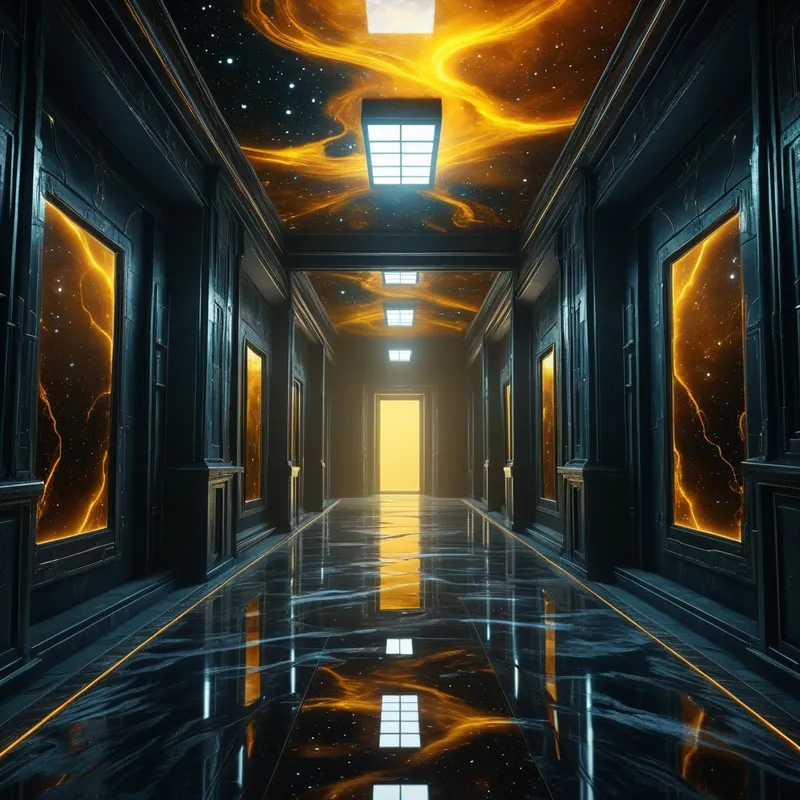
- Endless Corridors, Hallways, Tunnels: The path itself is the destination; the movement through uncertainty is the transformation.
- Waiting Rooms, Airports, Train Stations: Hubs of potential departure where the schedule is unknown. You are in the system, but not yet in motion.
- Thresholds (Doorways, Gates, Bridges, Shorelines): The precise point of neither/nor. To stand in a doorway is to be in both rooms and neither.
- Fog, Mist, Veils, Static: The sensory metaphor for the unknown. It obscures not to frighten, but to force perception inward.
- Empty Suitcases, Unpacked Boxes, Blank Canvases: Vessels awaiting content, symbolizing the self as potential rather than completed artifact.
- Construction Sites, Scaffolding, Ruins Being Repaired: The visible evidence of deconstruction and reconstruction in process.
Archetypal Resonance
The energy of the transitional space is most purely embodied by The Explorer Archetype in its most essential, stripped-down form. This is not the Explorer as triumphant adventurer, but the Explorer as the one who has willingly left the mapped territory and now stands in the trackless waste. The somatic echo—the hollow anticipation, the vibrational hum—is the Explorer’s nervous system recalibrating to an absence of landmarks. The core energy here is not discovery, but the capacity for disorientation that must precede it. The alchemical potential lies in this archetype’s innate willingness to value the question over the answer, the frontier over the homeland. In the shadow, this becomes the Aimless Wanderer, mistaking the transitional space for a permanent home, circling in the void out of a fear of actually arriving somewhere new and being defined by it. The sacred task is to embrace the Explorer’s courage to be lost, knowing this is the only way to find a territory that is authentically one’s own.
The Alchemical Process
The alchemical stage is the Nigredo: the blackening, the putrefaction, the descent into the primal murk. In the psyche’s laboratory, the heat source is the unbearable tension of the unresolved. The pressure is the weight of societal and internal voices demanding a premature answer, a swift re-formation. The "matter" in the vessel is your former self-concept.
The transmutation occurs not through forceful action, but through a disciplined, sacred passivity. It is the work of holding the vessel steady while the heat does its work. You must allow the grief for the dying self to be fully felt—not as a failure, but as a necessary chemical reaction. You must witness the terror of the formless without rushing to plaster it with an old identity. This is the intense psychological process: to resist the instinct to rebuild the familiar prison simply because its walls are known. The sovereign self is not born from a plan, but from the slow, patient crystallization that occurs only when the solution is saturated and utterly still. Sovereignty is earned by proving you can endure your own dissolution without betraying the mystery at its core.
The Integration Protocol
Question 1: What specific identity, role, or belief have I most recently felt becoming hollow, like a shell I am still carrying but no longer inhabit?
Question 2: If the silence or emptiness of this transitional space had a voice, what single, simple truth might it be whispering that the noise of my old life drowned out?
Question 3: What tiny, almost invisible seed of a new possibility have I been afraid to acknowledge, for fear that acknowledging it would make this disorientation "real" and irreversible?
Action 1 (Somatic Anchoring): For three minutes each day, stand (or sit) without moving. Focus entirely on the physical sensations in your feet and your solar plexus. Don't try to make them solid or change them. Simply describe them to yourself in neutral, granular language: "pressure," "tingling," "coolness," "hollowness," "vibration." This grounds the experience in the body, reclaiming it from abstract anxiety.
Action 2 (Vessel Mapping): Take a large sheet of paper. With your non-dominant hand, draw the outline of a simple vessel (a bowl, a cup, a crucible). Inside it, using words, images, or chaotic scribbles, depict the "contents" of your current inner state—the grief, fear, static, and sparks of hope. Outside the vessel, draw the sources of "heat" and "pressure" (external demands, internal critics, life circumstances). This externalizes and contains the alchemical process.
Action 3 (Threshold Ritual): Physically locate a threshold in your world—a doorway between rooms, a gate in a fence, a line between sand and water. Stand squarely upon it. State aloud: "I stand in the between. I release what I was behind me. I acknowledge what is before me is not yet known. I claim this space of becoming." Step forward. The ritual is in the conscious acknowledgment, not in any magical outcome.
Final Validation
It is terrifying because it is real. This dissolution is not a sign of breaking, but the profound, uncomfortable evidence of your psyche's integrity—its refusal to let you live a life that is no longer true. The transitional space is the psyche's most sacred workshop. It is not a curse, but the highest compliment your soul can pay you: it trusts you enough to take you apart, believing, with a faith deeper than your own fear, that you can withstand the unraveling and will be rewoven into something more intricate, more resilient, and more wholly your own. The corridor does end. But you will not exit as the one who entered. You will exit as the one who was forged in the walking.