
Transformational Invariance: The Dream of the Unshakeable Core
The Somatic Echo
Before the dream forms, the body knows. It is not a feeling of panic, nor of grief, but of a profound and unsettling stillness at the center of a storm. The breath catches not on a sob, but on a paradox. The stomach doesn’t drop; it crystallizes. There is a deep, somatic recognition of a truth so fundamental it feels architectural: everything is changing, and yet, I am here. Not the "I" of personality, of job or relationship, but the "I" that is the witness, the ground, the silent vertex upon which the turning world pivots. It is the vertigo of realizing the floor beneath you is not wood or stone, but the event horizon of your own being—infinitely yielding, yet incapable of breaking. This is the visceral prelude to the dream of Transformational Invariance.
The Dreamer's Log
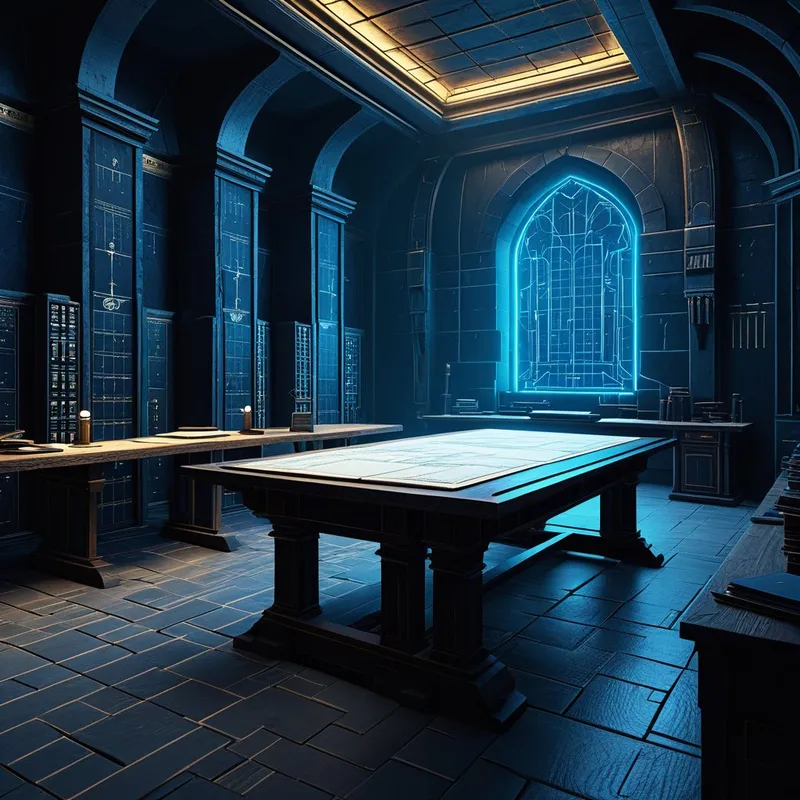
The dream is always of a vast system in flux: a city rebuilding itself into alien geometries, a forest where trees melt into data-streams, a family home whose rooms shift like a kaleidoscope. And in the midst of it, one thing remains, achingly, defiantly constant. A childhood toy on a shelf that never moves. A specific pattern of cracks on a ceiling. A smell of rain on concrete that lingers, untouched by the digital auroras tearing the sky apart.
The alchemical interpretation: The psyche is performing a radical stress-test, dissolving all contingent identities to locate and confirm the existence of the irreducible, non-negotiable Self.
The False Lead
This is not a dream of stagnation, nor of trauma’s repetitive loop. The terror here is not that nothing changes, but that everything does—except for one essential thing. To mistake this for mere "bad luck" or a symbol of being "stuck" is to miss the point entirely. The invariant element is not a problem to be solved, but a landmark to be recognized. It is the difference between a prison cell and a sacred temple: the walls may look similar, but one confines a persona, the other houses a soul.
Psychological Architecture
The work here is the deepest kind of Shadow excavation. It asks: what have I built my sense of "me" upon? The persona, the achievements, the wounds, the relationships—these are the shifting rooms in the dream-house. Transformational Invariance dreams arrive when the psyche begins to dismantle these rooms, not out of malice, but to test the foundation. The Shadow, in this process, is everything we wish were invariant but is not: our pride, our victimhood, our carefully curated self-image. The dream burns these away, revealing not emptiness, but a structural integrity beneath. This is Individuation in its most raw form—not becoming something more, but discovering what cannot be taken away, what was always there beneath the becoming. It is the experience of finding yourself not at the end of a journey, but as the ground upon which the journey has always been walking.
Mythic Resonance
We see this in the story of the Buddha beneath the Bodhi tree. Mara, the personification of illusion, attacks with armies of doubt, desire, and fear. He transforms the very ground into a raging river, hurls mountains, conjures terrifying visions. Yet, the Buddha simply touches the earth. That gesture is the ultimate symbol of Transformational Invariance. He does not fight the transformations; he invokes the one thing that is not an illusion, the earth itself—a metaphor for the unshakeable, witnessing consciousness. The entire phenomenal world may be in flux, but the ground of being is present, solid, and invariant.
Symbolic Nodes
- An unchanging object in a transforming room (a key, a book, a stone).
- A fixed point of light in a swirling vortex.
- A familiar, simple melody heard through cacophonous noise.
- Your own reflection remaining constant while the world behind you melts.
- A door that always leads to the same place, no matter where it is placed.
- The sensation of a steady heartbeat amidst seismic upheaval.
Archetypal Resonance
The energy at the core of this theme is that of The Sage Archetype. Not the Sage as a distant teacher, but the Sage as the inner knower, the principle of consciousness that observes phenomena without being consumed by them. The somatic echo of crystalline stillness at the storm’s center is the Sage’s presence. Its alchemical potential lies in its ability to discern the invariant from the illusion, to separate the signal of the Self from the noise of the personality. The Shadow Sage—dogmatic, judgmental—is what we encounter when we mistakenly cling to a thought or belief as the invariant thing, freezing a transient concept into a false idol. The true Sage archetype activates to help us realize that the only true invariant is the capacity for awareness itself, the silent space in which all transformations, including the dream, are allowed to play out.
The Alchemical Process
The transmutation here is from existential terror to profound sovereignty. The prima materia is the grief of watching every familiar landmark of your identity be washed away. The heat is applied by the relentless, dream-logic transformation of everything you thought was solid. The pressure is the paradoxical demand to find what remains. This is the alchemical solve et coagula—dissolve and re-coagulate—performed on the soul. You are dissolved not into nothingness, but into your essential substrate. The terror ("I am losing everything") is cooked in the vessel of the dream until it yields its gold: the realization ("I am what remains when everything is lost"). Sovereignty is not control over the changes, but the unassailable authority of the consciousness that witnesses them.

The Integration Protocol
Question 1: In my waking life, when do I feel that same deep, central stillness I felt in the dream? Is it in silence, in nature, in a specific action, or in a moment of pure, unforced being?
Question 2: What one belief, memory, or aspect of my self-image am I most terrified of losing? If I imagined it dissolving in the dream’s flux, what, if anything, would be left of "me"?
Question 3: If the invariant element in my dream were a message from the core of my being, what single, simple truth is it trying to show me that I keep decorating with complexity?
Action 1 (The Anchor Scan): For one week, upon waking, before checking any device, place a hand on your sternum. Identify one sensory input that is constant—the weight of the blanket, the sound of your breath, the faint light at the window. Note it. This is your daily, somatic landmark.
Action 2 (Blueprint of the Core): Using any medium—pencil, charcoal, digital art—create an abstract "blueprint" or "schematic" of the invariant object from your dream. Do not draw the object literally. Draw its essence as a system: its structural lines, its energy flow, its relationship to emptiness. Let the image reveal what the object means, not what it is.
Action 3 (The Ritual of Release and Recognition): Find a small, natural token—a smooth stone, a leaf. Hold it and consciously project onto it all the things in your life currently in flux that cause you anxiety. Then, go to a body of water or a patch of earth. Bury the token or set it afloat, verbally releasing the flux. Then, stand still. Feel the ground under your feet, the air on your skin—the invariant conditions of your existence. Take three breaths, acknowledging only that.
Final Validation
To dream of Transformational Invariance is to be invited into a crucible that few willingly enter. The disorientation is real, the sense of loss profound. It is the psyche’s most demanding rite of passage. Yet, this dream does not come to destroy you. It comes to show you, in the most visceral way possible, that there is a "you" that cannot be destroyed. The chaos is not your enemy, but the fire that reveals the diamond at your center. The work is not to stop the change, but to finally meet the changeless one who has been watching it all along.