
The Dream Theme of Temporary Halt
It arrives not as a thought, but as a somatic echo. A sudden, total absence of momentum in the body’s inner sea. It is the breath caught in the chest, not in panic, but in a profound suspension—as if the air itself has turned to glass. The stomach drops, not in freefall, but into a perfect, weightless equilibrium. The limbs feel heavy, yet this is not fatigue; it is density, a gathering of mass at the center. It is the visceral sensation of the internal narrative hitting a wall of silence, the body’s own systems registering a command that the conscious mind has not yet issued: Cease all forward propulsion. All systems, stand by.
The Dreamer's Log
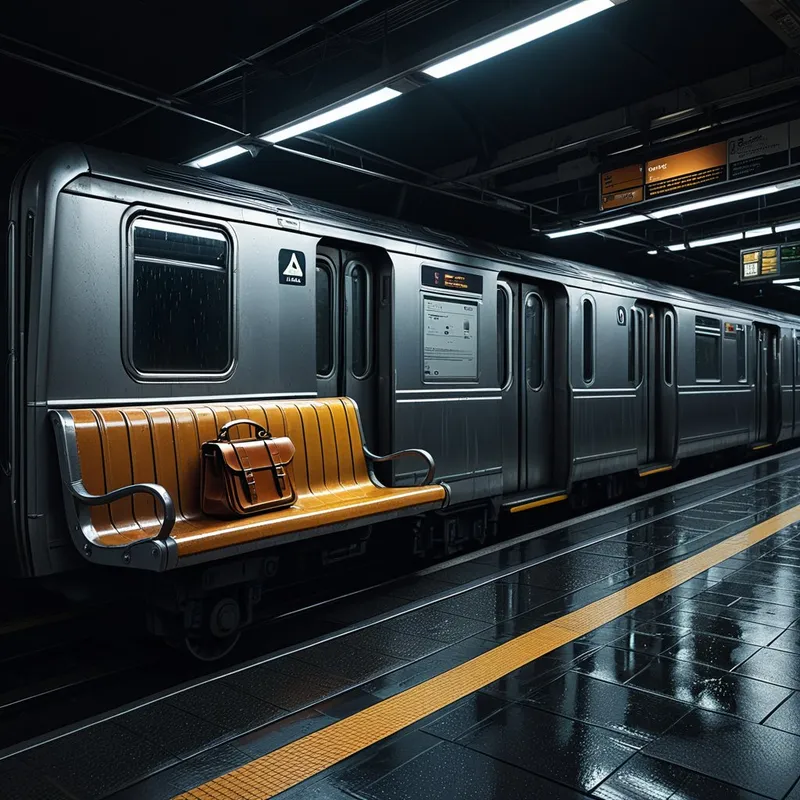
The dreamer stands on a rain-slicked subway platform, late at night. The train they need is there, doors open, but as they move to board, their body simply… stops. Not frozen in fear, but in a perfect, untroubled stillness. The train begins to pull away, its lights blurring into streaks against the dark tiles, while the dreamer remains, watching with a curious detachment, a forgotten satchel at their feet.
This is the alchemy of the forced pause: the psyche deliberately un-boarding the vehicle of automatic momentum to attend to what has been left behind on the platform of the self.
The False Lead
This is not mere obstruction or "bad luck." Do not mistake the Temporary Halt for a simple blockage on the path, a rock in the stream. A blockage implies an external adversary, a thing to be cleared. The Halt is interior, architectural. It is not the river hitting a dam; it is the river itself discovering, in mid-flow, that it must reconfigure its very bed. It is the system’s own intelligence initiating a diagnostic, a recalibration so fundamental that all forward motion must be sacrificed to the integrity of the whole. To interpret it as failure is to side with the tyrant of perpetual progress against the wisdom of the deeper self.
Psychological Architecture
The Halt is the Shadow’s most elegant intervention. We are built for motion; our identities are often narratives of progression—career paths, healing journeys, spiritual ascents. To stop is to threaten the core story. Yet, beneath this story lies a psychic architecture straining under unseen loads. The Halt occurs when an exiled part—a grief, a forgotten passion, a unintegrated trauma—has grown too heavy to be carried forward any longer. It demands audience.
This is the Individuation process in its most counterintuitive phase: not a heroic conquest, but a sovereign surrender. The ego, which identifies as the captain of the ship, is relieved of command. The internal family of subpersonalities falls silent. In that stillness, the central, organizing consciousness—the Self—can be heard. It is not doing anything. It is simply being, and in that being, it surveys the kingdom of the psyche. It sees where the foundations have cracked from relentless expansion, where one internal voice has been shouting to drown out another’s weeping. The Halt creates the empty, silent chamber necessary for this audit. The terror is not of stopping, but of what truth might emerge from the silence when the machinery of distraction finally winds down.
Mythic Resonance
We see this in the story of Odysseus, lashed to the mast of his own ship. He orders his crew to fill their ears with wax and bind him, unable to move, as they pass the Sirens. His relentless journey home—his nostos—requires this radical, voluntary paralysis. The forward motion of the ship continues, but he is in a state of Temporary Halt. He does this not to avoid temptation, but to experience it fully, to hear the song of divine, soul-shattering knowledge without being destroyed by it. The Halt is the mast. It is the binding that allows a deeper, more devastating truth to be integrated without the psyche fragmenting. Likewise, in the Buddhist concept of nirodha (cessation), enlightenment is not an accumulation of more light, but the cessation of the proliferating processes of craving and aversion. It is the ultimate, liberating Halt of the compulsive wheel of becoming.
Symbolic Nodes
- Engines that won’t turn over, despite being perfectly intact.
- Elevators stuck between floors.
- Timepieces with stilled hands, or digital clocks displaying a repeating, nonsensical sequence.
- Being physically unable to speak or cry out in a moment of need, without a sense of panic.
- A book with blank pages at a crucial chapter.
- A bridge that retracts its middle section, leaving two halves facing each other across a void.
Archetypal Resonance
The energy of the Temporary Halt is most intimately aligned with The Sage Archetype in its deepest, most inactive mode. This is not the Sage as lecturing teacher, but as the silent witness. The Sage’s core desire is truth and understanding, and the Halt is its primary methodology: the cessation of doing to allow for pure seeing. The somatic echo of weightless density is the Sage settling into its observational perch. The alchemical potential lies in this archetype’s ability to reframe the event not as a malfunction, but as a necessary, intelligent recalibration. The Shadow Sage—dogmatic and judgmental—would interpret the Halt as a fatal error, a reason for self-condemnation. The integrated Sage perceives it as the system’s own wisdom creating the perfect conditions for revelation, understanding that the deepest truths are not found in the clamor of action, but in the fertile void of stillness.
The Alchemical Process
The transmutation here is from Paralysis to Potentiation. The raw, leaden matter of the experience is the grief of lost momentum, the identity crisis of "I am not moving, therefore I am not." The alchemical nigredo, the blackening, is this dissolution of the old, action-based self.
The required heat is not the fire of effort, but the white-hot pressure of sustained attention in the absence of goal. It is the courage to stay in the silent, empty platform, to open the forgotten satchel and behold what one had been too busy to carry. The pressure is applied by asking, while in the Halt: "What is true right now, in this stillness, that was drowned out by my motion?" This is the albedo, the whitening—the washing of the psyche in the moon-cool light of pure observation.
The transmutation occurs when the halted system realizes it was not a machine meant only for linear travel, but an ecosystem. The new, golden consciousness—the citrinitas and rubedo—is the understanding that sovereignty is not the relentless ability to move, but the profound authority to choose when to move, and from which integrated center. The energy previously spent on propulsion is now available for depth, for foundation-building, for the subtle, inner work of reconciliation. The Halt becomes the crucible where the identity of "The One Who Journeys" is alloyed with the deeper identity of "The One Who Contains the Journey."

The Integration Protocol
Question 1: In the moment of halt in my dream, what was the quality of my stillness? Was it terrified, resigned, peaceful, or curiously observant? What does that feeling say about my relationship with being versus doing in my waking life?
Question 2: If my forward momentum is a vehicle I was boarding (a train, a car, a ship), what have I left behind on the platform? Name one tangible thing (a satchel, a book, a person) and one intangible quality (a memory, a feeling, a forgotten version of myself).
Question 3: What small, repetitive motion in my daily life (a habit, a worry-loop, a compulsive task) is the ego using to create the illusion of momentum, to avoid the deeper silence the Halt is asking for?
Action 1 (The Silent Audit): For five minutes today, sit in complete stillness. Do not meditate with a goal. Do not breathe purposefully. Simply be halted. Notice the first impulse to do something (check a phone, adjust posture, plan). Instead of following it, simply acknowledge it as a subpersonality begging for motion. Say internally, "I see you. We are stopped."
Action 2 (Mapping the Halted Landscape): Create a simple, abstract drawing. Let a line represent your "forward path." At some point, bring that line to a complete, unambiguous stop. At the point of the halt, let your hand move instinctively to create a shape, a blotch of color, or a tangle of new lines. Do not represent anything literal. Let the marks show what emerges or exists at the site of the cessation.
Action 3 (The Ritual of Un-Boarding): Physically enact a small, symbolic halt. Intentionally miss your usual train or bus stop and walk the rest of the way. Decline a routine social commitment to sit with a cup of tea in silence. Break the automatic sequence. In that created space, ask the dream's question: "What is attending to me now that I am not in transit?"
Final Validation
To experience the Temporary Halt is to be invited into a profound and terrifying intimacy with the bedrock of your own being. It feels, in the moment, like a betrayal by the universe or a failure of the self. Please, honor that grief. It is real. And then, consider this: only something of immense value and intelligence—your own deepest psyche—has the authority to issue such a total, system-wide command. It stopped you not to break you, but because what you are carrying is too precious to be lost in the rush. The integration is not about restarting the old engine. It is about learning to hear the new music that can only be composed in the sacred silence it has fought so hard to give you.