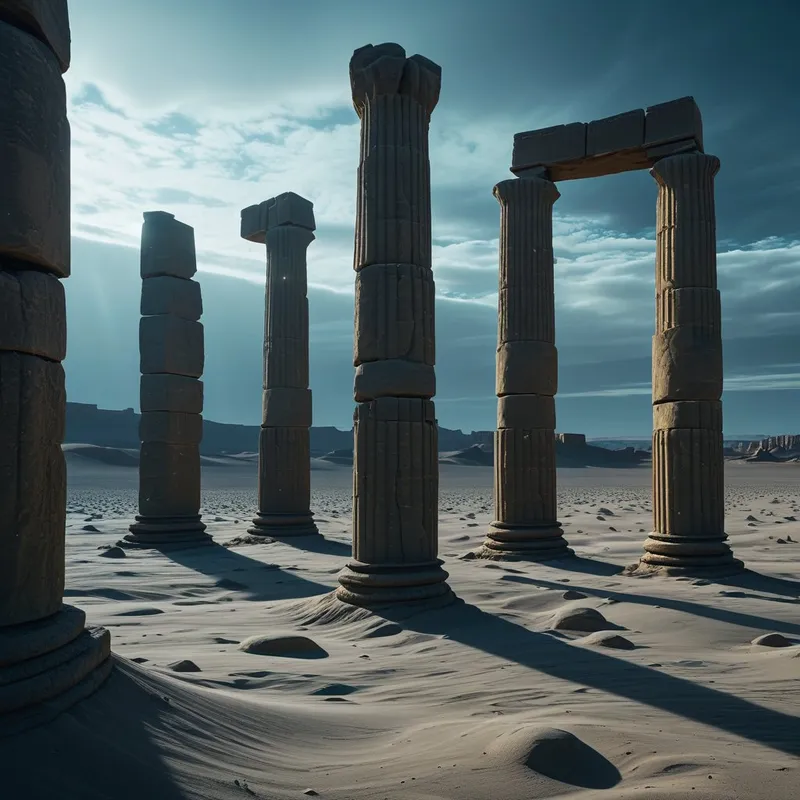
Temporal Erosion: When the Sands of Your Psyche Refuse to Hold
The Somatic Echo
It begins not as a thought, but as a gravity. A deep, internal leaning, as if the floor of your being is no longer level. There’s a hollowing in the solar plexus, a quiet, vertiginous pull that whispers of foundations turning to silt. You may feel a paradoxical fatigue—not of the body’s exhaustion, but of the spirit’s weight, as if you are carrying the ghost of a future that has already crumbled. The breath catches, not in panic, but in recognition of a silent, relentless subtraction. Time, the assumed medium of your life, no longer feels like a river to navigate, but like the bank you stand upon, eroding grain by grain beneath your feet. This is the visceral prelude the unconscious sounds before it sends the dream.
The Dreamer's Log
I am standing in the city square of my childhood, holding my grandfather’s pocket watch. Its familiar, reassuring tick is slowing, growing thick and syrupy. With each labored tock, a building at the edge of the square—the old cinema, the library—fades not to ruins, but to a faint, penciled sketch, then to empty air. I try to wind the watch, but the key turns to sand in my fingers.
This dream is the alchemical solutio—the dissolving of the psychic structures (the city) built upon inherited time (the watch), making way for a consciousness that must tell its own time.

The False Lead
This is not a dream about simple nostalgia or fear of aging. To mistake it for mere melancholy over “times gone by” is to stand at the ocean’s edge and lament the wetness of your shoes. Temporal Erosion is a far more radical report. It is not about the passing of time, but the deconstruction of time as you have known it. It is not a lament for lost moments, but a profound signal that the internal architecture of your past—the stories you used to justify your present, the traumas you built your personality around, the future you projected as salvation—is undergoing a structural failure. This is the psyche’s way of declaring that the old chronology, the narrative timeline you’ve lived by, is no longer structurally sound.
Psychological Architecture
When Temporal Erosion appears, the psyche is engaged in the deepest kind of Shadow work: the dismantling of the Chronological Self. This is the false, composite identity built like a sedimentary rock from layers of “who I was then” and “who I should be by now.” The erosion dream targets the cement holding those layers together—the “shoulds,” the unmet expectations, the unresolved griefs that we mistake for permanent foundations.
The individuation process here is one of terrifying liberation. It asks: Who are you when the story of your past loses its definitive power? Who are you when the projected future, that carrot-on-a-stick of achievement or healing, dissolves into mist? The process feels like a loss because it is—it is the loss of a familiar prison. The grief is real, for we must mourn the comforting, known shape of our own biography, even as it confines us. The psyche, in its infinite wisdom, uses the metaphor of decaying clocks and dissolving cities to force a confrontation with the part of you that exists outside of time—the essential Self that is not defined by its history or its potential, but simply is.
Mythic Resonance
We see this universal firmware in the story of the Wheel of Fortune in the Tarot, often misread as mere luck. It is, at its core, an image of Temporal Erosion in action. The figure rising on the wheel’s left side clings to the structure, believing in ascent. The figure falling on the right experiences the brutal erosion of their position. But the sphinx atop the wheel and the serpent-dragon descending it represent the forces outside the temporal cycle—the immutable laws and wisdom that operate whether you are rising or falling. The dream is an invitation to identify not with the figures on the wheel, but with the still, knowing center of the axle. Similarly, the Greek myth of Chronos (not to be confused with the Titan Cronus) personifies time as a deity who consumes all things. This isn’t a horror story, but a profound truth: Time, in its raw form, is a devourer of forms. To relate to time only as a measure of production or decay is to be consumed by it. The dream of erosion asks you to step into the role of Aion, the god of eternal, cyclical time—to find the perspective that contains the devouring.
Symbolic Nodes
- Malfunctioning or Melting Timepieces: Clocks with missing hands, watches filled with sand, digital displays showing impossible sequences.
- Architectural Dissolution: Buildings turning to dust or water, bridges crumbling from the middle out, maps where ink bleeds and borders vanish.
- Unstable Ground: Sand that swallows, floors that become viscous, familiar paths that no longer lead to their expected destinations.
- Fading Media: Photographs where faces blur, books where text disappears, recordings that slow into indecipherable drones.
- Granular Substances: Sands, dust, salt, or ash falling upwards or in impossible quantities, representing the deconstruction of solid reality into its constituent, timeless particles.
Archetypal Resonance
The energy at the core of Temporal Erosion is that of The Shadow Rebel.
This theme resonates not with the Rebel’s outward revolution, but with its most profound, shadowy function: the destruction of internal tyranny. The Shadow Rebel here is not an anarchist in the world, but the saboteur of the psyche’s own oppressive regime—the dictatorship of Linear Time. Its somatic echo—the hollow gravity, the vertigo—is the feeling of this internal regime’s foundations being dynamited. The Shadow Rebel works in the dark, eroding the unquestioned laws (“I am my past,” “My future defines me”) with silent, relentless subversion. Its alchemical potential is immense: by destroying the prison of chronological identity, it creates the necessary vacuum—the nigredo or blackening—in which the timeless, essential Self can be discovered. It rebels so that something more authentic can rule.
The Alchemical Process
The transmutation here is From Chronos to Kairos. Chronos is quantitative, tick-tock time. Kairos is the qualitative, opportune moment—the right time, the moment of inflection that exists outside the stream. The alchemical fire is the intense, often painful, pressure of disorientation. It is the heat generated when your internal map fails. The prima materia—the base lead of your suffering—is the grief and terror of losing your story.
The process requires you to stay in the dissolve. Do not rush to rebuild a new narrative. This is the crucial solutio stage, where all solid forms must return to the watery, chaotic state of potential. You must let the old city of your identity fade. The pressure feels like meaninglessness, like a vacuum. The alchemical secret is that this vacuum is not an error, but the vessel for a new kind of consciousness. By enduring the erosion without panic, by witnessing the dissolution of your personal timeline, you perform the great work: you separate the eternal gold of your essential being from the alloy of your historical circumstances. The sovereignty gained is not control over time, but liberation from its tyranny. You become the author of your moments, not the prisoner of your years.

The Integration Protocol
Question 1: What one story from my past—a victory, a trauma, a defining role—do I feel is most responsible for who I am today? Can I imagine its emotional weight slowly lightening, its details becoming less sharp?
Question 2: Where in my life right now am I living for a "future version" of myself (e.g., "I'll be happy when...")? What if that future landmark began to dissolve? What present-moment sensation or truth would be exposed?
Question 3: If I were not the product of my timeline, what timeless quality or essence might I be? Describe it not as an achievement, but as a texture, a color, or an element (e.g., "a deep, still forest pool," "a resilient, flexible reed").
Action 1 (Grounding in the Grain): Find a handful of sand, salt, or soil. Sit quietly and slowly let it pour from one hand to the other. Feel its granular, non-solid reality. As you do, mentally repeat: "What is solid was once fluid. What is fluid will become solid again. I am the hand that holds, not the grain that falls."
Action 2 (Chronology Collage): Without writing a narrative, create a visual collage. Gather old photos, magazine clippings, fabric scraps, and natural materials. Tear them, layer them, let them overlap and obscure one another. Let the final piece be non-linear, a simultaneous expression of your life's themes rather than its story. The goal is not a picture of your life, but a map of its textures outside of time.
Action 3 (The Kairos Anchor): Choose one small, daily ritual (making morning coffee, looking out a specific window, stretching). For the duration of that ritual, practice Kairos. Feel the quality of the moment—the light, the temperature, the silence or sound, the sensation in your body. For those two minutes, let go of what came before and what comes next. Be the still axle. Anchor yourself not in the hour of the day, but in the depth of the experience.
Final Validation
The disorientation is real. The grief for a vanishing world, even an internal one, is valid and profound. This is not a small dream; it is the psyche undertaking the demolition of a lifetime’s construction. It is terrifying because it is meant to be—you are being asked to release the very handholds by which you’ve always climbed. Yet within this erosion lies your greatest liberation. The sands are falling away to reveal not an abyss, but the bedrock that was always there, the immutable ground of your being that exists before story and beyond time. You are not losing your self. You are being returned to its source.